Welcome to the next lesson in our module on Strategic Infrastructure and Resilience. In our last session, we explored how non-functional requirements (NFRs)—such as availability, performance, and compliance—act as fundamental constraints that shape and guide our infrastructure choices. We established that architectural decision-making is a process of navigating trade-offs between these competing requirements, driven by business goals.
Today, we'll apply that thinking to one of the most foundational and recurring decisions in system design: the choice between building and managing your own infrastructure (self-hosting) and using a provider's managed services. This is the classic "build versus buy" dilemma, recast for the cloud era. Our goal is to develop a robust framework for assessing the trade-offs between these two approaches, focusing on the critical dimensions of control, cost, and operational burden. As an experienced engineer, you've likely navigated these choices implicitly; this lesson will provide a strategic lens to make them explicitly and justifiably.
Defining the Spectrum: From Self-Hosted to Managed
The terms "self-hosted" and "managed" represent two ends of a spectrum of responsibility. The core question is: who is responsible for what?
- Self-Hosting: In this model, you take on maximum responsibility. You might rent raw virtual machines (like EC2 instances) or use your own on-premise hardware, but your team is responsible for everything "above" the hypervisor or the physical machine: installing and configuring the operating system, managing security patches, setting up networking, installing databases or orchestration tools, and handling backups and disaster recovery.
- Managed Services: In this model, you offload significant responsibility to a cloud provider. For a managed database like Amazon RDS, the provider handles OS patching, database software updates, high availability, and backups. You are responsible only for schema design, queries, and access control.
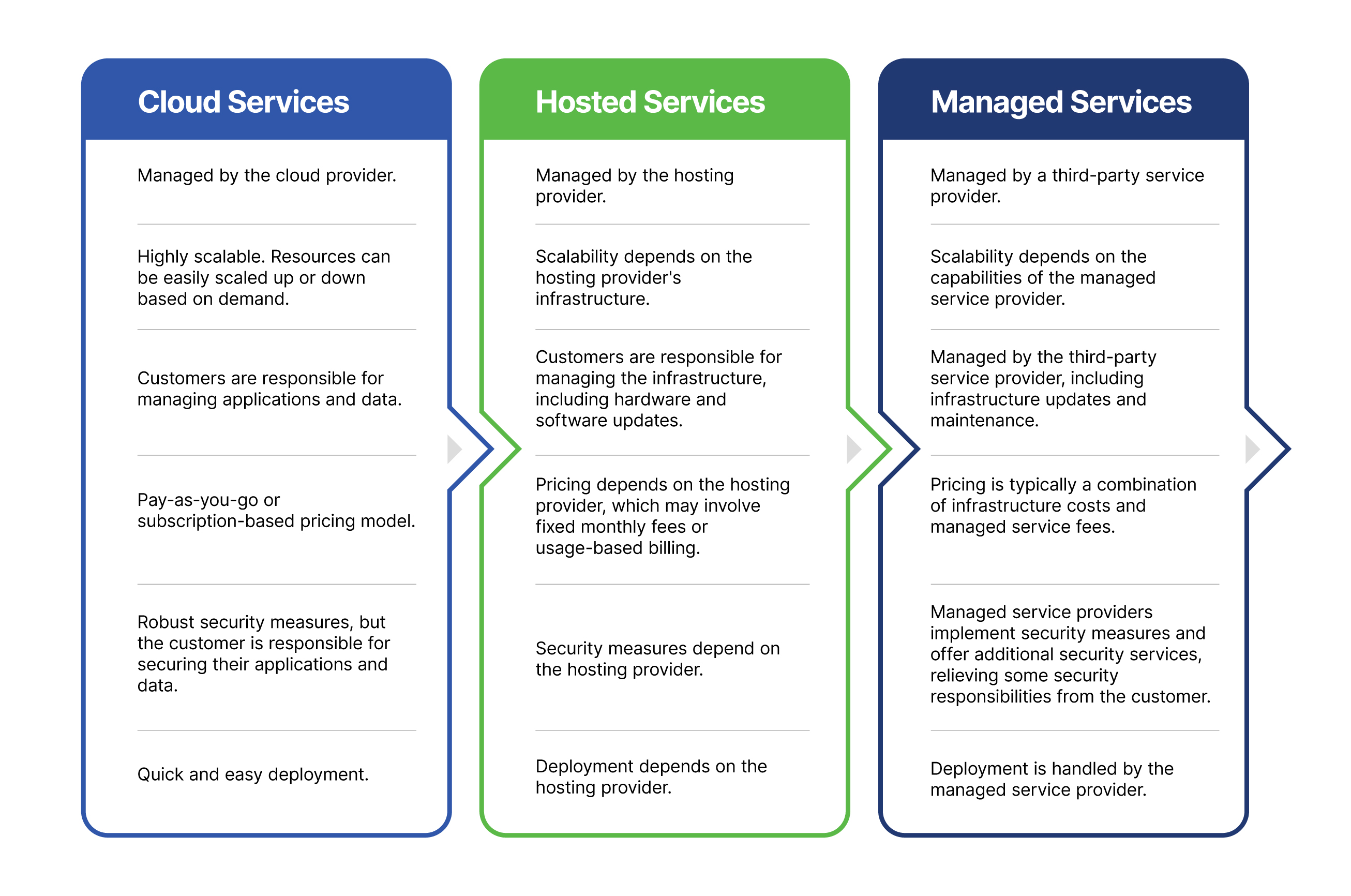
The following diagram offers a useful, if simplified, visual breakdown of different service models. The key takeaway is to see them as points on a continuum of outsourced responsibility.
To formalize these definitions, let's turn to a concise explanation.
Self-Hosted vs Managed Infrastructure for Modern Projects ...
This article from the DistantJob blog clearly defines self-hosting and managed services, framing the fundamental trade-off.
Please read the first two sections, What is Self-Hosting? and What are Managed Services?. Focus on the core exchange being described: autonomy and control versus convenience and focus.
A Strategic Framework: Beyond "Build vs. Buy"
Making this decision effectively requires a strategic framework that looks beyond immediate costs and technical features. It's a business decision as much as a technical one. A powerful way to frame this is to evaluate any new capability—whether it's a feature or the infrastructure to run it—through a set of high-level strategic questions before diving into the tactical details.
The following article offers a CTO-level perspective that elevates the conversation from a simple "build vs. buy" binary to a more nuanced analysis of long-term value.
Build, Buy, or Partner: The CTO Decision Framework That Accounts ...
This article provides a robust framework for technology acquisition that is directly applicable to the self-hosted vs. managed debate. It forces a long-term, strategic view.
Please read from the beginning of the article through the end of the section on the third core question. Focus on these three critical questions that reframe the decision: Is it a differentiator or a commodity? What is the true TCO? What level of control is needed long-term?
These three questions provide the pillars for our trade-off analysis:
- Differentiator vs. Commodity: This maps to strategic alignment. You should invest your limited engineering resources in building what makes your business unique. If a capability like running a Postgres database is a commodity for your business, buying it as a managed service frees up your team to work on your core, differentiating logic.
- True Five-Year TCO: This directly addresses cost. It forces you to look beyond the monthly cloud bill and consider the "hidden" costs, primarily the engineering time spent on maintenance, which we'll explore next.
- Required Control: This maps to control and flexibility. Outsourcing a capability means relinquishing some control over its roadmap and configuration. The key is to assess if that loss of control will impede your strategic goals in the future.
Deep Dive into the Trade-offs
With this strategic framework in mind, let's dissect the core dimensions of cost, control, and operational burden using concrete examples.
1. Cost: The Iceberg of Total Cost of Ownership (TCO)
The most common mistake in this analysis is comparing the sticker price of a managed service to the cost of a raw virtual machine. The true cost of self-hosting is an iceberg, with the visible hardware/VM cost being only the tip. The vast, submerged portion is the operational burden, which translates into engineering time and salary.
The article "Self-Hosted vs Managed Infrastructure" breaks this down well. It highlights that the most expensive resource in a tech company is engineering time. Let's look at a specific, and often contentious, example: Kubernetes.
Why Kubernetes Costs More Than It Saves
This video from TECH NOW, "Why Kubernetes Costs More Than It Saves," provides a sharp analysis of the hidden TCO of self-hosting a complex platform.
Please watch from the beginning to the 4:38 mark. As you watch, focus on: The paradox between adoption rates and the majority experience of higher-than-expected costs. The core argument that Kubernetes' design encodes assumptions about scale and operational maturity that don't apply to all organizations. The identification of the primary hidden cost: the need for highly specialized engineering expertise to manage the system's inherent complexity.
This case study demonstrates that for many teams, the cost of the specialized talent required to operate a complex self-hosted system far outweighs any infrastructure savings. This "people cost" is the essence of operational burden.
However, the reverse can also be true. A highly distributed architecture built on managed services can introduce its own overhead. A famous recent example comes from Amazon Prime Video.
Serverless was a big mistake... says Amazon
This Fireship video, "Serverless was a big mistake... says Amazon," discusses a compelling case where moving away from a serverless (managed) architecture to a more consolidated model resulted in massive cost savings.
Watch the segment from the start to the 2:59 mark. Pay attention to the technical reason for the high cost in the serverless architecture: the overhead of data serialization and network communication between many small, distributed services.
The key insight here is that the cost-effectiveness of an architecture is highly dependent on the workload profile. There is no universally cheaper option; the analysis must be specific to the problem you are solving.
2. Control vs. Convenience
This is the central trade-off. Self-hosting gives you complete control, while managed services offer convenience and velocity by abstracting away complexity.
When you need control:
- Deep Customization: You need to install a specific database extension not supported by the managed version, or tune kernel-level parameters for unique performance needs.
- Strict Compliance: You have data residency requirements so strict that you must run on specific hardware in a specific data center (data sovereignty).
- Avoiding Lock-in: By using open-source software (like Postgres or Kubernetes) on generic VMs, you retain theoretical portability between cloud providers. If you build your application around a proprietary managed service (like Google's Spanner or AWS's DynamoDB), migrating to another cloud becomes a massive refactoring effort.
The LINK article you read earlier discusses these points in its sections on Control vs. Convenience and "Lock-in" and Portability.
3. Operational Burden
This is where the value proposition of managed services is most clear. They handle the undifferentiated, heavy lifting of running infrastructure. Let's revisit the LINK article for concrete examples in Kubernetes and databases.
Self-Hosted vs Managed Infrastructure for Modern Projects ...
This section provides excellent, specific comparisons for complex systems.
Please read the section Specialized Infrastructure. As you read, study the comparison table for Kubernetes/DB metrics and note the operational tasks that shift from "Manual" in the self-hosted column to "Automated" or "Built-in" in the managed column. These include: Patch Management High Availability Configuration Backup Strategy
The difference in operational burden is starkest during failure scenarios. A managed database like AWS RDS can automatically fail over to a standby replica in a different availability zone within 60-120 seconds. Achieving similar resilience with a self-hosted database requires significant expertise in clustering, data replication, and automated failover scripting—and your team is on the hook to build, test, and maintain it.
The video on Kubernetes costs provides a perfect illustration of this point.
Why Kubernetes Costs More Than It Saves
Let's return to "Why Kubernetes Costs More Than It Saves" for a direct comparison of recovery operations.
Watch the short segment comparing stateful workloads, from this timestamp. Notice the dramatic difference in recovery time and ownership between a self-managed stateful set on Kubernetes and a managed database service like RDS.
This contrast perfectly encapsulates the trade-off: with a managed service, you are paying the provider to take on the operational burden of ensuring reliability and to be on call when things fail.
Synthesizing a Decision Framework
So, how do you make the final choice? The decision hinges on your priorities and context. The LINK article concludes with a simple but effective framework.
Go with Managed Services if:
- Your priority is speed to market and developer velocity.
- The capability is a commodity for your business (e.g., logging, email, a standard database).
- Your team is small and lacks deep, specialized DevOps/SRE expertise.
- The cost of downtime is high, making the reliability guarantees of a managed service a worthwhile investment.
Go with Self-Hosting if:
- You operate at massive scale where the provider's profit margin becomes a significant absolute cost (e.g., Dropbox's famous egress from AWS).
- You have absolute requirements for data sovereignty or customization that managed services cannot meet.
- The capability is a core competitive differentiator that you must have complete control over.
- You have a mature platform/SRE team capable of managing the complexity and operational load.
Conclusion
Today we have dismantled the simple "build vs. buy" question and reassembled it as a strategic analysis of trade-offs. We moved beyond sticker-price comparisons to a more robust evaluation based on total cost of ownership, strategic control, and the very real cost of operational burden.
Key Takeaways:
- The choice between self-hosted and managed services is a spectrum of responsibility. The central question is what operational tasks you want to own versus what you want to outsource.
- The decision framework should be strategic, starting with whether a capability is a core differentiator or a commodity. You should invest your engineering talent in what makes you unique.
- Total Cost of Ownership (TCO) is the most critical metric for cost. It must include the often-underestimated "people cost" of the operational burden required to run self-hosted systems.
- The fundamental trade-off is Control versus Velocity. Self-hosting provides maximum control and flexibility at the cost of higher operational burden and slower speed. Managed services accelerate development but reduce control and can lead to vendor lock-in.
- The "right" answer is always context-dependent, hinging on your business goals, team capabilities, risk tolerance, and specific workload characteristics.
Preview of the Next Lesson:
Now that we have a solid framework for analyzing this trade-off, we are ready to apply it to one of the most significant architectural debates today. In the next lesson, we will compare serverless architectures with container orchestration (e.g., Kubernetes) along the dimensions of cost, scalability, and operational complexity. This will build directly on our discussion, examining two very different points on the "managed vs. self-hosted" spectrum.