Hello again. In our previous lesson, we established a strategic framework for the "build versus buy" decision, evaluating infrastructure choices through the lenses of control, cost, and operational burden. We saw that the "right" choice is less about the technology itself and more about its alignment with your business goals and operational capabilities.
Today, we'll apply this framework to one of the most pivotal architectural decisions in cloud-native development: choosing between serverless compute and container orchestration. This lesson directly tackles the comparison of serverless architectures (like AWS Lambda) with container orchestrators (specifically, managed Kubernetes like EKS) along the critical dimensions of cost, scalability, and operational complexity. Our goal is not to declare a universal winner, but to arm you with a nuanced understanding that will enable you to make a justified choice based on specific contexts.
The Spectrum of Responsibility, Revisited
This decision sits squarely on the spectrum of managed services we discussed previously. To visualize this, consider the shared responsibility model. As we move from traditional IaaS to containers and then to serverless, the provider takes on an increasing share of the operational load.

With Kubernetes on EC2 nodes, you are still responsible for the container OS, orchestration configuration, and the worker nodes themselves. With serverless functions, you offload virtually everything but your application code and its configuration. This fundamental difference drives the trade-offs we will explore.
The core dilemma, as framed for an architect, is how to balance control with operational overhead. Let's start by reading a concise framing of this central conflict.
The Architect's Decision: Kubernetes vs. Serverless Containers for ...
This article from Developers.dev provides a pragmatic, decision-focused framework targeted at architects and engineering managers, which aligns perfectly with our strategic focus.
Please read the introduction and the section titled "The Core Decision: Control Versus Operational Overhead." You can find this right after the "Key Takeaways" box. Focus on how the article frames the central choice between Kubernetes' control and the reduced operational burden of serverless models.
Now, with this core trade-off in mind—Control vs. Operational Overhead—let's dissect the three key dimensions of our comparison.
1. Operational Complexity & Maintainability
This dimension goes beyond simple ease-of-use and gets to the heart of the total "people cost" of running a system. It includes everything from initial setup and configuration to ongoing maintenance, patching, upgrades, and the level of expertise required on your team.
The AWS re:Invent talk "Competition of the modern workloads" features a friendly debate that captures the essence of this trade-off from a practitioner's point of view.
AWS re:Invent 2022 - Competition of the modern workloads: Serverless vs Kubernetes on AWS (COM207-R)
This video from the AWS Events channel provides a head-to-head comparison from two experienced engineers. We'll watch their arguments on maintainability.
Watch the segment on Maintainability, from this timestamp. Pay close attention to the arguments made for each side: Serverless: The argument centers on the idea that "no server is easier to manage than no server." You are only responsible for your code. Kubernetes: The argument acknowledges the complexity of version upgrades but frames it as a "double-edged sword" that enforces good hygiene and keeps you up-to-date.
To summarize the points from the video and our previous analysis:
- Serverless (e.g., AWS Lambda):
- Low Operational Complexity: The provider manages the runtime, OS, and underlying hardware. There are no clusters to manage, no nodes to patch, and no orchestrator versions to upgrade.
- Simplicity as a Trade-off: The complexity doesn't vanish; it shifts. You now have to manage function timeouts, cold starts, package size limits, and concurrency quotas. Observability can also be more challenging in a highly distributed, event-driven function architecture.
- Container Orchestration (e.g., Kubernetes/EKS):
- High Operational Complexity: Even with a managed control plane (like EKS), you are still responsible for the worker nodes (unless using Fargate), node group scaling, OS patching, and managing the entire ecosystem of tools (ingress controllers, service meshes, monitoring agents, etc.).
- Expertise Required: Running Kubernetes effectively demands significant DevOps/SRE expertise. The cost of this specialized talent is a major component of its TCO. The ecosystem is vast and complex, requiring a dedicated team to navigate.
2. Scalability
Scalability is about how the system adapts to changes in load. Both paradigms are "scalable," but they scale differently, and are suited to different workload patterns.
- Serverless: Scales based on incoming events or requests. It can scale from zero to thousands of concurrent executions almost instantly, making it ideal for bursty or unpredictable traffic. The main performance caveat is cold start latency—the time it takes to initialize a new function instance if one isn't "warm" and ready.
- Kubernetes: Scales based on resource metrics like CPU or memory. The Horizontal Pod Autoscaler (HPA) adds or removes pods, and the Cluster Autoscaler (or tools like Karpenter) adds or removes nodes. This is better for sustained, high-volume workloads. Scaling is powerful but not instantaneous, as provisioning a new node can take minutes.
To understand the mechanics, the following video gives a clear, concise explanation of how scaling works in both models.
How to Design Scalable Architecture? VM vs Serverless vs Kubernetes
This video from IT k Funde breaks down the technical aspects of scaling in different cloud stacks.
Watch the following two segments: First, watch the section on serverless scaling. Focus on the explanation of cold starts vs. warm starts and the concept of provisioned concurrency. Next, watch the explanation of Kubernetes scaling. Note the two distinct layers of scaling: pod-level (HPA) and node-level (Cluster Autoscaler/Karpenter).
Now let's hear the strategic debate on which approach is "better" for scaling.
AWS re:Invent 2022 - Competition of the modern workloads: Serverless vs Kubernetes on AWS (COM207-R)
Let's return to the AWS re:Invent debate for the scalability round.
Watch the segment on Scalability, from this timestamp. Notice how the discussion isn't about which one can scale more, but about the nature of that scaling—instant and event-driven (Serverless) versus controlled and resource-based (Kubernetes)—and the responsibilities that come with it.
This discussion highlights that the choice depends on your workload's profile. An event-processing pipeline with spiky traffic is a natural fit for serverless, while a high-traffic, stateful application with predictable resource needs may be better served by Kubernetes.
3. Cost
Cost analysis is where your interest in economics and business becomes critical. A superficial comparison is misleading; a true Total Cost of Ownership (TCO) analysis must include both direct cloud spend and indirect "people costs."
- Serverless: Operates on a pay-per-use model. You pay for execution time and the number of requests. This is extremely cost-effective for low or intermittent traffic because there are no idle costs. However, at high, sustained volumes, the cost can become unpredictable and exceed that of a provisioned system.
- Kubernetes: Operates on a provisioned resources model. You pay for the underlying EC2 instances (nodes) by the hour, regardless of utilization. This has a higher baseline cost but can be more economical at scale, especially when optimized with Reserved Instances/Savings Plans and Spot Instances. The major "hidden cost" is the salary of the SRE team required for management.
The article "Serverless vs Kubernetes for LLM Deployment" provides an excellent, data-rich analysis of this economic trade-off, including a break-even point. While it's focused on LLM workloads, the principles are broadly applicable.
Serverless vs Kubernetes for LLM Deployment - Latitude.so
This article from Latitude.so dives deep into the cost models, including concrete examples and a discussion of hidden costs that are often overlooked.
Please read the entire section on Cost Efficiency. Pay close attention to: The different pricing structures (pay-per-request vs. fixed hourly rates). The discussion of the break-even point where Kubernetes becomes more economical. The analysis of hidden costs for both paradigms (e.g., vector storage for serverless, FTEs for Kubernetes).
This detailed financial analysis reinforces a key takeaway: the most cost-effective solution is entirely dependent on your scale and traffic patterns.
Synthesizing a Decision Framework
We've analyzed the trade-offs across three dimensions. Now, how do we synthesize this into a practical decision-making tool? A decision tree can provide a clear path based on your workload's primary characteristics.
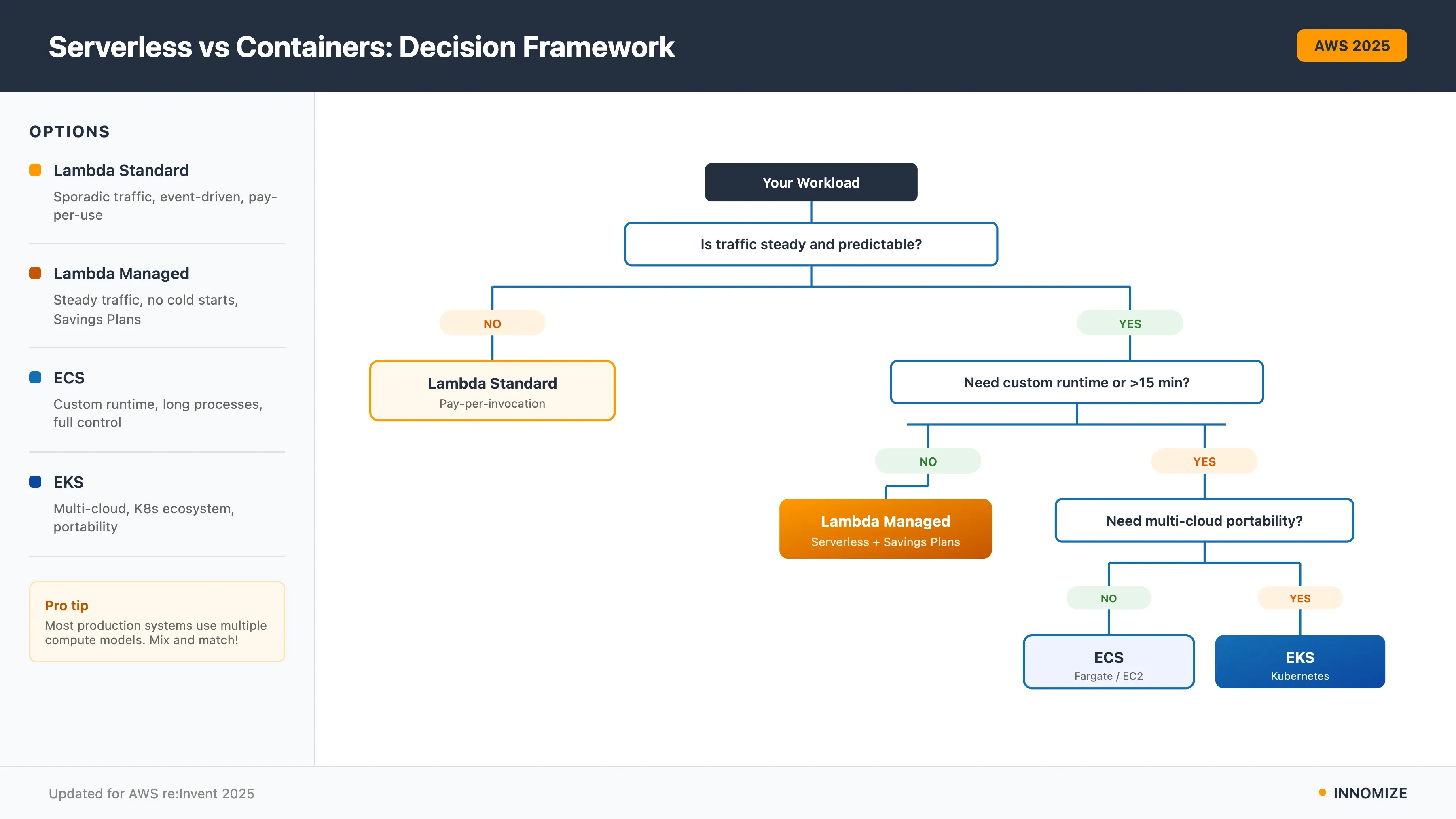
Let's walk through this framework:
- Is traffic steady and predictable?
- No (Sporadic/Bursty): This strongly points toward serverless (
Lambda Standard) to take advantage of the pay-per-use model and avoid paying for idle resources. - Yes: If traffic is steady, provisioned capacity might be more economical. We proceed to the next question.
- No (Sporadic/Bursty): This strongly points toward serverless (
- Need custom runtime or >15 min?
- Yes: If you need a specific, non-standard runtime environment or your processes run longer than the typical serverless function limit (e.g., 15 minutes for AWS Lambda), you need more control. This points toward containers. Now the question is which container service.
- Need multi-cloud portability? If a core requirement is to run on different clouds or on-prem, Kubernetes (
EKS) is the standard. If not, a simpler container service likeECSmight suffice.
- Need multi-cloud portability? If a core requirement is to run on different clouds or on-prem, Kubernetes (
- No: If your workload fits within the serverless constraints, you can still use serverless but optimize for cost with provisioned concurrency or savings plans (
Lambda Managed).
- Yes: If you need a specific, non-standard runtime environment or your processes run longer than the typical serverless function limit (e.g., 15 minutes for AWS Lambda), you need more control. This points toward containers. Now the question is which container service.
This flowchart is a great starting point. To add more granularity, the "Architect's Decision Checklist" from the first article we read provides a set of targeted questions to further refine your choice.
The Architect's Decision: Kubernetes vs. Serverless Containers for ...
This checklist translates our three dimensions of analysis into a series of direct questions that force a decision.
Review the checklist questions. Notice how each question maps back to our core themes: control (custom kernel modules), operational complexity (dedicated SRE team), cost (OpEx sensitivity), and scalability (bursty workloads).
Conclusion
We have applied our strategic infrastructure framework to the serverless vs. Kubernetes debate, moving beyond simple feature comparisons to a nuanced analysis of trade-offs.
Key Takeaways:
- The decision is a strategic trade-off between the operational simplicity and velocity of serverless and the control, portability, and performance-at-scale of Kubernetes.
- Operational Complexity: Serverless drastically reduces operational burden but introduces new constraints (limits, cold starts). Kubernetes offers limitless control but demands significant, specialized engineering expertise to manage.
- Scalability: Serverless excels at handling bursty, event-driven traffic with near-instant scaling. Kubernetes is superior for predictable, high-volume workloads where scaling can be more controlled and optimized.
- Cost: The most economical choice is a function of scale. Serverless is cheaper for low/unpredictable traffic due to its pay-per-use model. Kubernetes becomes more cost-effective at high, sustained volumes when leveraging resource optimization techniques like bin-packing and Spot Instances, but its TCO must include hefty personnel costs.
- Decision Framework: Your choice should be driven by workload characteristics (traffic patterns, runtime needs) and business priorities (time-to-market vs. long-term cost optimization).
Preview of the Next Lesson:
With this comparative framework in hand, you are now equipped to make an informed recommendation. In our next lesson, we will move from analysis to action. You will be given a scenario with specific organizational constraints and system requirements and tasked to formulate a justified infrastructure recommendation in a format suitable for a CTO-level audience.