Introduction
Welcome to our next lesson on strategic infrastructure. In our previous session, we focused on crafting a compelling trade-off analysis for a CTO-level audience, learning to frame major platform decisions like serverless versus Kubernetes in terms of business impact, Total Cost of Ownership (TCO), and strategic risk. We established that the best architectural choices are those that align with and advance the company's core objectives.
Today, we will deepen that strategic approach by focusing on system resilience. Our objective is to articulate a resilience strategy by balancing pattern selection with business impact, cost, and operational complexity. This moves us from the macro-level platform choice to the crucial micro-decisions that determine how a system behaves under stress. You already have hands-on experience with patterns like timeouts and circuit breakers; our focus here will not be on what they are, but on when, why, and to what extent we should invest in them. A resilience strategy is not a technical checklist—it's an economic and business decision about how much we are willing to invest to mitigate specific risks.
The Goal of Resilience: Managing Failure, Not Eliminating It
At its core, resilience is the ability of a system to withstand and recover from failures. The goal isn't to build a system that never fails—in any complex distributed environment, that is an impossibility. As Werner Vogels, CTO of Amazon, famously says, "Everything fails, all the time." The real goal is to ensure that when failures happen, their impact on the business and the customer is minimized and managed.
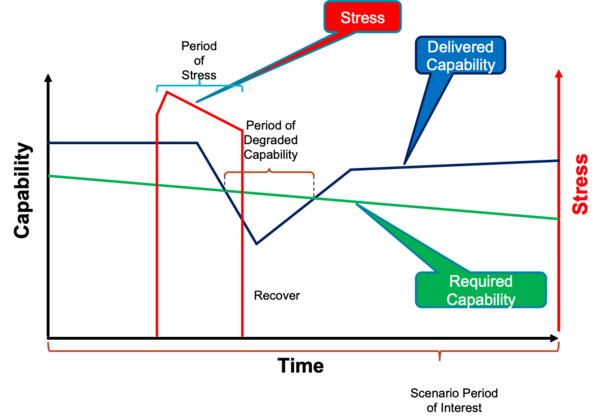
This perspective shifts resilience from a purely technical concern to a core feature of the product. How available and reliable your service is directly impacts customer trust, revenue, and brand reputation.
Part 1: From Technical Tactic to Business Strategy
In a startup's early days, resilience is often handled reactively. An engineer gets paged, manually restarts a service, and the problem is "solved." This approach, however, doesn't scale. As a company grows, the cost of downtime—in lost revenue, engineering hours spent firefighting, and customer churn—becomes a major bottleneck.
To move beyond this, an organization must treat resilience as an explicit business requirement. A fantastic article by Punit Lad and Carl Nygard on MartinFowler.com, "Bottleneck #05: Resilience and Observability," explores this transition.
Bottleneck #05: Resilience and Observability
This article frames the journey from a startup's reactive approach to a scaleup's strategic view of resilience. It provides the business context for our technical decisions.
First, read the section "How did you get into the bottleneck?" to understand the typical evolution where speed is prioritized over resilience, creating future problems. Next, focus on the section "Shift to explicit resilience business requirements." Pay close attention to the concepts of understanding the cost of service failure and managing resilience as a feature.
The key takeaway is that resilience is an investment, and like any investment, its level should be justified by the return. A public-facing, revenue-critical API warrants a much larger investment in resilience than an internal, batch-processing service that can be rerun if it fails.
This leads to a crucial strategic tool: service tiering. You can't and shouldn't apply the same level of resilience to every component of your system. A common practice is to classify services into tiers:
- Tier 1: Mission-Critical Services. These are the systems that directly impact customers and revenue. Failure here has immediate and significant consequences. Examples: payment processing, core login services, or the main e-commerce checkout flow. These services require the highest level of investment in resilience.
- Tier 2: Business-Critical Services. These systems are important for business operations but a temporary failure might not be immediately customer-facing. Graceful degradation is a key strategy here. Examples: an inventory management system, or a customer support tooling API.
- Tier 3: Non-Critical Services. These are internal systems, analytics pipelines, or other components where downtime is tolerable or can be easily worked around. Examples: a service that generates a weekly internal report.
By categorizing your services, you can make deliberate, cost-effective decisions about where to focus your engineering effort. You are creating a portfolio of risk and deciding how to manage it.
Part 2: A Framework for Balancing Resilience Trade-offs
Once we have our service tiers, we need a systematic way to decide which resilience patterns to apply. This is where we balance cost, complexity, and business impact. The Infosys white paper on "Resilience in Distributed Systems" provides a structured way to think about failure.
RESILIENCE IN DISTRIBUTED SYSTEMS
This paper gives us a more formal language for discussing failure and resilience, helping us move from intuition to a more structured analysis.
Read the introductory section for the definitions of resilience and its importance. Next, read the section on "Failure modeling." Focus on the five stages of failure handling: Fault Prevention, Detection, Isolation, Treatment, and Recovery.
This framework helps us think about our patterns not just as code, but as tools to improve specific stages of handling a failure. For example:
- Timeouts help with Fault Detection (detecting a non-responsive dependency).
- Bulkheads and Circuit Breakers help with Fault Isolation (preventing a failure from cascading).
- Retries and Fallbacks are forms of Fault Treatment and Recovery.
Now, let's analyze the trade-offs of the most common patterns through this lens. For this, we'll draw heavily on the excellent practical examples in Adrian Hornsby's talk, "Patterns for building resilient software systems."
Patterns for building resilient software systems by Adrian Hornsby
Before diving into specific patterns, let's watch the introduction to this talk by Adrian Hornsby. He sets the stage perfectly by emphasizing that failures are a given in distributed systems.
Watch the introduction from the beginning up to the definition of resiliency. This reinforces the core concept that resilience is about the ability to recover.
Part 3: Analyzing the Trade-offs of Key Resilience Patterns
You're already familiar with implementing these patterns. Our goal here is to analyze them from an architect's perspective: What are the second-order effects? What is the operational cost? What is the business trade-off?
A. Foundational Resilience: Redundancy (Multi-AZ vs. Multi-Region)
The most fundamental resilience pattern is redundancy. The principle of parallel systems dramatically increases availability.
Patterns for building resilient software systems by Adrian Hornsby
Adrian Hornsby provides a clear explanation of how availability math works and how cloud providers structure their infrastructure to enable it.
Watch the segment on availability and Availability Zones (AZs). This covers the basic math of parallel systems and the distinction between AZs and Regions.
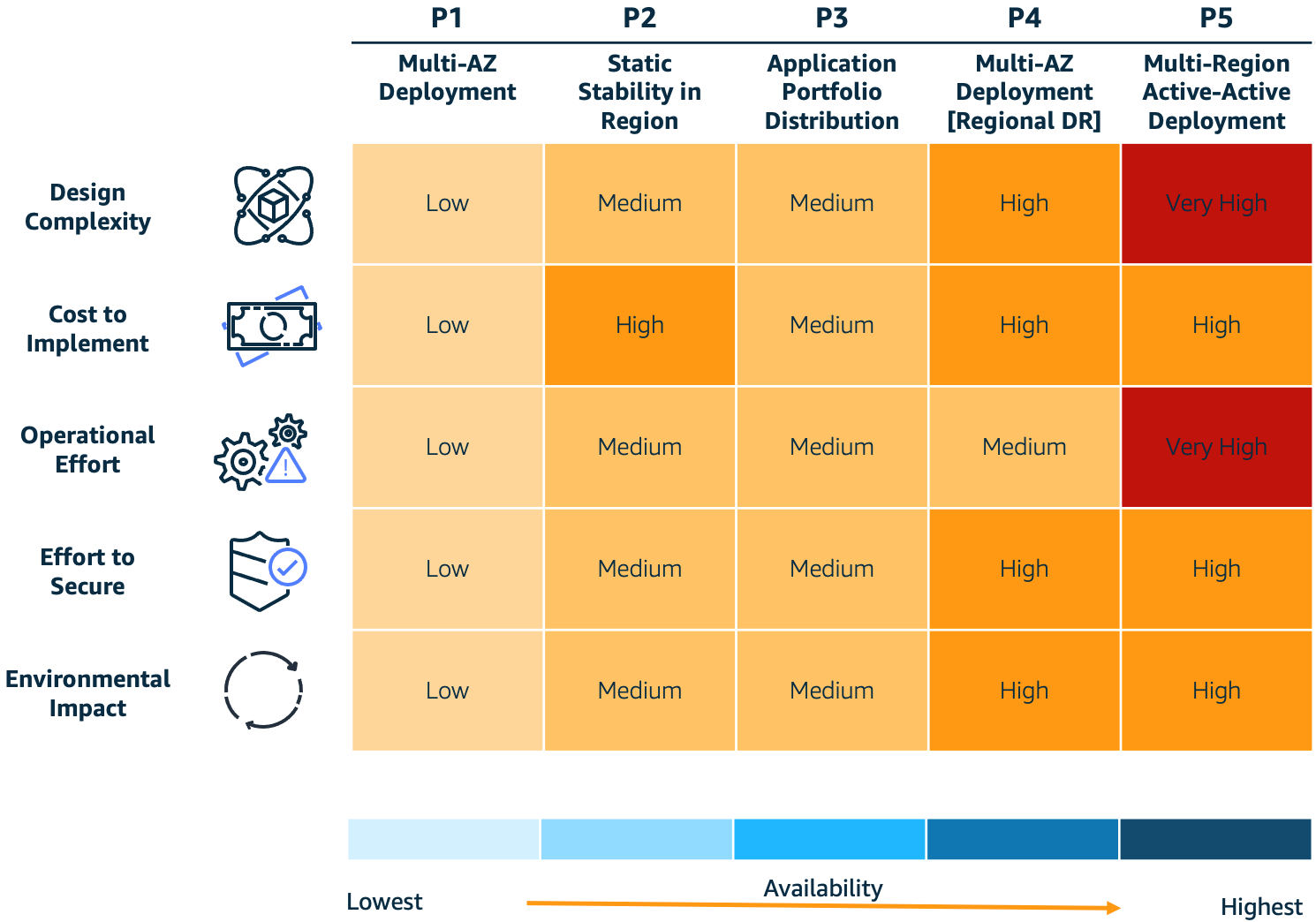
This leads to our first major strategic trade-off. As we move from a single deployment to multi-AZ, and then to multi-region, availability increases, but so do cost and complexity.
The Strategic Decision:
- For a Tier 1 service, a Multi-AZ deployment is the minimum standard. For extreme availability (like a global media service), a multi-region architecture might be justified despite the immense cost and complexity.
- For a Tier 3 internal tool, a single-AZ deployment might be perfectly acceptable. The cost saving is the trade-off for lower availability.
B. Application Resilience: Timeouts, Retries, and Circuit Breakers
These patterns are designed to handle transient failures and prevent them from cascading through the system.
Patterns for building resilient software systems by Adrian Hornsby
This part of the talk is a masterclass in the practical consequences of timeout and retry strategies, and how circuit breakers provide a solution.
First, watch the section on cascading failures, timeouts, and retries. The explanation of "infinite timeouts" in common libraries and the danger of simple retries is a critical insight. Next, watch the segment on idempotency and the circuit breaker pattern, including the Netflix example of using fallbacks to serve cached data.
Let's break down the trade-offs:
-
Timeouts:
- Cost/Complexity: Implementing a timeout is simple. The hidden complexity is choosing the right value. Too short, and you kill valid, slow requests. Too long, and you tie up resources, leading to exhaustion.
- Business Impact: The default "infinite" timeout in many libraries is an unacceptable business risk. It means a single slow downstream service can cause a cascading failure that brings down your entire application. Your strategy must mandate explicit, sensible timeouts for all network calls.
-
Retries:
- Cost/Complexity: A simple retry loop is easy. An exponential backoff with jitter strategy is more complex to implement and test. Furthermore, any retry logic necessitates that the target operation be idempotent (safe to call multiple times), which can add significant design complexity.
- Business Impact: Retrying immediately without backoff is a recipe for a self-inflicted DDoS attack on your own services. For a Tier 1 service, investing in a robust exponential backoff with jitter strategy is crucial to prevent a minor hiccup from becoming a major outage. For a less critical Tier 3 service, perhaps a single retry attempt or no retry at all is the more pragmatic choice, avoiding the complexity.
-
Circuit Breakers:
- Cost/Complexity: This is the most complex of the three. It requires state management (tracking failures), configuration (thresholds), and most importantly, fallback logic.
- Business Impact: The true value is in the fallback. This is where you architect graceful degradation.
- Can you return a cached response? (e.g., Netflix showing cached recommendations).
- Can you return a default value? (e.g., An e-commerce site showing a default shipping estimate if the live rating service is down).
- Can you queue the request for later processing?
This pattern allows a Tier 1 service to remain partially functional, preserving the customer experience and revenue, rather than returning a hard error.
C. Decoupling and Data Resilience
Decoupling parts of your system with queues and designing your data layer for resilience are powerful, but costly, strategies.
Patterns for building resilient software systems by Adrian Hornsby
Hornsby provides excellent examples of how queues and database patterns directly enable business-level resilience strategies.
Watch the section on decoupling with queues. Focus on how this enables independent scaling and, more importantly, priority queues for graceful degradation. Then, watch the section on database resilience. The concept of a "read-only mode" and avoiding storing transient state in a database are key strategic points.
-
Decoupling with Queues:
- Cost/Complexity: Introduces asynchronous communication, which is harder to debug and monitor. You now have an extra piece of infrastructure (the message broker) to manage and pay for.
- Business Impact: This is a powerful tool for resilience. It allows the frontend (e.g., your API) to remain responsive even if the backend workers are slow or failing. More strategically, using priority queues allows you to decide which work gets done first during a period of degraded capability. You might prioritize new user signups or paid customer actions over free user actions. This is a direct architectural implementation of a business priority.
-
Database Patterns (Read Replicas):
- Cost/Complexity: Running read replicas incurs extra infrastructure cost and introduces replication lag (eventual consistency), which the application must be designed to handle.
- Business Impact: The ability to switch the application to a read-only mode during a database failure can be a business-saver. As Hornsby notes, Netflix can still serve videos (the core customer value) even if their master database for writes is down. This is a profound example of designing for business continuity.
Part 4: Articulating Your Resilience Strategy
Having analyzed these trade-offs, the final step is to articulate the strategy in a clear, actionable document. This is not a list of every possible pattern but a concise declaration of principles and choices, suitable for an ADR or a dedicated strategy document.
Here is a template you can adapt:
Resilience Strategy for [System/Product]
-
Business Objectives & Service Tiers:
- The primary business drivers are [e.g., customer trust, 24/7 availability for global users, speed of feature delivery].
- Our services are classified as follows:
- Tier 1 (Mission-Critical): [List services]. Availability Target: 99.99%. RTO < 5 mins.
- Tier 2 (Business-Critical): [List services]. Availability Target: 99.9%. RTO < 1 hour.
- Tier 3 (Non-Critical): [List services]. Availability Target: Best effort.
-
Resilience Principles & Pattern Application:
- This table defines the minimum required resilience patterns for services in each tier. Teams are encouraged to exceed this where justified.
| Pattern | Tier 1 (Mission-Critical) | Tier 2 (Business-Critical) | Tier 3 (Non-Critical) |
|---|---|---|---|
| Deployment | Multi-AZ by default. | Multi-AZ by default. | Single-AZ acceptable. |
| Timeouts | Mandatory, short, configured per-endpoint. | Mandatory, sensible defaults. | Mandatory, sensible defaults. |
| Retries | Exponential backoff with jitter. Idempotency required. | Max 1 retry, simple backoff. | No retries. |
| Circuit Breakers | Mandatory for all external dependencies. Must have a meaningful fallback (cache/default). | Recommended for key dependencies. Fallback can be a graceful error. | Not required. |
| Asynchronous Decoupling | Required for long-running or non-critical sub-processes. | Use where it simplifies workflow. | Avoid complexity. |
| Database | Read/write splitting with read replicas. App must support a read-only mode. | Read replicas recommended. | Single master instance acceptable. |
- Accepted Risks & Trade-offs:
- We are not investing in a multi-region active-active architecture at this time due to high cost and operational complexity. We accept the risk of a full-region outage, which we will mitigate via our disaster recovery plan with an RTO of 4 hours.
- For Tier 2 services, we prioritize development velocity over maximum resilience, accepting that some non-critical user journeys may experience errors during transient failures.
Conclusion
In this lesson, we have moved beyond the implementation details of resilience patterns to the strategic decision-making process behind them. You've learned how to frame resilience as a business concern and develop a strategy that intelligently allocates engineering effort based on business impact.
Key Takeaways:
- Resilience is a Business Strategy: It's about managing the business impact of failure, not preventing failure entirely. Its cost must be justified by the risk it mitigates.
- Tier Your Services: Not all services are created equal. Classifying services into tiers is the most effective way to focus investment where it matters most.
- Balance is Everything: Every resilience pattern introduces trade-offs in cost, complexity, and performance. An architect's job is to make conscious, defensible choices about these trade-offs.
- Articulate the Strategy: A clear, concise document outlining your principles, pattern applications, and accepted risks is essential for aligning teams and justifying your approach to leadership.
Preview of the Next Lesson
A resilience strategy is only effective if you know when your system is healthy and when it is degraded. In our next lesson, we will explore how to connect resilience and observability strategies to ensure system health can be monitored and diagnosed effectively. We will see how metrics, logs, and traces are the essential feedback loop that makes our resilience strategy a living, breathing part of our operations.