Welcome back. In our last lesson, we focused on building the architectural blueprint for your profile—organizing interview material around a central theme and arranging it into a strong narrative structure. You now have the skeleton of a story.
Today's lesson is about adding the flesh and blood. We'll explore how to write vivid descriptions that make your subject feel like a real, three-dimensional person to your reader. By the end of this session, you'll be able to write descriptions of a subject's appearance, mannerisms, and environment specifically to build and reveal their character. This is the skill that transforms a profile from an informative report into a memorable portrait.
1. The Foundation: Show, Don't Tell
Before we get into the specifics of what to describe, we need to master the core principle that governs all great descriptive writing: Show, don't tell.
Telling your reader that a subject is "nervous" is a summary. Showing them the subject's "fingers drumming on the table, their gaze darting towards the door" allows the reader to feel the nervousness themselves. It invites them into the scene.
This concept is crucial for writers of all kinds, but especially for journalists who need to convey truth and personality with precision. The following video offers a fantastic deep dive into this principle.
How to Show, Not Tell: The Complete Writing Guide
This video from the Quotidian Writer channel, "How to Show, Not Tell: The Complete Writing Guide," provides an excellent framework for understanding this essential writing craft.
Please watch these three segments: Two plus two: Pay attention to Pixar director Andrew Stanton's theory. The idea that audiences want to "work for their meal" by connecting details themselves is a powerful insight for any storyteller. Use evidence: This section, featuring advice from author Chuck Palahniuk, demonstrates how to replace abstract "thought verbs" (he knew, she believed) with concrete evidence that lets the reader draw the same conclusion. Replace the abstract: This part gives practical before-and-after examples and introduces a brilliant diagnostic question: "Can the camera see it?"
The key idea is that your job isn't to deliver a final judgment ("He was kind," "The room was eerie"). Your job is to present the reader with the evidence—the specific, concrete, sensory details—that led you to that conclusion, and let them experience the moment of discovery for themselves.
2. A Framework for Observation: The S.T.E.A.L. Method
So, how do you know what details to look for during an interview? The S.T.E.A.L. method is a useful mnemonic for gathering the raw material of character. While it originated in literary analysis, it's a perfect tool for a journalist's observation toolkit.
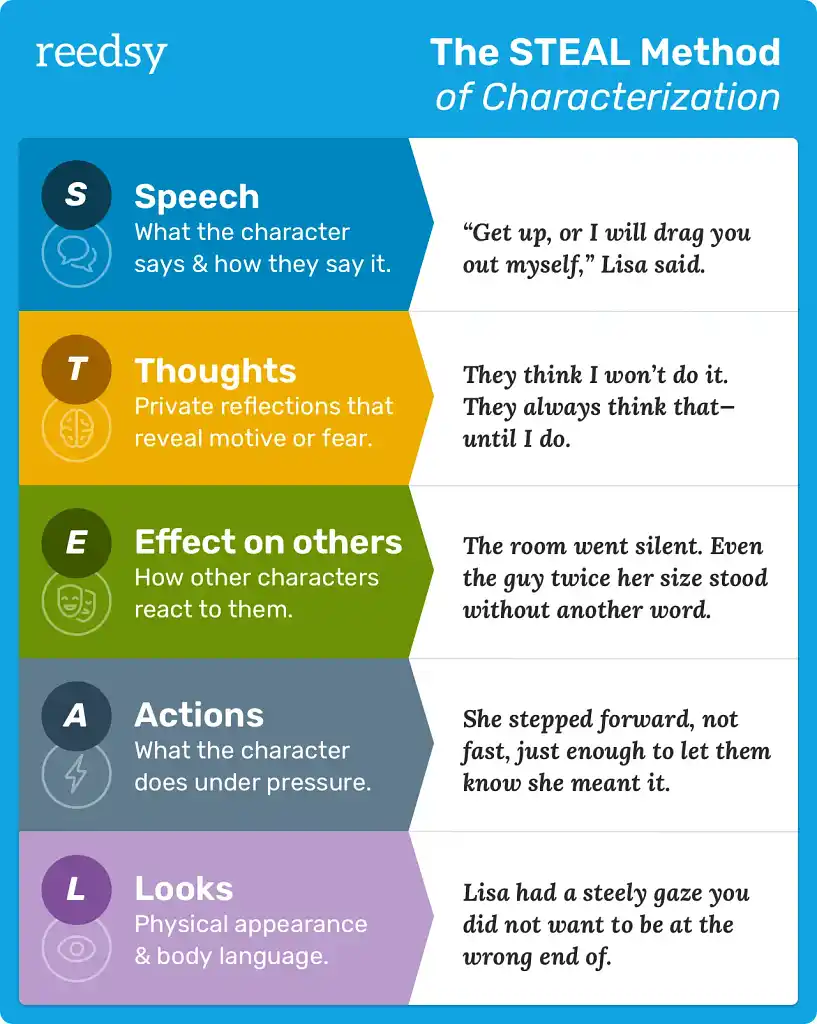
For a journalist writing a profile, we can adapt it like this:
- Speech: What they say (your quotes) and how they say it (their tone, accent, word choice).
- Thoughts: You can't know their thoughts, but you can show them through their quotes about their feelings, beliefs, and motivations.
- Effect on others: How do people react to them? Does the room go quiet when they speak?
- Actions: Their mannerisms, habits, gestures, and how they interact with their environment.
- Looks: Their physical appearance, clothing, and the environment they inhabit.
Today, we're focusing primarily on Actions and Looks, as these are the cornerstones of descriptive writing in a profile.
3. The Three Layers of Descriptive Detail
Let's break the learning outcome down into its three components: appearance, mannerisms, and environment.
A. Looks: Appearance and Environment
More than just a list of features, a description of appearance and environment should function as a set of clues about the subject's personality, status, and state of mind.
This article from Poynter provides excellent examples from professional journalists.
Character Sketches: Putting People on the Page - Poynter
This article is a treasure trove of practical advice and examples on how to write character sketches that bring people to life.
Please read the following sections: Start from the beginning and read to the end of the section titled "IN A SENTENCE." Notice how quickly an image can be formed with just a few well-chosen words ("freckle-faced," "more comfortable in Birkenstocks"). Read the section titled "Report for story." The list of notes taken during an interview is a perfect real-world example of the kind of raw detail you should be capturing.
The Poynter article highlights that you need to be an active observer, constantly gathering details. Your notebook should contain more than just quotes.
To be systematic about it, this next resource offers a helpful checklist.
Profiles – English 102: Journey Into Open 2.0
This text provides clear, actionable advice on using description in profiles.
Read these three sections: "Using description": Focus on the examples that turn vague statements ("smelled good," "was so beautiful") into specific, sensory experiences. "Physical Attributes" and "Accessories & Clothing": Use these lists as a mental checklist during an interview. Is there anything about their appearance or what they carry that feels significant? "Key Features of a Profile": Note how "descriptive, sensory details" is listed as a fundamental feature.
Key takeaway: Don't just say an actor is "stylish." Describe the "custom-tailored suit that contrasted with his scuffed-up sneakers." Don't just say a director's office is "messy." Describe the "stacks of vintage sci-fi novels threatening to avalanche onto a desk littered with half-empty coffee mugs."
B. Actions: Mannerisms and Gestures
Mannerisms are the unconscious physical language that can often say more than words. A tapping foot, a steady gaze, a nervous laugh—these are the details that animate your subject.
The following video shows how to translate abstract emotions into observable actions.
How to Use Description to Enhance Journalism Writing
This video by journalist Mark Grabowski gives practical advice on using description specifically for journalistic writing.
Please watch these two clips: Describing emotion: The example of how to show "Evan was terrified" is a perfect illustration of turning an internal feeling into an external, visible action. Note-taking tips: Pay close attention to the advice to take notes on "character"—appearance, emotions, mannerisms, speech, and movement.
When you're in an interview, watch for repetitive gestures. What does the person do when they are thinking? When they are excited? When they are uncomfortable? These actions are storytelling gold.

4. Your Turn: From Telling to Showing
Let's apply these concepts to our ongoing example of the pop star, KAI, who is breaking from her manufactured image. In the last lesson, we noted an observation: "During the interview in her minimalist apartment, she's dressed in all black and constantly fidgets with a silver ring."
Now, let's practice transforming a flat, "telling" sentence into a vivid, "showing" paragraph.
Your Task:
Here is a "telling" summary of a moment with KAI.
In her modern, empty apartment, KAI seemed uncomfortable with her past fame and nervous but determined about her new direction.
Rewrite this statement into a short paragraph (3-5 sentences). Your goal is to show this to the reader. Use the principles we've discussed:
- Appearance: What about her "all black" outfit is significant?
- Mannerisms: What is she doing with her hands, eyes, or posture? How does her speech sound?
- Environment: What specific details in the "minimalist apartment" can you use to reflect her state of mind?
Think like a camera. What would it see and hear?
Click here to see a sample revision.
Here is one possible way to rewrite the sentence:
KAI sank into a stark white sofa that seemed to swallow her black-clad frame. Her eyes scanned the bare walls of the apartment, empty except for a single platinum record for "Bubblegum Pop Heart" that was propped against the floor, facing away. She twisted a simple silver band around her finger, the metal a dull gleam in the cold afternoon light. "I'm not that girl anymore," she said, her voice quiet but steady, "and I don't know if anyone wants to meet the person I am now. But I have to try."
Notice how this version uses specific details—the white sofa, the turned-around record, the twisting ring, the quiet-but-steady voice—to convey her internal conflict and resolve without ever using words like "uncomfortable," "nervous," or "determined." It lets the reader put two and two together.
Conclusion
In this lesson, you've learned how to move beyond simple statements and paint a living portrait with your words. By focusing on concrete, sensory details, you allow your reader to step into the scene and draw their own conclusions about your subject.
Key Takeaways:
- Show, Don't Tell: This is the golden rule. Instead of summarizing a feeling or quality, provide the specific evidence that demonstrates it.
- Observe with a Framework: Use the S.T.E.A.L. method (Speech, Thoughts, Effect, Actions, Looks) as a guide for what to look for during an interview.
- Describe in Layers: Weave together details of a subject's appearance, mannerisms, and environment to create a rich, multi-dimensional character sketch.
- Details Reveal Character: Every choice of clothing, every nervous tic, every item on a desk can be a clue to your subject's personality and story.
You now have the skills to structure a profile and to fill it with vivid, character-building description. In our next lesson, we will focus on weaving together narration, observation, and sourced material (quotes/paraphrasing) into a cohesive narrative. You'll learn how to blend your own voice, your descriptive passages, and your subject's quotes into a seamless and compelling final piece.