Welcome back. In our last lesson, you practiced using specific comedic tools—like the Rule of Three and witty comparisons—to inject humor into your writing. We established that humor is a skill built on learnable techniques.
Today, we address a crucial question that follows: how do you use these tools without sacrificing your authority as a journalist? Your goal for this lesson is to learn and describe strategies for maintaining credibility while employing a witty or humorous tone. This is the fine art of being entertaining without losing the reader's trust, a balance that is fundamental to sophisticated entertainment journalism.
We'll move beyond just making jokes and explore how wit can actually enhance your credibility when used with purpose and intelligence.
1. The Two Pillars of Credibility: Trust and Expertise
Before we look at specific writing strategies, we need a framework for understanding what "credibility" even is. Why do we trust one source but dismiss another, especially when both are trying to be entertaining?
A helpful model comes from communication studies, which breaks credibility down into two main components:
- Trustworthiness: Is the writer perceived as honest, fair, and authentic? Do they seem to have the reader's best interests at heart? This is about the writer's perceived character and integrity.
- Expertise: Is the writer perceived as knowledgeable, skilled, and experienced? Do they know what they're talking about? This is about the writer's perceived competence.
A writer who projects both trustworthiness and expertise can get away with a lot more—including sharp humor—because the reader trusts their judgment and respects their knowledge.
Let's dive into a research paper that analyzed how the satirical news show Last Week Tonight with John Oliver successfully built a reputation as a credible source, even though its host is a comedian.
[PDF] Credibility in Comedy is No Joke - Diva-Portal.org
This paper provides the theoretical vocabulary we need to discuss credibility. It uses John Oliver as a case study to explore how a humorous source can be seen as highly credible.
As you read, focus on how the author defines and applies these key concepts: Start on page 15 with the section "5.1 Theory of source credibility." Read through the explanations of Trustworthiness, Expertise, and Attractiveness. This will give you the core theory. Then, jump to page 26, and read the sections "7.2 Trustworthiness" and "7.3 Expertise." These sections analyze how John Oliver's show actively builds these two qualities. Notice how his credibility isn't just about him; it's about the sources he uses and his perceived honesty.
The key insight here is that John Oliver's credibility doesn't come from him being a traditional journalist (he isn't). It comes from his perceived trustworthiness (his passion feels authentic, he is transparent) and the expertise of the journalistic sources his team rigorously researches and cites. His humor is the vehicle for delivering well-vetted information.
2. Strategy 1: Ground Your Humor in Facts and Expertise
The John Oliver example reveals our first and most important strategy: your wit must be backed by substance.
Humor lands with the most impact when it arises from a place of deep knowledge. When you can make a joke that demonstrates you've done your homework, you build both pillars of credibility at once: your expertise is evident, and your cleverness builds a trustworthy rapport with the reader.
Let's look at a writer who does this masterfully. Wes Siler is a journalist who writes about outdoor gear. In the following article, he uses a very witty, direct, and even confrontational tone to discuss the serious topic of journalistic ethics.
Let's Talk About Ethics In Gear Reviews (Or, How To Be A More ...
This article is a case study in using a strong, humorous voice to build credibility. Siler tackles accusations against his profession head-on.
Please read the section titled "Performative Objectivity." Notice how Siler uses his specific, insider knowledge to critique other publications. His humor is sharp, but it's effective because it's rooted in a well-argued expert opinion.
Siler’s critique of Consumer Reports and The Wirecutter works because he doesn't just say "they're wrong." He provides specific examples (the Ford Ranger's headlights, the Coleman stove's safety issues) that demonstrate his expertise. The wit makes the critique engaging, but the facts make it credible.
3. Strategy 2: Use Humor for Radical Transparency
Our second strategy focuses on building trustworthiness. One of the quickest ways to lose a reader's trust is to seem like you're hiding something. Witty writers can turn this on its head by using humor to be radically transparent about potential conflicts of interest or the messy reality of their work.
This approach disarms skepticism by acknowledging it openly, creating a frank and honest relationship with the reader. Let's return to Wes Siler's article, where he provides a brilliant example of this.
Let's Talk About Ethics In Gear Reviews (Or, How To Be A More ...
This section demonstrates how to use humor to address sensitive topics like conflicts of interest.
Please read the section "Why Not Disclose?" Pay close attention to the long, humorous "real disclosure" paragraph. Analyze how it works: it's funny and over-the-top, but it also makes a serious point about the complexities of his job and ultimately makes him seem more trustworthy, not less.
By turning a boring disclosure into a funny, revealing anecdote, Siler accomplishes several things:
- He shows self-awareness.
- He addresses potential reader skepticism head-on.
- He reinforces that despite the messy reality, his professional commitment is to objectivity.
This is a high-level move that builds a powerful sense of trust.
4. The Pitfall: Wit vs. Snark
Of course, humor can also destroy credibility if it's used poorly. The danger lies in letting wit curdle into snark.
- Wit is intelligent, insightful, and clever. It aims to illuminate a subject in a surprising way. It invites the reader to share in a moment of understanding.
- Snark is condescending, dismissive, and often mean-spirited. Its goal is not to illuminate but to signal the writer's superiority. It creates an in-group and an out-group, telling the reader, "We're smarter than them."
Snark can be tempting, but it often reads as insecure and can alienate your audience.
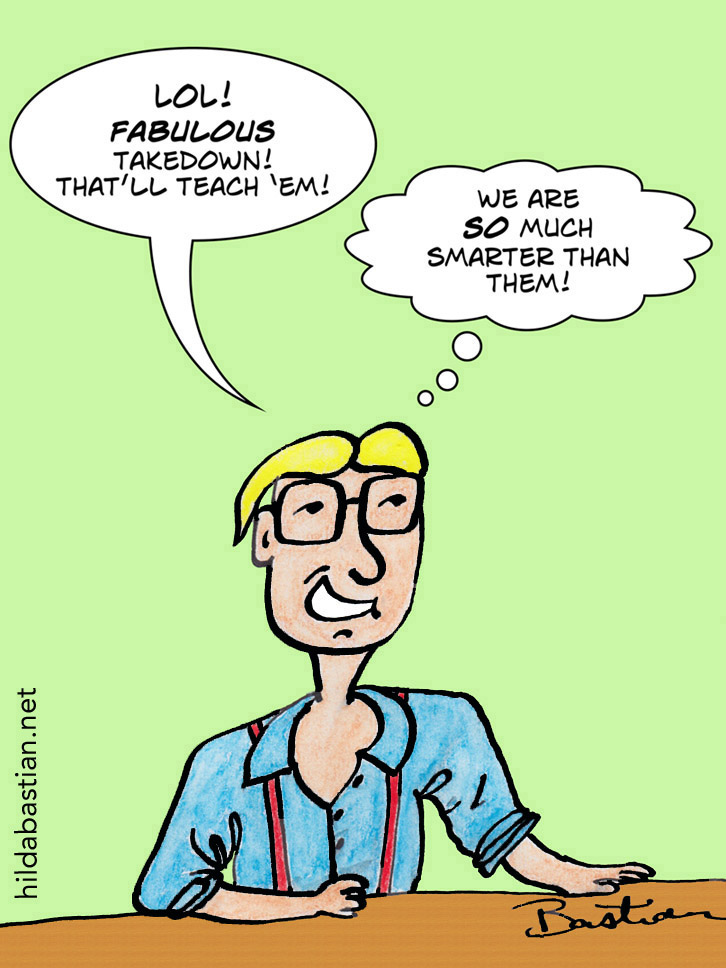
A credible writer uses humor to punch up at systems, ideas, or powerful figures. A less credible one uses it to punch down at easy targets or simply to show off.
5. Practice: Finding the Line
Let's apply these ideas. Imagine you're reviewing a new fantasy TV series. The show has great world-building and a compelling plot, but the lead actor's performance is distractingly wooden.
Your Task: Write two short, distinct critiques (1-2 sentences each) of the actor's performance.
- The Snarky Critique: Write a version that is dismissive and relies on a cheap shot.
- The Witty Critique: Write a version that makes the same point but with more wit and insight, grounding the humor in a specific observation.
Take a few minutes to write both versions.
Click to see my examples
-
Snarky Example: "The lead actor delivers his lines with all the emotional range of a cardboard cutout. Did they find him on Craigslist?"
- Analysis: This is just mean. "Cardboard cutout" is a cliché, and the "Craigslist" jab is a cheap, irrelevant insult.
-
Witty Example: "The lead actor has two facial expressions: mild concern and mild concern while holding a sword. He recites ancient prophecies with the same energy one might use to order a pizza."
- Analysis: This is more effective. It uses specific observations ("mild concern"), a witty comparison ("order a pizza"), and the Rule of Three (implicitly: concern, concern with a sword) to make the point in a funnier, more specific, and ultimately more credible way.
Notice how the witty version is more descriptive and analytical, even while being humorous. It's criticism that stems from observation, not just contempt.
Conclusion
In this lesson, we explored the delicate but crucial balance between humor and credibility. You've learned that a witty voice, when used strategically, can be a powerful tool for building authority.
Key Takeaways:
- Credibility is built on two pillars: trustworthiness (perceived honesty) and expertise (perceived knowledge).
- Ground your humor in facts, research, and deep knowledge. A joke is more powerful when it proves you know your subject inside and out.
- Use humor to be transparent. Addressing potential issues with wit and honesty can disarm skepticism and build a strong rapport with your reader.
- Strive for wit, not snark. Wit is about insightful commentary, while snark is about superiority. One builds credibility, the other erodes it.
We've now completed our module on voice and tone. You've analyzed professional writing, practiced humorous techniques, and learned how to maintain your credibility while doing so.
In our next module, we will zoom out from the sentence level to the paragraph level. We'll begin by looking at how to construct paragraphs that each develop a single, clear idea, ensuring your well-crafted sentences are organized into a logical and powerful structure.