Hello! Welcome back to our module on Word Choice and Precision.
In our last session, we explored the "Ladder of Abstraction," learning to make our writing more vivid by choosing specific nouns and concrete, sensory details. We saw how moving from a general statement like "the movie was good" to a specific description of a key scene can transform the reader's experience.
Today, we'll sharpen our focus on the engine of the sentence: the verb. Your goal for this lesson is to replace vague or weak verbs (e.g., 'is,' 'has') with precise, powerful action verbs. Mastering this skill will make your prose more dynamic, concise, and engaging—essential qualities for any entertainment journalist who wants to capture the energy of a performance or the tension of a film.
This lesson should take you about 60 minutes.
1. Identifying Strong vs. Weak Verbs
At its core, the distinction is simple: strong verbs show action, while weak verbs often state a condition or require other words to make their meaning clear. Strong verbs are specific and create a mental image. Weak verbs are often general and abstract.
To get a clear overview of the main categories, let's watch a short video.
Weak Verbs vs Strong Verbs (Writing Advice)
The video "Weak Verbs vs Strong Verbs" from writer Brandon McNulty provides a concise and practical introduction to this concept.
Please watch the following sections: Start with the introduction to strong verbs, where the presenter explains how active, physical verbs create a stronger connection with the reader. Next, watch the breakdown of the three categories of weak verbs: 'is' verbs, 'have' verbs, and abstract verbs. Finally, observe the before-and-after examples, which demonstrate how to revise sentences for greater impact.
As the video illustrates, the most common weak verbs fall into a few key groups:
- Linking Verbs (forms of "to be"): is, am, are, was, were, be, being, been. These verbs connect a subject to a description but show no action.
- Weak: The movie's cinematography is beautiful.
- "Empty" Verbs: Forms of have, give, make, get, do. These verbs are so general they often need help from other words, making sentences wordy.
- Weak: The showrunner gave an explanation for the plot twist.
- Abstract Verbs: love, think, believe, feel, know. These tell the reader about an internal state without showing any evidence of it.
- Weak: The audience loved the concert.
Your first step in editing is to develop an eye for spotting these verbs in your own writing.
2. The Power of a Strong Verb: Showing vs. Telling
Why is this distinction so important? Strong verbs help you follow the fundamental writing principle of "show, don't tell." A weak verb tells the reader something is happening, while a strong verb shows it.
A helpful analogy is to think of strong verbs as a camera's zoom lens.
Strong Verbs: How to Edit Your Writing to Get Rid of Weak Verbs
The video "Strong Verbs: How to Edit Your Writing" by Self-Publishing School effectively explains the "why" behind this technique and then demonstrates the editing process in detail.
First, watch the explanation of why strong verbs matter, which introduces the "zoom lens" analogy for creating specific, vivid pictures. Then, watch the very practical, extended editing session from start to finish. Pay close attention to the presenter's thought process as she revises an entire paragraph. Notice how changing a single verb like "walked" to "moped" or "set" to "slammed" completely alters the mood and meaning of the scene.
The key insight from that editing session is that replacing a weak verb isn't just about finding a more interesting synonym. It's about asking yourself: How did the character perform that action? The answer provides the specific, powerful verb you need and, in doing so, adds layers of character, emotion, and context to your writing.
3. A Toolkit for Strengthening Verbs
Now that you can spot weak verbs and understand their effect, let's build a practical toolkit for finding and replacing them during your editing process.
How to Edit Weak Verbs into Strong Verbs to Improve Readability
This article from Readability Formulas provides several excellent, easy-to-use strategies for your editing workflow.
Please review the following sections: Start by studying the first table, which demonstrates how to replace a weak verb and an adverb with a single strong verb. This is a common pattern to look for. For example, instead of "walked slowly," you can use "strolled" or "shuffled." Next, read the section "Nouns Hide Clues." This points out how verbs are often hidden inside nouns (a process called nominalization). Transforming "She made a decision" into "She decided" makes the sentence more direct and active. Then, look over the lists of common weak verbs like get, do, create, take, give, and make. Scan the examples to see how phrases built around these verbs can be revised into stronger, more concise sentences. Finally, glance at the table under "common scenarios when you should use strong verbs." Note the entry for "Journalistic Writing," which confirms how central this skill is to your field.
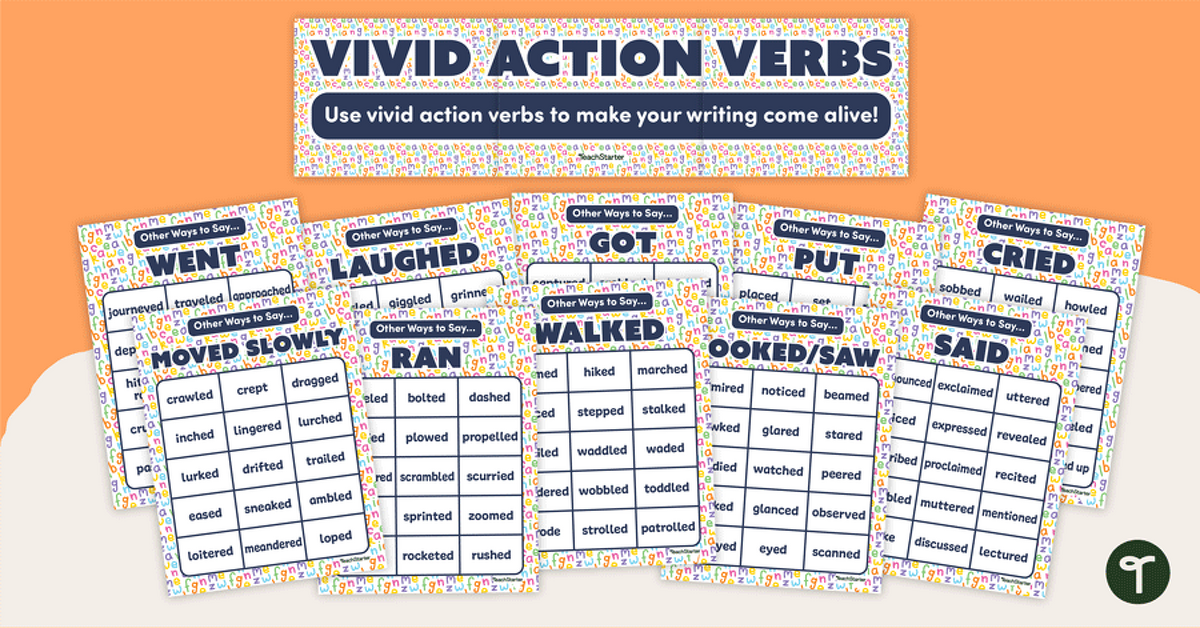
To help you brainstorm replacements, you can also use visual aids. Think of the image below as a targeted thesaurus for verbs.
4. Practice: Strengthening Your Prose
Let's apply these strategies. Rewrite the following sentences, which are typical of first-draft entertainment journalism. Focus on replacing the weak, telling verbs (in bold) with strong, showing verbs. Aim for prose that is more dynamic and specific.
- The lead singer was on the stage, full of raw energy.
- The director made a choice to end the film on an ambiguous note.
- The crowd got louder when the band did their most famous song.
- The actor had a look of disappointment on his face when he lost the award.
There are many ways to revise these. The goal is to activate the sentence by making the verb do the heavy lifting.
View suggested revisions
Here are a few possible revisions. Your sentences will be different, but compare them to see if you also replaced the weak verb with a more active one.
-
Original: The lead singer was on the stage, full of raw energy.
- Revision 1: The lead singer stalked the stage, radiating raw energy.
- Revision 2: The lead singer exploded onto the stage, a whirlwind of raw energy.
-
Original: The director made a choice to end the film on an ambiguous note.
- Revision 1: The director chose to end the film on an ambiguous note. (More concise)
- Revision 2: The director steered the film toward an ambiguous, haunting conclusion. (More evocative)
-
Original: The crowd got louder when the band did their most famous song.
- Revision 1: The crowd roared when the band launched into their most famous song.
- Revision 2: The stadium erupted as the opening chords of the band's anthem blasted from the speakers.
-
Original: The actor had a look of disappointment on his face when he lost the award.
- Revision 1: Disappointment flashed across the actor's face when he lost the award.
- Revision 2: The actor's smile faltered as his name went uncalled for the award.
Conclusion
In this lesson, you've learned to identify and replace weak verbs with strong, precise action verbs. This isn't just a grammatical tweak; it's a fundamental shift in how you construct meaning. By making your verbs more powerful, you make your writing more immediate, concise, and compelling.
Key Takeaways:
- Strong verbs create action, imagery, and emotion, showing the reader what is happening.
- Weak verbs, like forms of "to be" and "to have," often state a condition or tell the reader something is happening, resulting in passive or wordy prose.
- When editing, actively look for weak verb + adverb combinations and verbs hidden within nouns.
- Replacing weak verbs is a powerful way to make your writing more dynamic and engaging for your audience.
In our next lesson, we'll continue building on this foundation. We will learn how to use concrete, sensory language to make descriptions more engaging and memorable. You've learned to activate your sentences with strong verbs; next, you'll learn to immerse your reader in the scene by appealing to all five senses.