Welcome to the second module of our course, "Word Choice and Precision." In our last lesson, we concluded our work on sentence structure by focusing on how to place words for emphasis. You learned to arrange your sentences so that the most important information lands in the positions of natural strength—the beginning and, especially, the end.
Now that you know where to place your key ideas, we'll shift our focus to the words themselves. This lesson tackles a fundamental skill of compelling writing: distinguishing between general and specific word choices and selecting the more vivid option. Moving from abstract statements to concrete details is what separates forgettable prose from writing that creates a lasting image in the reader's mind. For an entertainment journalist, this is the difference between telling a reader a movie is "good" and making them feel the thrill of its best scene.
This lesson should take you about 60 minutes to complete.
1. The Ladder of Abstraction: From Vague to Vivid
A useful way to think about the difference between general and specific language is the "Ladder of Abstraction." This is a mental model that helps you visualize language on a spectrum, from abstract, high-level concepts at the top of the ladder to concrete, sensory details at the bottom.
Good writing doesn't live at one end of the ladder; it moves up and down, connecting broad ideas to specific, memorable examples.
To understand this concept visually, let's watch a short video that explains the ladder and shows it in action within a piece of non-fiction writing.
The Ladder of Abstraction: Make Your Writing Memorable
This video from InkwellMedia, titled "The Ladder of Abstraction," provides an excellent introduction to this foundational writing concept.
Please watch the following segments: Start with the introduction to the ladder to grasp the basic concept. Continue with the river rafter example, which clearly demonstrates moving from a specific person ("McDougal") up to abstract concepts ("universal human lessons"). Pay close attention to the key principle that good writing constantly moves up and down the ladder. Finally, watch the section on applying this to non-fiction. This directly relates to how you can make abstract points in an article understandable and engaging through concrete stories and examples.
The key takeaway is that abstract words (e.g., "freedom," "success," "art") are useful for summarizing and making broad points, but they don't create a picture. Concrete words, which appeal to the five senses, are what ground your reader in the story. Your task as a writer is to know when to climb the ladder to make a point and when to climb down to show what you mean.
2. Choosing Specific Nouns and Verbs
The most direct way to climb down the ladder of abstraction is by choosing more specific nouns and verbs. Vague nouns and verbs create fuzzy, generic images. Specific ones create sharp, clear pictures.
- General: The man walked down the street.
- Specific: The old man shuffled along the cobblestone lane.
Notice how "old man" is more specific than "man," "shuffled" is more descriptive than "walked," and "cobblestone lane" paints a much clearer picture than "street."
Let's look at some practical strategies for making your word choices more precise.
Word Choice (Style) - The Comm Spot
This article from The Comm Spot offers clear, actionable advice on word choice. We'll focus on the sections that directly address specificity.
Please read the section titled "3. Use Specific Nouns to Add Clarity and Depth." Note the simple but effective example of moving from "device" to "tablet" or "scanner." Next, review the table under the subheading "D. Creative Nonfiction or Blog Post." This is highly relevant to entertainment journalism. Pay attention to how it transforms generic words into evocative ones: "place" becomes "market square" "went" becomes "wandered into" "bad weather" becomes "bone-soaking rain"
This idea of replacing a weak description with a stronger, more active one is a recurring theme in good writing. The following video offers some quick, punchy examples of this in action.
7 Tips to Use the Words Readers Love | Master Your Word Choice in Writing
This video from Trevor Wiltzen, "7 Tips to Use the Words Readers Love," provides direct comparisons that show the power of specific word choice.
Watch these two short clips: First, see how a simple verb change transforms a sentence in this example. "Walked" becomes "tiptoed," "stormed," or "glided," each carrying a different emotional weight. Then, watch the example from "punching up" descriptions. The shift from "It was a cold night" to "The icy wind sliced through her coat" is a perfect example of moving from a general statement to a specific, sensory detail. You're moving from telling the reader it's cold to making them feel the cold.
3. Case Study: Vividness in Narrative Journalism
To see how these principles come together at a professional level, let's analyze how Pulitzer Prize-winning journalist Jon Franklin uses specific, sensory language to build a world for his reader.
Using Literary Techniques in Narrative Journalism - Writer's Digest
This article from Writer's Digest breaks down the techniques used in Jon Franklin's classic story, "Mrs. Kelly's Monster." It's a masterclass in making a technical subject (brain surgery) immediate and compelling through word choice.
Please read these two key sections: "The use of sensory details": Focus on how Franklin uses sounds ("pop, pop, popping," "electrical bzzzzzt") and smells ("ozone and burnt flesh") to pull the reader directly into the operating room. This is the bottom of the ladder of abstraction in its most powerful form. "Word choice": Notice the emphasis on powerful verbs ("twists and dances") and vivid comparisons (an aneurysm like "a tire about to blow out"). This demonstrates how to choose words that do more than just state a fact—they create an experience.
Franklin's work shows that specificity isn't just about adding adjectives. It's about finding the precise noun, the most active verb, and the most evocative sensory detail to make your subject come alive.
4. Practice: From General to Specific
Let's put this into practice. The image below shows two descriptions of the same house. The writer has used different word choices in each example to create a completely different mood.
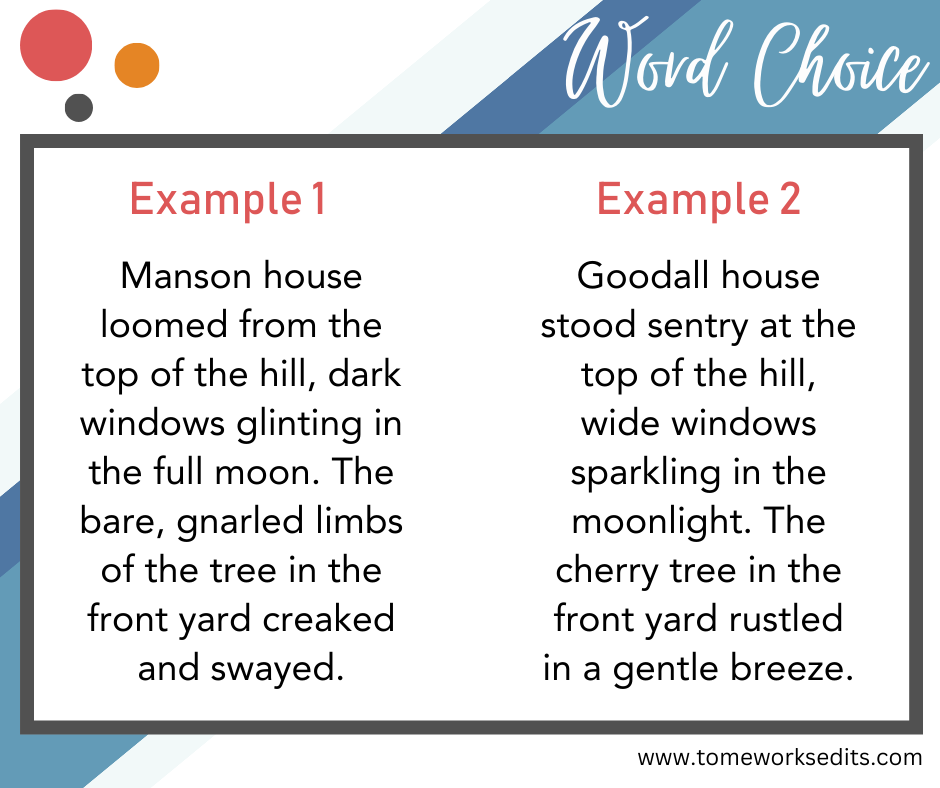
Now, it's your turn. Rewrite the following sentences from the world of entertainment journalism. Your goal is to replace the general, abstract language with specific, concrete, and vivid details. Climb down the ladder of abstraction.
- General: The film's final action sequence was exciting.
- General: The comedian's performance was funny.
- General: The actress wore a nice dress on the red carpet.
- General: The stadium was loud after the concert's encore.
There's no single "correct" answer. The goal is to practice replacing vague words with sharp, sensory details. Try to create a distinct image or feeling for each.
View suggested revisions
Here are some possible ways you could have rewritten the sentences. Your versions will be different, but check if you also replaced general words with more specific ones.
-
Original: The film's final action sequence was exciting.
- Specific Revision: In the film's climax, the hero dangled from a helicopter skid over a volcano, the roar of the rotors battling the thrum of erupting lava below as he reached for the detonator.
-
Original: The comedian's performance was funny.
- Specific Revision: The comedian stalked the stage, her wry observations on airline travel causing waves of laughter to build from scattered chuckles into a room-shaking roar.
-
Original: The actress wore a nice dress on the red carpet.
- Specific Revision: The actress glided down the red carpet in a midnight-blue velvet gown, its train pooling behind her like a puddle of ink under the glare of the flashbulbs.
-
Original: The stadium was loud after the concert's encore.
- Specific Revision: After the final chord of the encore faded, a deafening wall of sound—cheers, whistles, and thousands of stomping feet—erupted from the stadium, shaking the cheap plastic seats.
Conclusion
In this lesson, you've learned to identify the difference between general and specific language and, more importantly, how to transform the former into the latter. This is a core skill for bringing your subjects to life, whether you're describing a film, a performance, or a person.
Key Takeaways:
- The Ladder of Abstraction is a mental tool to move between high-level ideas and ground-level details.
- Specific Nouns and Verbs are your primary tools for creating clear, vivid images.
- Concrete, Sensory Details (sights, sounds, smells, etc.) immerse your reader in the world you are describing.
- Moving from telling (e.g., "it was exciting") to showing (describing the exciting actions) is the key to engaging prose.
This skill is the foundation of powerful word choice. In our next lesson, we will zoom in on one specific aspect of this: replacing vague or weak verbs (e.g., 'is,' 'has') with precise, powerful action verbs. You'll learn how to make your sentences more dynamic by ensuring the verb carries the action.