Hello! In our last lesson, we focused on making your sentences clearer by ensuring every pronoun points to a specific antecedent. Today, we'll continue honing your prose by tackling two common habits that add clutter and sap energy from your writing.
This lesson is about identifying and eliminating wordiness caused by nominalizations and expletive constructions. These might sound like technical linguistic terms, but they are simple concepts that, once you learn to spot them, will transform how you edit your work. Getting rid of them makes your writing more direct, active, and confident—all essential qualities in sharp journalistic prose. By the end of this lesson, you'll have a new set of tools to make your sentences more powerful.
This lesson should take you about 60 minutes.
1. What is Wordiness?
In journalism, every word should serve a purpose. Wordiness is the tendency to use more words than necessary to convey an idea. It can make your writing feel slow, bureaucratic, or unclear.
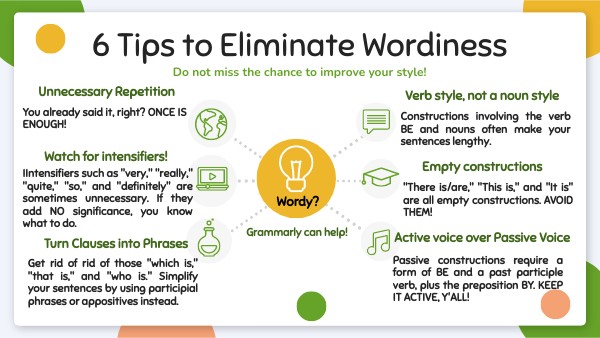
Let's dive into the first and most widespread pattern: nominalizations.
2. Battling "Zombie Nouns" (Nominalizations)
A nominalization is a verb or an adjective that has been turned into a noun, often by adding a suffix like -tion, -ment, -ance, or -ism. Writer Helen Sword memorably calls them "zombie nouns" because they tend to suck the life out of active verbs.
Let's watch a short, animated video that vividly illustrates this concept.
Beware of nominalizations (AKA zombie nouns) - Helen Sword
This fantastic TED-Ed video, "Beware of nominalizations (AKA zombie nouns)," introduces the concept in a highly memorable way.
Watch these key parts to understand what zombie nouns are and the damage they do: Start from the beginning to understand the definition of nominalizations as "zombie nouns." Watch the "reanimation" example to see how a sentence can be brought back to life. Finally, see George Orwell's famous demonstration of how nominalizations can turn clear language into abstract jargon in the biblical passage example.
As the video shows, nominalizations often force you to use weak "be" verbs (is, was, were) instead of strong, active ones. The key to fixing them is to find the verb hidden inside the zombie noun and make it the engine of your sentence.
How to Revise Nominalizations:
- Spot the noun: Look for words ending in
-tion,-ment,-ance,-sion,-ence,-ity. - Find the hidden verb: What action is the noun describing? (e.g., evaluation -> evaluate; decision -> decide)
- Identify the doer: Who or what is performing the action?
- Rewrite: Make the "doer" the subject and the "hidden verb" the main verb of the sentence.
Let's look at some examples from an entertainment journalism context:
-
Wordy (with nominalization): The decision of the producers was to delay the film's release.
-
Concise (verb-driven): The producers decided to delay the film's release.
-
Wordy: The actor gave a performance that was a demonstration of his commitment.
-
Concise: The actor's performance demonstrated his commitment. (Here, one nominalization is kept as the subject, but the other is turned into the main verb, which is a good compromise).
For more examples and a formal definition, have a look at the following resource.
Revision Techniques – Howdy or Hello? Technical and ...
This page from Texas A&M's writing center provides a clear definition and a helpful table of before-and-after examples.
Read the section on "Nominalizations" and review "Table 10.3. Nominalizations to verbs." This will help solidify your understanding of how to convert these nouns back into verbs.
3. Clearing Out "Empty" Starters (Expletive Constructions)
Our second target is the expletive construction. In grammar, an "expletive" isn't a swear word; it's a filler word that serves a grammatical function but has no real meaning. The most common are There is..., There are..., and It is... at the beginning of a sentence.
These constructions delay the main point by putting the true subject after the verb. Removing them makes your sentences more direct and forceful.
There is… There are… (Expletive Construction, Dummy Subjects)
This short video from GrammarRevolution explains expletive constructions clearly.
Watch the following segments: The introduction explains why "there" is not the subject in these sentences. See how to rewrite the sentence to find the true subject. Finally, test your understanding with the "many leaves" example.
As the video demonstrates, the fix is usually straightforward:
- Spot the expletive:
There is,There are,There were,It is,It was. - Find the true subject: Look for the real subject of the sentence, which usually comes after the verb.
- Rewrite: Start the sentence with the true subject.
Let's see this in action:
-
Wordy (with expletive): There are many fans who are unhappy with the series finale.
-
Concise: Many fans are unhappy with the series finale.
-
Wordy: It is essential for critics to see the film before its release.
-
Concise: Critics must see the film before its release.
Now, let's put these two ideas—nominalizations and expletives—together.
What does writing clearly and concisely mean? ...
This guide from Stanford's Technical Communication Program shows how nominalizations and expletives are often linked.
Please read the sections titled: "Monitor and reduce nominalizations" "Avoid unnecessarily using forms of the verb 'be'" Notice how often the weak verb "is" or "was" appears alongside nominalizations and in expletive constructions like "There is...". This connection is key to spotting wordiness.
4. Practice: From Wordy to Powerful
It's time to apply what you've learned. Rewrite the following sentences to eliminate the nominalizations and expletive constructions. Make them more direct and active.
- There was an expectation among the cast that the director would make a revision to the script.
- It is the belief of the studio that the film's success is an indication of audience interest in historical dramas.
- The adaptation of the comic book into a series had the result of a significant increase in sales.
- There is a need for the clear establishment of a motive for the main character.
View suggested revisions
-
Original: There was an expectation among the cast that the director would make a revision to the script.
- Revision: The cast expected the director to revise the script.
- (This removes both the expletive "There was" and the nominalizations "expectation" and "revision.")
-
Original: It is the belief of the studio that the film's success is an indication of audience interest in historical dramas.
- Revision: The studio believes the film's success indicates that audiences are interested in historical dramas.
- (This removes the expletive "It is" and the nominalizations "belief" and "indication.")
-
Original: The adaptation of the comic book into a series had the result of a significant increase in sales.
- Revision: Adapting the comic book into a series significantly increased sales.
- (This turns the nominalizations "adaptation" and "increase" into active verbs.)
-
Original: There is a need for the clear establishment of a motive for the main character.
- Revision: The main character needs a clear motive. (Or: The writer needs to establish a clear motive for the main character.)
- (This removes the expletive "There is" and the nominalizations "need" and "establishment.")
Conclusion
You've just learned to spot and fix two of the most common culprits behind clunky, passive prose. By turning zombie nouns back into lively verbs and eliminating empty sentence starters, you make your writing more immediate, clear, and professional. This isn't just about cutting words; it's about closing the distance between your reader and your ideas.
Key Takeaways:
- Nominalizations are verbs-turned-nouns (e.g., investigation instead of investigate). They weaken sentences by forcing the use of "be" verbs. Revise by making the hidden verb the main verb.
- Expletive constructions (
There is...,It is...) are weak sentence starters that delay the subject. Revise by finding the true subject and putting it first. - Aim for a verb-driven writing style. Strong verbs are the engine of powerful sentences.
In our next lesson, we'll continue our mission to make your writing as lean and effective as possible. We will broaden our focus to analyzing and tightening sentences by eliminating redundancies and other unnecessary words, building directly on the skills you've developed today.