In our last lesson, we focused on using the active voice to make your sentences more direct and forceful, while also noting the strategic moments when the passive voice is the better choice. We're continuing our work on sentence-level clarity by tackling another common pitfall: modifiers that have gone astray.
Today's lesson is about misplaced and dangling modifiers. These are descriptive words or phrases that, due to poor placement, create confusion, ambiguity, or even unintentional humor. As a journalist, your primary goal is to be understood clearly. Mastering modifiers will help you build sentences that are not just grammatically correct, but also precise and professional. By the end of this lesson, you'll be able to spot and fix these errors, ensuring your reader understands exactly what you mean.
This lesson should take about 60 minutes to complete.
1. The Rule of Proximity: What Are Modifiers?
A modifier is a word, phrase, or clause that describes or provides more information about another part of the sentence. Your background in linguistics gives you a head start here, as you're already familiar with adjectives, adverbs, and descriptive phrases.
The single most important rule for using modifiers is the rule of proximity:
A modifier should be placed as close as possible to the word or phrase it is modifying.
When this rule is broken, the meaning of a sentence can change dramatically, or become nonsensical. The word "only" is a classic example of a modifier that frequently gets misplaced.
Let's watch a short video that introduces modifiers and demonstrates how easily they can be misplaced.
This video, "Writing - Misplaced Modifiers" from engVid, provides a great introduction to the topic and uses the word 'only' to show how placement is key to meaning.
Please watch these two clips: First, get a quick refresher on what a modifier is. Then, pay close attention to the explanation of how moving the word "only" changes the entire meaning of the sentence in this example.
As the video shows, the difference between "I call only my mother" and "I only call my mother" is significant. One describes who you call, while the other describes when you call. This is the kind of precision that separates good writing from great writing.
2. Misplaced Modifiers: Unintended Meanings
A misplaced modifier is a modifier that is grammatically connected to the sentence, but is in the wrong place. This separation from its intended target creates an awkward or illogical meaning. Sometimes, the results are just confusing; other times, they can be quite funny.
A classic example from journalism is: "The suspect was described as a tall man with a black mustache weighing 200 pounds."
This sentence unintentionally suggests the mustache weighs 200 pounds. The fix is to move the modifier "weighing 200 pounds" closer to its real subject, "man": "The suspect was described as a tall man, weighing 200 pounds, with a black mustache."
The video we just watched has some wonderful, memorable examples of this.
Let's return to the same video to see some humorous examples of misplaced prepositional phrases.
Watch the section from clouds and bears. The instructor uses a famous Groucho Marx joke to illustrate perfectly how a misplaced phrase can create an absurd mental image.
The joke "I shot an elephant in my pajamas" works because of the ambiguity created by the misplaced modifier "in my pajamas." The listener's first assumption is that the speaker was in his pajamas, but the punchline reveals the other, more absurd possibility. In journalism, you can't afford that kind of ambiguity.
Squinting Modifiers
A specific type of misplaced modifier is the squinting modifier. It's placed between two parts of a sentence, making it unclear which part it's supposed to be modifying.
Writing: Keeping Modifiers In Their Place - Quill
This article from Quill, a magazine for professional journalists, provides an excellent, concise look at modifier errors in media writing.
Read the section titled "A squinting (or two-way) modifier confuses..." down to the sentence "...fail almost every part of the test?" Pay attention to the examples with "rarely," "recently," and "almost."
As the article shows, in the sentence "Adults who napped rarely were tired," it's unclear if you mean "adults who rarely napped" or "adults who were rarely tired." The fix is to rephrase the sentence to state your meaning unambiguously:
- If they rarely napped: "Adults who napped only rarely were tired."
- If they were rarely tired: "Adults who napped were rarely tired."
3. Dangling Modifiers: The Missing Subject
While a misplaced modifier is in the wrong place, a dangling modifier has nothing to modify at all. The word or phrase it's supposed to describe has been left out of the sentence entirely.
These often appear as introductory phrases, like in this sentence:
Having finished the article, the television was turned on.
Who finished the article? The sentence doesn't say. The modifier "Having finished the article" is left "dangling" because its subject is missing.
To fix a dangling modifier, you must rewrite the sentence to include the missing subject.
- Correct: Having finished the article, I turned on the television.
- Correct: After I finished the article, the television was turned on.
This next video gives a clear explanation of dangling modifiers and how they differ from misplaced ones.
Misplaced and Dangling Modifiers
This video from the "Writing Better" channel provides a very structured look at the difference between misplaced and dangling modifiers.
Watch the section that explains dangling modifiers. Notice that fixing them isn't just about moving the phrase; you often have to add a subject or change the sentence structure.
The infographic below provides a helpful summary of how to identify and correct dangling modifiers.
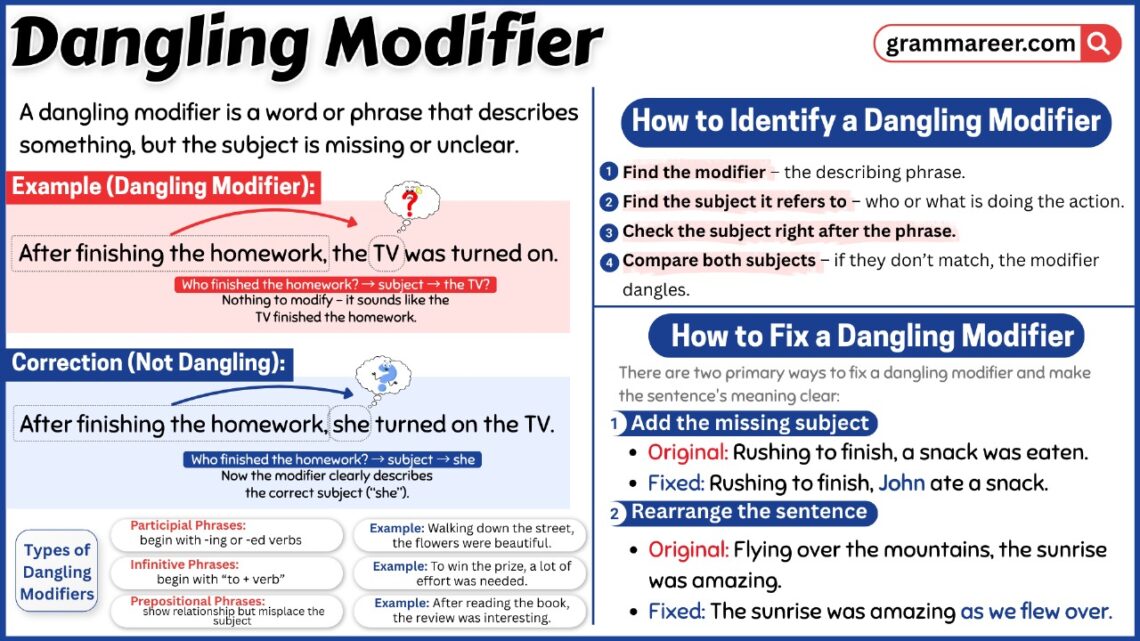
4. Practice: Spotting and Fixing Modifier Errors
Now it's time to apply these concepts. The best way to get a feel for these errors is to practice correcting them.
Let's use some exercises from the online textbook Writing for Success.
Part A: Misplaced Modifiers
Rewrite the following sentences to fix the misplaced modifiers.
- The young lady was walking the dog on the telephone.
- The teacher served cookies to the children wrapped in aluminum foil.
- We returned the wine to the waiter that was sour.
- Charlie spotted a stray puppy driving home from work.
View suggested corrections
- While on the telephone, the young lady was walking the dog.
- The teacher served the children cookies that were wrapped in aluminum foil.
- We returned the sour wine to the waiter.
- Driving home from work, Charlie spotted a stray puppy.
Part B: Dangling Modifiers
Rewrite the following sentences to fix the dangling modifiers. Remember, you'll likely need to add a subject.
- Bent over backward, the posture was very challenging.
- Walking in the dark, the picture fell off the wall.
- Packing for a trip, a cockroach scurried down the hallway.
- Piled up next to the bookshelf, I chose a romance novel.
View suggested corrections
- Bent over backward, I found the posture very challenging.
- As I was walking in the dark, the picture fell off the wall.
- While I was packing for a trip, a cockroach scurried down the hallway.
- From the books piled up next to the bookshelf, I chose a romance novel.
5. Final Challenge
Now, let's tackle a full paragraph. The following text is filled with misplaced and dangling modifiers. Rewrite it to make it clear and logical.
2.7 Misplaced and Dangling Modifiers – Writing for Success
This exercise from Writing for Success challenges you to apply everything you've learned to a single paragraph.
Read the paragraph that begins, "I bought a fresh loaf of bread for my sandwich shopping in the grocery store." Rewrite the entire paragraph in a separate document, correcting all the modifier errors.
Once you have your own version, you can compare it to this corrected version:
View a possible revision
While shopping in the grocery store, I bought a fresh loaf of bread for my sandwich. Wanting to make a delicious sandwich, I spread the mayonnaise thickly. After placing the cold cuts on the bread, I placed the lettuce on top. Turning on the radio, I cut the sandwich in half with a knife. As I was biting into the sandwich, my favorite song blared loudly in my ears. Humming and chewing, I found that my sandwich went down smoothly. Smiling, I decided that my sandwich will be made again, but next time I will add cheese.Conclusion
Clear writing is precise writing. Today you've learned to identify and correct two common errors that create ambiguity and confusion: misplaced and dangling modifiers. By ensuring your descriptive phrases point clearly to their subjects, you make your writing more professional and your message more effective.
Key Takeaways:
- The Rule of Proximity: Always place modifiers as close as possible to the words they are meant to describe.
- Misplaced Modifiers: These are phrases in the wrong spot, often creating illogical or humorous meanings. Fix them by moving the modifier next to its intended subject.
- Dangling Modifiers: These are phrases whose subject is missing from the sentence entirely. Fix them by rewriting the sentence to add the missing subject.
- Read Your Work Aloud: This is one of the best ways to catch awkward phrasing. If a sentence sounds strange when you hear it, there's a good chance it has a modifier error.
In our next lesson, we will address another source of confusion: ambiguous pronoun references. You'll learn how to ensure that words like "it," "he," "she," and "they" clearly refer to a single, identifiable noun, preventing your reader from having to guess who or what you're talking about.