Welcome back! In our recent lessons, we've focused on crafting different types of creative leads to hook your reader, from telling a small story to painting a vivid scene or posing a provocative question. We briefly touched on the idea that these creative openings need a partner: the nut graf.
Today, we'll put that partnership under the microscope. Your learning outcome is to analyze the relationship between a creative lead and its supporting nut graf. Understanding this dynamic is like learning how a one-two punch works in boxing: the first move sets up the second, and together they deliver the impact. A great lead without a solid nut graf can leave a reader intrigued but ultimately confused. Mastering this connection is essential for turning a good opening into a great story.
1. The Opening Act: Lead and Nut Graf as a Team
Think of the first few paragraphs of your article as the "opening act." Their job is to grab the audience and convince them to stay for the main event. In journalistic writing, this opening act is almost always performed by two key players: the lead and the nut graf.
How To Tell a Great Story, Part 1: Structure - Sapiens
The writing guide from Sapiens magazine lays out a common and effective structure for articles. We'll start by looking at how it positions the lead and nut graf.
Read the section "A GOOD FRAMEWORK FOR STORIES," paying close attention to the definitions of the first two elements: "An intriguing lead" and "The nut paragraph." Then, skip down to the subheading "THE NUT PARAGRAPH" and read the three paragraphs just below it, starting from "You can think of the lead and nut graf..." and ending with "...propels readers into the rest of the article." This emphasizes their role as a single, fast-paced unit.
As the Sapiens article highlights, the lead and nut graf work together to form the first section of your story. The lead draws the reader in, and the nut graf provides the map, telling them where the story is headed and why it's worth their time.
In newsrooms, the nut graf is famously known as the "so what?" or the "why we invited you to this party" paragraph. It’s the moment you deliver on the promise of your creative opening.

2. What the Nut Graf Does
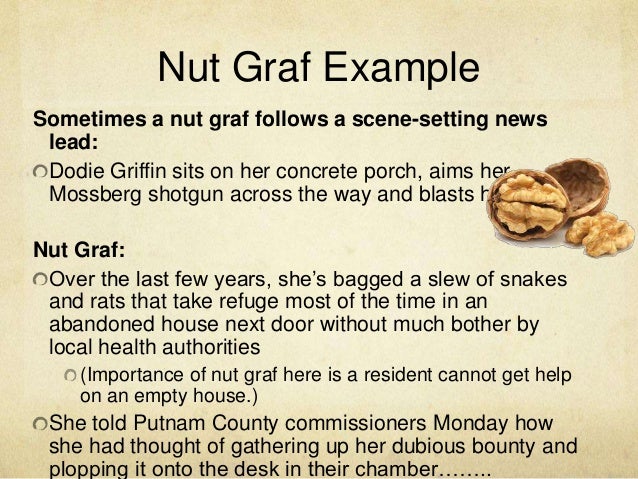
When you use a creative lead—like an anecdote or a scene—you intentionally delay giving the reader the core facts (the Who, What, When, Where, and Why). The nut graf is the paragraph where you finally provide that essential information.
Journalism 101: How to write a lead
In the "Journalism 101" video we've used before, Mark Grabowski explains this exact function.
Watch the segment from this alternative approach. He explains that a creative lead "may not contain the most important facts," and that this delayed information must appear in the nut graf—the "nutshell" of the story.
The core relationship is this:
- The Creative Lead asks an implicit question or creates a puzzle. It makes the reader wonder, "What is this about?" or "Why are you telling me this?"
- The Nut Graf answers that question directly. It provides the context, stakes, and significance.
3. The Dynamic in Action: Hook, Pivot, Explain
A powerful way to think about this relationship comes from the world of modern digital content. A popular formula for creating viral "hooks" involves setting up an idea, creating a surprising turn, and then explaining the new direction. This is exactly what the lead-nut graf duo does.
How to Create Irresistible Hooks (and blow up your content)
The YouTube channel Kallaway breaks down this dynamic in his video on creating irresistible hooks. While his focus is on video, the psychology is identical to journalistic writing.
Watch from the three-step formula. Pay close attention to his analysis of the Vegas Sphere video: Context Lean: "The tech in the Vegas sphere is insane." (This is the lead, getting you interested). Scroll Stop Interjection: "...but get this..." (This is the pivot). Contrarian Snapback: "the screen is actually the least impressive part... the most impressive part is the audio." (This is the nut graf, revealing the true, surprising focus of the story).
This "hook-pivot-explain" structure is fundamental to compelling storytelling. The lead hooks the reader with an interesting angle, and the nut graf pivots to the real heart of the matter.
Let's analyze an example from entertainment journalism. In 2023, Ellen Gamerman of The Wall Street Journal wrote a profile of Fran Drescher during the Hollywood actors' strike.
How to Write a Profile: Examples from The Wall Street Journal
This article breaks down the structure of a good profile, using the Fran Drescher piece as a prime example.
Read section "2. Nut graph." It quotes the opening paragraphs of the profile. Identify the lead and the nut graf.
Let's break down that Fran Drescher example:
-
Lead: "The 65-year-old performer known for the ’90s sitcom 'The Nanny,' who once talked about bringing glitz and glamour to her role as president of the Screen Actors Guild... suddenly finds herself in a very different situation."
- Function: This lead establishes a familiar, glamorous persona ("The Nanny") and creates tension by hinting at a dramatic change ("a very different situation"). It makes the reader ask, "What situation?"
-
Nut Graf: "Now her uniform is T-shirts and leggings as she pickets in broiling heat... Her next step may prove even more challenging: Holding together a union famous for its infighting..." Followed by her quote: “I’m not ‘The Nanny.’ I’m an activist on behalf of labor.”
- Function: This nut graf answers the question raised by the lead. It replaces the "glitz and glamour" with a gritty image ("T-shirts and leggings") and explains the specific stakes: a difficult strike and a fractious union. The quote provides the ultimate payoff, solidifying the story's central theme of transformation.
The lead used our knowledge of Fran Drescher's celebrity past to create a hook. The nut graf pivoted to her challenging present, explaining why she was in the news and why her story mattered now.
4. Your Turn: Analyzing the Partnership
Now, let's practice identifying and analyzing this relationship. Below are two examples of creative leads followed by their nut grafs. For each one, identify the type of creative lead and explain how the nut graf provides the necessary context and significance.
Example 1 (from the "Journalism 101" video):
Lead: The lights shine down and the music surrounds her as she spins across the stage into the arms of her partner. The audience roars its approval as the music slows down and the curtains begin to rise. In the end, it’s just another workday for teenager Chelsea Rittenhouse.
Nut Graf: At 18, the Howell resident is the youngest member of the New York Theatre Ballet, which describes itself as the most widely seen chamber ballet company in the United States. The professional group also tours abroad.
- What type of creative lead is this?
- How does the nut graf change or deepen your understanding of the scene described in the lead? What is the "so what?"
See the analysis
1. This is a **scenic or descriptive lead**. It paints a picture of a professional ballet performance. 2. The nut graf provides the crucial context that makes the story newsworthy. The lead describes a professional dancer, but the nut graf reveals she is only 18—the youngest in a prestigious company. The "so what?" is her exceptional status as a teenage prodigy in the highly competitive world of professional ballet. The lead shows *what* is happening, but the nut graf explains *why it's remarkable*.Example 2 (also from the "Journalism 101" video):
Lead: Bill Clinton will finally get taken to the cleaners. So will Dracula and a Playboy bunny.
Nut Graf: The three are among some 6,000 smoke-damaged costumes that will visit dry cleaners in the next few days because of a fire that broke out Wednesday night at Morris Novelty, a popular costume and novelty store. With Halloween only weeks away, the fire couldn't have come at a scarier time for the shop...
- What type of creative lead is this?
- How does the nut graf resolve the puzzle created by the lead?
See the analysis
1. This is a **wordplay lead**. It uses the idiom "taken to the cleaners" and a list of seemingly unrelated characters to create a humorous and puzzling statement. 2. The nut graf acts as the punchline and the explanation. It immediately clarifies that the lead was not about famous people, but about *costumes* of them. It then delivers the actual news story: a fire at a costume shop right before its busiest season, Halloween. The lead creates a moment of "huh?" and the nut graf delivers the "aha!" moment, along with the core news elements.Conclusion
Today, we've established that a creative lead and a nut graf are not separate entities, but a powerful team. A strong opening is a two-part harmony.
Key Takeaways:
- The creative lead hooks the reader with an anecdote, scene, or provocative statement, intentionally delaying the main point.
- The nut graf is the pivot. It follows the lead and delivers the "nutshell" of the story: its core topic, its significance, and why it matters now.
- This relationship can be seen as a "hook, pivot, explain" maneuver that builds curiosity and then provides satisfying clarity.
In our next lesson, we will build on this by learning how to evaluate a lead's effectiveness based on its hook, clarity, and relevance to the story. You'll move from analyzing how the pieces fit together to judging whether they form a successful whole.