Introduction
Welcome to your third lesson. In our previous session, we explored the neurochemical "hardware" of bonding, looking at how dopamine, oxytocin, and vasopressin work together to create feelings of attraction and long-term attachment. We learned that this biological system is the foundation for the powerful connections we form.
Today, we shift from the biological "how" to the psychological "what." This lesson addresses the learning outcome: to describe the major adult attachment styles (e.g., secure, anxious, avoidant) and how they manifest in romantic relationships. We will explore Attachment Theory, which provides a framework for understanding the different psychological "programs" or patterns we develop for relating to others. Think of the neurochemicals from our last lesson as the signals, and your attachment style as the operating system that interprets and responds to those signals.
Understanding these styles is a critical step in building your personal relationship framework, as they profoundly influence how we experience trust, intimacy, conflict, and security.
The Origins of Attachment Theory
To understand adult attachment, we first need to go back to its origins in the study of infant-caregiver relationships. Psychologist John Bowlby proposed that humans have an innate "attachment behavioral system" designed to ensure survival by keeping an infant close to its caregivers.
The following audio clip from Jessica Fern's Polysecure provides an excellent overview of these foundational concepts.
"Polysecure" Chapter 1.1: An Overview of Attachment Theory (Secure Attachment) - Jessica Fern
This clip explains Bowlby's core ideas, including how the attachment system is activated by distress and the importance of a 'safe haven' and 'secure base' in development.
Please listen to the segment from 00:58 to 04:41. As you listen, focus on the distinction between the 'attachment behavioral system' and the 'exploratory behavioral system' and how they relate to each other.
As the clip explains, our early experiences with caregivers—whether they were consistently responsive and available or not—shape our expectations for future relationships. These expectations form what psychologists call internal working models. These models are essentially a set of unconscious rules and beliefs about:
- Self: Am I worthy of love and care?
- Others: Can I depend on others to be there for me when I need them?
These models, formed in childhood, don't just disappear. They are carried into adulthood and become the blueprint for our romantic relationships.
A Framework for Adult Attachment: The Two Dimensions
While it's common to talk about four distinct "styles," it's more accurate and useful to think of attachment patterns as existing along two continuous dimensions. This approach avoids rigid boxing and allows for more nuance.
The following reading from a leading attachment researcher, Dr. R. Chris Fraley, explains this two-dimensional model.
A Brief Overview of Adult Attachment Theory and Research
This text introduces the two fundamental dimensions that underlie adult attachment patterns: attachment-related anxiety and attachment-related avoidance.
Please read the section titled 'Do We Observe the Same Kinds of Attachment Patterns Among Adults that We Observe Among Children?'. Focus on understanding the definitions of 'attachment-related anxiety' and 'attachment-related avoidance'.
To summarize the key ideas from the reading:
- Attachment-Related Anxiety: This dimension reflects the degree to which you worry about your partner's availability and responsiveness. A high level of anxiety corresponds to a negative working model of the self ("Am I lovable/worthy?").
- Attachment-Related Avoidance: This dimension reflects the degree of discomfort you feel with closeness and dependency. A high level of avoidance corresponds to a negative working model of others ("Can I trust others to meet my needs?").
By plotting these two dimensions on axes, we can visualize the four major attachment styles as quadrants in a two-dimensional space.

Now, let's explore the characteristics of each of these four styles.
The Four Adult Attachment Styles
The following infographic provides a concise summary of the four styles, which we will then explore in more detail.
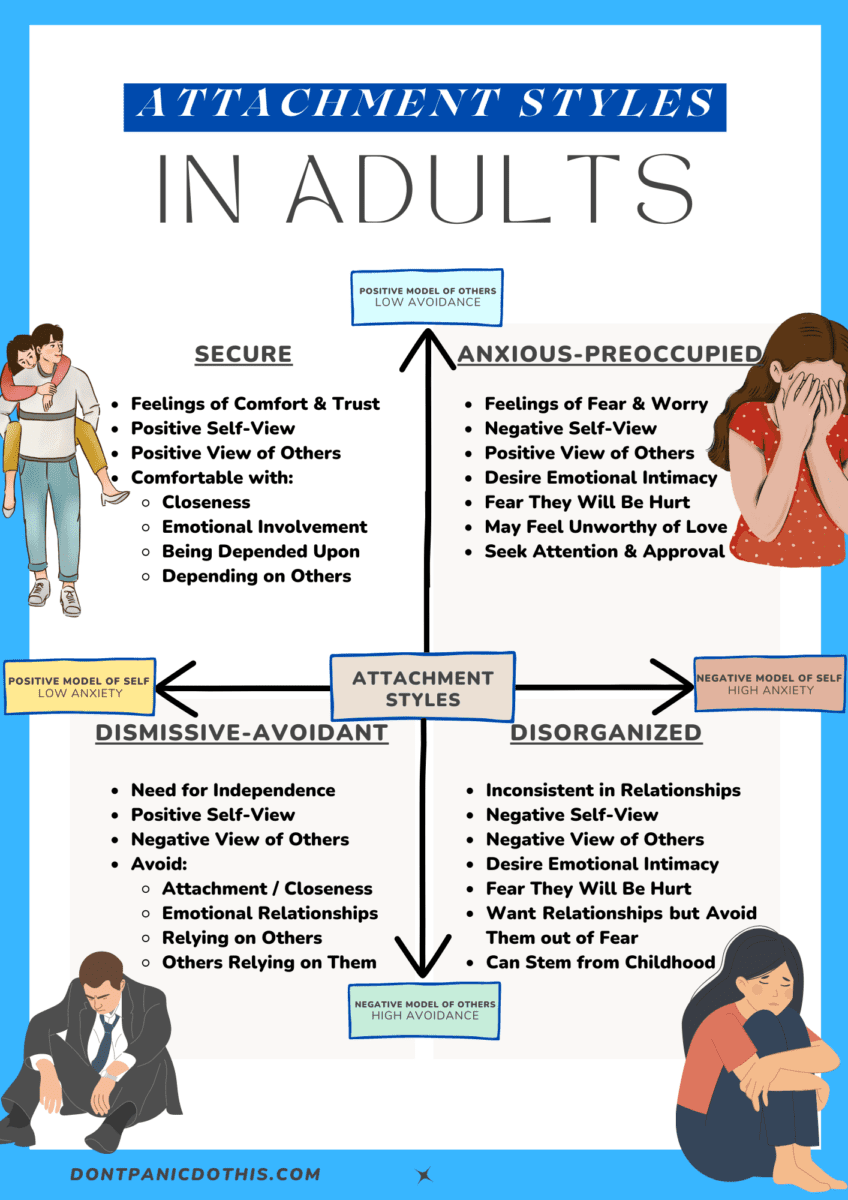
1. Secure Attachment (Low Anxiety, Low Avoidance)
A secure attachment style develops from a childhood where caregivers were generally available, responsive, and attuned. As adults, securely attached individuals hold positive models of both self and others.
- In Relationships: They are comfortable with intimacy and interdependence, but also with autonomy. They trust that their partner will be there for them but don't panic when they are apart. They can communicate their needs effectively, manage conflict constructively, and are generally more satisfied in their relationships. They see dependency not as a weakness, but as a normal and acceptable part of human connection.
- A Secure Mantra: "I am worthy of love, and I can trust others to love and support me. It's comfortable to be close, and it's also comfortable to be on my own."
2. Anxious-Preoccupied Attachment (High Anxiety, Low Avoidance)
This style often stems from a history of inconsistent caregiving, where a parent was sometimes available and loving, but other times intrusive or distracted. This creates a positive model of others (they can provide love) but a negative model of self (am I worthy of receiving it consistently?).
- In Relationships: Individuals with this style crave a high degree of intimacy and can become preoccupied with their relationships. They have a deep-seated fear of abandonment and are highly attuned to any signs—real or imagined—that their partner might be pulling away. This leads them to "hyperactivate" their attachment system, seeking frequent reassurance. They may be perceived as "needy" or "clingy," but this behavior is a strategy to maintain connection in the face of deep insecurity.
- An Anxious-Preoccupied Mantra: "I desperately want to be close, but I'm worried you don't really love me and will leave. I need you to show me you care."
3. Dismissive-Avoidant Attachment (Low Anxiety, High Avoidance)
This style is often a result of experiencing caregivers who were distant, rejecting, or unavailable. The child learns that seeking closeness leads to disappointment or punishment. To cope, they develop a positive model of self ("I can take care of myself") and a negative model of others ("I can't rely on anyone").
- In Relationships: These individuals value independence and self-sufficiency to an extreme. They are uncomfortable with emotional closeness and dependency, viewing it as a threat to their autonomy. They "deactivate" their attachment system by suppressing emotions and creating distance when they feel a partner is getting too close or trying to rely on them. They may appear emotionally unavailable, logical, and highly self-reliant.
- A Dismissive-Avoidant Mantra: "I am fine on my own; I don't need anyone. Closeness feels like a trap, and it's safer to keep my distance."
4. Fearful-Avoidant (Disorganized) Attachment (High Anxiety, High Avoidance)
This style is most often associated with childhood trauma, loss, or abuse, where the caregiver—the person who is supposed to be a source of safety—is also a source of fear. This creates a deeply confusing internal conflict and negative models of both self ("I am unworthy/damaged") and others ("Others are dangerous/untrustworthy").
- In Relationships: This is the "one foot on the gas, one foot on the brake" style. Individuals with this pattern both desire and fear intimacy. They want connection but are terrified of being hurt once they get it. Their behavior can seem erratic or chaotic, vacillating between anxious clinging and avoidant distancing. They struggle to trust others and themselves, and their relationships can feel unstable.
- A Fearful-Avoidant Mantra: "I want you to come here, but go away. I'm afraid of being alone, but I'm also afraid of being close to you."
Important Caveats: Styles, Not Statues
Before concluding, it's crucial to hold these concepts with nuance. Your attachment style is not a fixed, unchangeable identity. The following short clip from Polysecure makes several vital points about how to think about these labels responsibly.
"Polysecure" Chapter 1.1: An Overview of Attachment Theory (Secure Attachment) - Jessica Fern
Please listen to this important segment on the nuances of attachment styles. It addresses common misconceptions and provides a healthier perspective on using these labels.
Listen to the segment from 24:09 to 28:09. Pay close attention to the points about styles not being static and the danger of essentializing yourself or your partners.
The key ideas here are:
- Styles can change. Through new relationship experiences and conscious effort, a person can develop an "earned secure" attachment.
- You are not your style. It's more helpful to say "I sometimes struggle with anxious behaviors" than "I am an anxious person." The style is a pattern you exhibit, not the totality of who you are.
- Context matters. Your attachment pattern can shift depending on the partner you are with. A secure person might be pulled into anxious behaviors by a highly avoidant partner, for example.
- It is not an excuse. An attachment style can explain behavior, but it does not excuse harmful actions.
Conclusion
In this lesson, we have defined the four major adult attachment styles—secure, anxious-preoccupied, dismissive-avoidant, and fearful-avoidant—and explored how they manifest in romantic relationships.
Key Takeaways:
- Attachment styles are patterns of relating that originate in early caregiver relationships and form our "internal working models" of self and others.
- They are best understood as existing on two dimensions: attachment anxiety (fear of abandonment) and attachment avoidance (discomfort with closeness).
- Secure individuals are comfortable with both intimacy and autonomy.
- Anxious-preoccupied individuals crave intimacy but fear abandonment, leading to hyper-activating strategies (e.g., seeking reassurance).
- Dismissive-avoidant individuals value independence and suppress their need for closeness, leading to de-activating strategies (e.g., creating distance).
- Fearful-avoidant individuals both desire and fear closeness, leading to contradictory behaviors.
- These styles are dynamic patterns, not rigid identities, and can change over time.
Preview of the Next Lesson
Now that you have a solid understanding of these foundational psychological patterns, our next lesson will be highly practical. We will begin to analyze how different attachment styles can interact with the specific challenges and opportunities of non-monogamous relationship structures. We'll explore questions like: How might an anxious-preoccupied person handle their partner experiencing New Relationship Energy (NRE)? How does a dismissive-avoidant style cope with the increased communication demands of polyamory? This will be the first major step in connecting these core psychological theories to your goal of building a personal framework.