Welcome to the fourth lesson in our Strategic Foundations module. In our last session, we explored the critical zones where design creates disproportionate strategic value: shaping vision, defining positioning, crafting the experience, and ensuring coherent expression. We established that the most powerful brands are built when the analytical rigor of strategy and the creative magic of design are seamlessly integrated.
Today, we delve into the cognitive engine that drives this integration. We will explore the interplay of three fundamental types of reasoning—deductive, inductive, and abductive—that underpin all strategic decision-making. This lesson aims to provide a formal vocabulary for the very thinking processes you employ as a designer and strategist. Understanding these modes of logic will not only sharpen your own strategic thinking but also give you a powerful language to articulate your creative leaps to more analytically-minded stakeholders, effectively bridging the "brand gap" we discussed.
The Strategist's Cognitive Toolkit
At its heart, strategy is about making sense of the world and then making choices to create a desired future. This process of sense-making and choice-making relies on different forms of logical inference. Let's begin by establishing clear, simple definitions for each.
To ground our understanding, we'll watch a short, clear explanation from a course on Knowledge-Based AI from Georgia Tech. It breaks down the three reasoning types using a simple framework of "Rule," "Cause," and "Effect."
Deduction, Induction, Abduction - Georgia Tech - KBAI: Part 5
This video, "Deduction, Induction, Abduction," provides a concise and structured overview of the three fundamental forms of inference.
Please watch the following segments. As you watch, think about how each type of reasoning might apply to a typical design or strategy project. First, watch the introduction, which sets up the Rule-Cause-Effect framework. Next, see how it defines Deduction as reasoning from a known rule and cause to a necessary effect. Then, understand Induction as generalizing a rule from repeated observations of cause and effect. Finally, focus on the definition of Abduction as inferring a possible cause from a known rule and an observed effect. Pay close attention to the discussion on truth-preservation, which highlights a crucial difference in the certainty of these inferences.
Let's summarize this in the context of strategic work:
| Reasoning Type | Logic | Description | Role in Strategy |
|---|---|---|---|
| Deduction | Rule + Cause → Effect | "If X is true, and we do Y, then Z must happen." It applies general rules to specific cases to prove a conclusion. It is truth-preserving. | Analysis & Prediction. Applying established business models (e.g., Porter's Five Forces) to analyze a market and predict outcomes. ("Our competitor lowered prices, and our model says market share will fall.") |
| Induction | Cause + Effect → Rule | "We've seen Y happen every time we see X. Therefore, X likely causes Y." It observes specific instances to create a general rule. It is not truth-preserving, but creates probable truths. | Pattern Recognition & Generalization. Synthesizing user interviews, market data, or competitive actions to identify trends and patterns. ("After 15 interviews, we see a pattern where users who do A also desire B. We generalize this into a user persona.") |
| Abduction | Rule + Effect → Cause | "We see Z happening. We know that Y can cause Z. Therefore, Y is a possible explanation for Z." It starts with a surprising observation and generates the most plausible hypothesis to explain it. | Hypothesis & New Idea Generation. The creative leap. Seeing a strange market signal or user behavior and inferring a new, unmet need or a novel opportunity. ("Our sales are surprisingly high in an unexpected demographic. Perhaps their underlying 'job-to-be-done' is completely different from what we assumed.") |
Deduction and induction are the bread and butter of traditional analysis. They organize what is already known or observed. Abduction, however, is the engine of novelty. It generates the new ideas that deduction and induction can then test and validate.
Abduction: The Designer's Native Language
As a designer, abductive reasoning is a cognitive muscle you have been training your entire career. Every time you look at a set of user behaviors and ask "what if the real problem isn't what they're saying, but something deeper?", you are reasoning abductively.
Roger Martin, whose work we touched on in a previous lesson, argues passionately that this mode of thinking is what designers uniquely bring to the world of business, which often over-indexes on induction and deduction.
Roger Martin's How Strategy Really Works Lecture at ArtCenter
In this segment of his lecture at ArtCenter, Roger Martin discusses the different types of logic and why designers' thinking is so crucial—and so often misunderstood—in a business world obsessed with "STEM" logic.
Please watch the segment from "I would rather see" to "an important component". Martin makes a powerful case for teaching abductive logic explicitly to designers so they can better articulate the rigor behind their creative process. Pay attention to his critique of the "stem oriented" world that's increasingly dominant. Then, continue watching from "people in inhabiting The abductive Logical world" to "close all those schools down". Here, he explains how designers can gain more credibility by making their abductive leaps explicit, rather than defaulting to "it was my gut."
Martin's point is clear: your ability to imagine what could be is a distinct and rigorous form of logic. Your goal as a strategist is not to abandon this intuition, but to frame it, support it with evidence, and articulate it as a plausible hypothesis—an abduction.
The HBS paper, "Design in the Age of Artificial Intelligence," formalizes this by placing abduction at the core of design thinking.
[PDF] Design in the Age of Artificial Intelligence - Harvard Business School
This paper from Harvard Business School explores how AI is reshaping design. We'll focus on its definition of the core principles of design thinking.
Please read the paragraph beginning here. Notice how it explicitly defines abductive reasoning as a central pillar of design, contrasting it with deductive and inductive reasoning. It states that design "creates through abductive reasoning, i.e. by making hypotheses about how things might be."
This interplay is beautifully visualized in the context of the user research methods you are already familiar with.
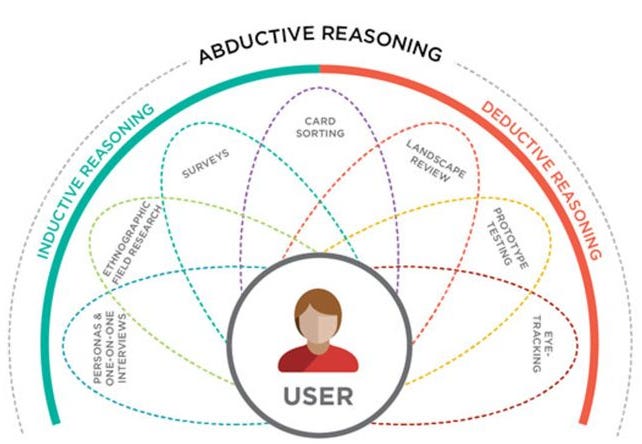
This diagram shows that the design process isn't a linear application of one logic. It's a continuous cycle:
- You start with inductive methods (e.g., interviews, ethnographic research) to gather specific observations and build a rich understanding of the user's world.
- From these observations, you make an abductive leap—you form a hypothesis about an unmet need, a "job-to-be-done," or a new value proposition that could exist. This is where you might use card sorting to explore users' mental models or create personas to embody your insights.
- You then use deductive methods to test that leap. You build a prototype and run a test with the logic: "If my hypothesis (the new value prop) is true, then users should be able to complete this task easily and find it valuable." Eye-tracking and prototype testing are tools for validating or falsifying your abductive hypothesis.
From Abduction to Action: The Insight and the Bet
In a business context, an abductive leap isn't just a creative fancy; it's the foundation for a strategic choice. The tech and startup world has a useful vocabulary for this, framing abduction as the combination of an "insight" and a "bet."
The following article from Ribbonfarm provides a sharp, practical lens on this idea.
Startups, Secrets, and Abductive Reasoning — Ribbonfarm
This article translates the philosophical concept of abduction into the high-stakes world of startups and strategy. It's a great practical guide to making and evaluating abductive leaps.
Please read the following sections: Start with The Three Kinds of Logical Reasoning for a quick recap of the definitions in a business context. Next, read the sections Forming Abductions. Focus on the core idea that an abduction consists of an insight and a bet. Then, read the section on Insights. Notice how insights are built upon the groundwork laid by inductive and deductive reasoning (domain experience, watching the market). Finally, read the section on Bets, which frames the strategic choice as a calculated risk based on a unique insight.
This "Insight + Bet" model is a powerful way to structure your strategic work. The insight is the product of your inductive research and deductive analysis—your "prepared mind." It’s the answer to "What do I know/see that others don't?" The bet is the abductive leap—the choice you make based on that insight, in the face of uncertainty.
When P&G created the Olay "masstige" category that Roger Martin described, their insight was that women aged 35-50 were an underserved segment who disliked the pushy department store experience but wanted a higher-quality product than typical drugstore offerings. Their bet was that they could create a new category in between, with a prestige-like experience in a mass channel. That wasn't a conclusion derived from a spreadsheet; it was an abductive leap that created a multi-billion dollar business.
Conclusion
In this lesson, we have formalized the cognitive toolkit of the strategist, moving from the where of strategic design to the how.
Here are the key takeaways:
- Three Modes of Thought: Strategic thinking cycles through three logics. Deduction proves what must be, induction generalizes what likely is, and abduction hypothesizes what might be.
- Abduction is the Engine of Novelty: While analysis (deduction and induction) is crucial for understanding the present, abduction is the only form of reasoning that generates genuinely new ideas and strategies.
- Design as Abductive Practice: Your background as a designer has implicitly trained you in abductive reasoning. The challenge and opportunity is to make this process explicit, rigorous, and communicable.
- Insight + Bet: A strategic abduction is a bet on a better future, grounded in a unique insight. The insight comes from rigorous research; the bet is a courageous creative leap.
In our next and final lesson for this module, we will put this entire toolkit to use. We will deconstruct a landmark strategy case, identifying its core strategic principles and moves. You will be asked to identify the inductive observations, the deductive analyses, and, most critically, the pivotal abductive leaps that defined the company's success.