Hello! Welcome to your new lesson.
In our last session, we learned how to open a professional update by introducing yourself, your role, and your topic. This gives you a strong, confident start. Now, it's time to deliver the core message.
Today's lesson continues Module 3: Giving Structured Professional Updates. Our goal is to learn vocabulary for describing progress and project status. As a technical consultant, you frequently need to report on how projects are going. This lesson will give you the precise words and phrases to describe whether a project is on time, facing delays, or hitting its targets, ensuring your team and managers are always well-informed.
1. The Language of Project Status
Professionals often use reports and dashboards to track project health. Before we learn the words, let's look at what they describe. Notice the key status words in these two typical project reports.
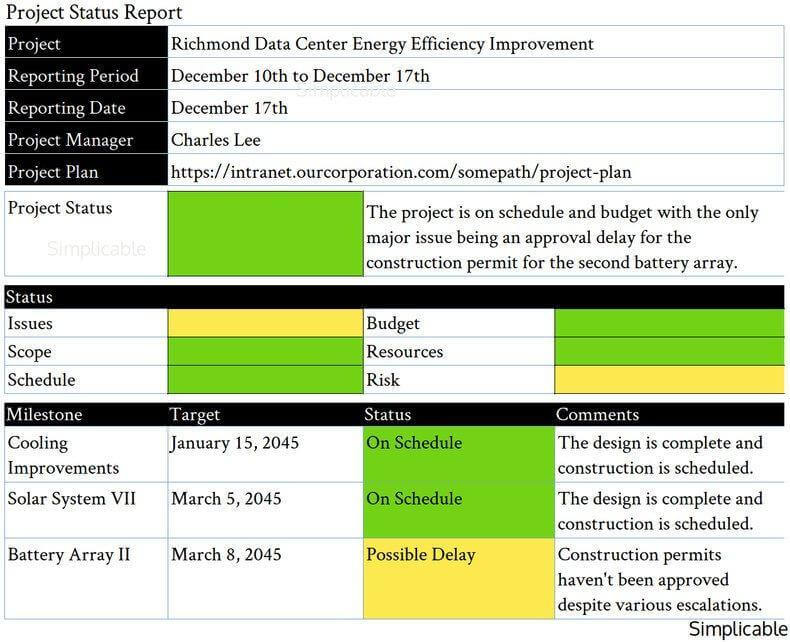

These reports show that the most important information in a project update is about schedule, budget, and task completion. Let's learn the vocabulary for each.
2. Talking About Schedules and Deadlines
The most common question in a project update is: "Are we on time?" The following video will teach you the essential phrases to answer this question clearly. You'll learn how to talk about the project schedule and manage deadlines.
40+ Vocabulary & Phrases For Project Management | Business English
Watch this section from the video '40+ Vocabulary & Phrases For Project Management' by Derek Callan. It covers the core vocabulary for project schedules and deadlines.
Watch the segment from 04:46 to 08:01. Focus on these two groups of phrases: Schedule Status: on schedule, behind schedule, ahead of schedule. Deadline Actions: set a deadline, meet a deadline, miss a deadline, extend a deadline.
Here’s a summary of those key phrases:
| Phrase | Meaning | Example for a Technical Consultant |
|---|---|---|
| On schedule | The project is progressing as planned. | "The network upgrade is on schedule." |
| Behind schedule | The project is late. | "We are behind schedule with the testing phase." |
| Ahead of schedule | The project is progressing faster than planned. | "Good news, we are ahead of schedule on the server deployment." |
| Meet the deadline | To finish on time. | "We are working hard to meet the deadline for the client report." |
| Miss the deadline | To fail to finish on time. | "We missed the deadline because of unexpected hardware failures." |
| Extend the deadline | To move the deadline to a later date. | "We need to extend the deadline by one week." |
3. Talking About the Budget
After the schedule, the budget is often the next most important topic. The next short clip from the same video teaches the three simple phrases you need.
40+ Vocabulary & Phrases For Project Management | Business English
Now, let's learn how to talk about money. Watch this clip to learn the phrases for describing the project's budget.
Watch from 03:46 to 04:46. Listen for the phrases over budget, under budget, and on budget.
- Over budget: Using more money than planned.
- Example: "The project is over budget because we had to buy more licenses."
- Under budget: Using less money than planned.
- Example: "We finished the data migration under budget."
- On budget / Within budget: Using the planned amount of money.
- Example: "We are working hard to keep the project on budget."
Test your understanding!
Imagine your manager asks for a quick update on the "System Upgrade" project. The project is on time, but it is costing more money than planned. How would you describe this status in one sentence using the vocabulary we just learned?
Show answer
A good answer would be: "The System Upgrade project is on schedule, but it is currently over budget."
4. Describing Progress on Specific Tasks
When you give an update, you also need to talk about which specific tasks are finished and which are not. A very common and professional way to do this in English is by using the present perfect tense with the words already, yet, and still.
This next video explains exactly how to use these words to report on task status.
40+ Vocabulary & Phrases For Project Management | Business English
This video section focuses on using specific grammar to communicate task completion. It's a very practical way to give clear updates.
Watch from 08:01 to 13:59. Pay close attention to the examples for already, yet, and still. Try to say the sentences with the presenter to practice pronunciation.
Here is a quick reference:
- Use
alreadyto emphasize that a task is completed.- "We have already deployed the new software patch."
- Use
yetin negative sentences and questions to talk about something that has not happened.- "We haven't received the client's approval yet."
- "Have you finished the system analysis yet?"
- Use
stillin negative sentences to show you are surprised or annoyed that a task is not finished.- "We still haven't fixed the main bug."
5. Sounding More Natural: Phrasal Verbs for Progress and Problems
To sound more fluent and natural in meetings, native speakers often use phrasal verbs. These are short, professional, and very common. The following video introduces phrasal verbs that are perfect for describing progress and challenges.
Sound Fluent & Professional: English Phrases for Meetings & Updates
In this video from Speak Confident English, you will learn phrasal verbs that make your updates sound more confident and natural.
Watch from 05:55 to 13:19. The first part is about describing progress, and the second is about discussing delays and problems. Note down 2-3 phrases you think are most useful for your work.
Here are some of the most useful phrasal verbs from the video:
For Describing Progress:
- move forward with: To progress to the next stage.
- "We are ready to move forward with the user testing phase."
- carry on with: To continue an activity.
- "We will carry on with the development as planned."
- work on: To be actively engaged in a task.
- "Our team is working on the final report."
For Describing Problems:
- run into: To encounter an unexpected problem.
- "We ran into an issue with the database compatibility."
- hold up: To cause a delay.
- "The final approval is holding up our timeline."
- push back: To postpone or delay something.
- "We have to push back the launch date by two weeks."
6. Putting It All Together: Key Phrases for Your Update
Finally, let's look at some simple, professional phrases that you can use to introduce your status update. These phrases act as signals to your audience, telling them you are about to report on progress.
120+ Useful and Impressive Words for Meetings
This article from Preply contains a great list of phrases for meetings. We will focus only on the section for sharing updates.
Read the short section titled 'Sharing updates'. Notice phrases like 'The current status is...' and 'Our recent milestones include...'. These are excellent ways to begin your update.
Here are some of the best phrases to start your progress report, combining what we've learned:
- "Here’s the current status: We are on track to meet the deadline."
- "To update you on our progress: We have already completed the first phase, and we are now working on the second."
- "The latest update is that we ran into a small issue, but we are still on schedule."
- "Our recent milestones include finishing the initial design and getting it approved. We haven't started development yet."
Conclusion
Excellent work! You now have a solid vocabulary for talking about project status like a professional. You can clearly state whether a project is on time and on budget, describe which tasks are complete, and use more natural phrasal verbs to discuss progress and challenges.
Key Takeaways:
- Describe schedule status with on schedule, behind schedule, or ahead of schedule.
- Describe budget status with on budget, over budget, or under budget.
- Use
already,yet, andstillto report the status of specific tasks. - Use phrasal verbs like
move forward with(progress) andrun into(problems) to sound more fluent. - Start your update with phrases like "The current status is..." or "To update you on our progress...".
Preview of the Next Lesson:
Now that you have the vocabulary, the next step is to organize it. In our next lesson, you will learn how to outline a short project update using a 'What I did, What I'm doing, What's next' structure. This will help you present your updates in a logical, clear, and confident way.