Hello! Welcome to your next English lesson.
In our last session, we focused on connecting your ideas using conjunctions like 'and', 'but', and 'so'. That skill helps you present your thoughts clearly. Today, we'll work on the other side of the conversation: how to get information from others by asking clear and effective questions.
This lesson addresses the learning outcome: Form clear questions to request information and clarification. As a technical consultant, asking the right questions is essential. You need to gather information from clients, understand the details of a problem, and confirm that everyone in a meeting is on the same page. Mastering this will make your professional conversations much more effective.
1. The Two Main Types of English Questions
In English, we have two basic types of questions. Understanding the difference is the first step to asking them correctly.
- Closed Questions (or Yes/No Questions): These are questions that can be answered with a simple "yes" or "no". They are used to confirm information.
- Example: "Is the server running?" (Answer: Yes, it is. / No, it isn't.)
- Open Questions (or WH- Questions): These questions use words like What, Where, When, Why, How, and Who. They are used to get more detailed information.
- Example: "What is the problem with the server?" (Answer: The memory usage is too high.)
This video provides an excellent overview of the structure for both types of questions.
Asking Questions in English | Question Structure | Fix Your Grammar Mistakes!
The video 'Asking Questions in English' from mmmEnglish clearly explains the fundamental structure of English questions. It will show you the building blocks you need.
Watch from the beginning (01:13) to 06:13. Pay close attention to: The four main parts of a question (Question word, Auxiliary verb, Subject, Main verb). The difference between 'closed questions' and 'open questions'.
2. The Golden Rule: QUASM
As the video explained, most English questions follow a consistent structure. You can remember it with the acronym QUASM:
Question Word - Auxiliary Verb - Subject - Main Verb
| Question Word | Auxiliary Verb | Subject | Main Verb | Rest of sentence |
|---|---|---|---|---|
| (none) | Do | you | have | the access code? |
| (none) | Is | the system | running | now? |
| Where | did | you | find | the error? |
| How | can | we | improve | the performance? |
Important Note: The auxiliary verb (the "helping" verb) changes to match the subject and the tense.
- Do you need help? / Does the client need help?
- Have you finished? / Has she finished?
- Were they in the meeting? / Was he in the meeting?
This is a crucial point. For a clear summary, you can review the tables in the following resource. They provide simple, direct examples of how to form these questions.
The webpage 'Making Questions' from the University of Victoria's Study Zone offers clear tables that show how to form Yes/No and WH- questions. It's a great quick reference.
Scroll down and look at the tables under 'Making a Question with a “To Be” Verb', 'Making a Question with “Do” or “Does”', and 'Information Questions'. You don't need to read everything, just review the examples in the tables.
Test your understanding!
A colleague makes this statement: "The new software update causes a problem on Windows machines."
How would you ask:
- A closed (Yes/No) question to confirm the problem?
- An open (WH-) question to get more information about the problem?
Show answer
- Closed Question: "Does the new software update cause a problem?" or "Is there a problem with the new software update?"
- Open Question: "What problem does the new software update cause?" or "Why does the update cause a problem?"
3. Asking for Information in a Technical Context
In your work, you will often need to ask for specific information. Open (WH-) questions are perfect for this. Look at these examples of technical interview questions. They are all open questions designed to get detailed information.
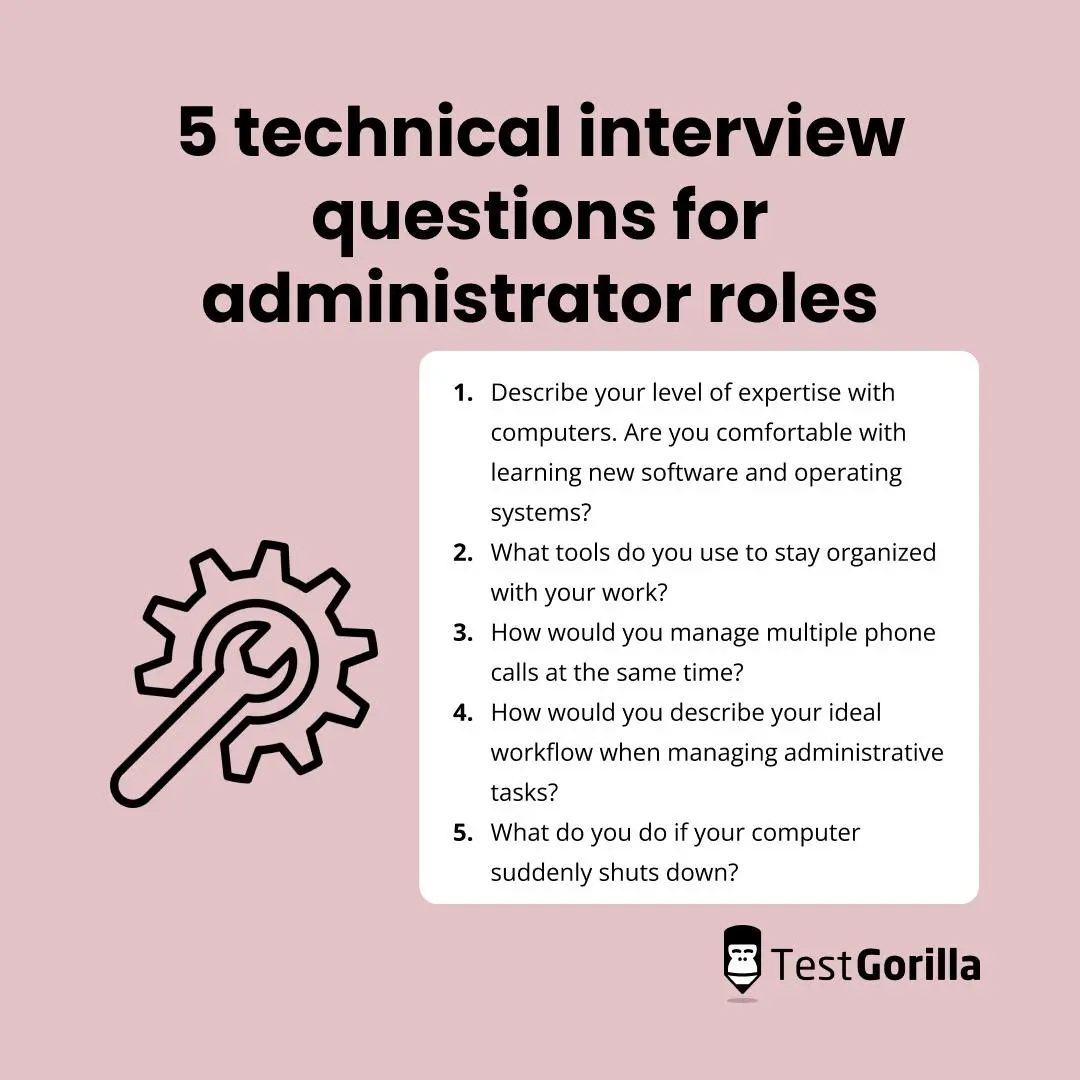
Your own questions might be about a project status or a technical issue:
- "When is the deadline for this task?"
- "What are the requirements for the new system?"
- "How can I reproduce the bug?"
4. Asking for Clarification and Repetition
Sometimes, the problem isn't a lack of information, but a lack of understanding. In a fast-paced meeting, or when someone uses unfamiliar words, you need to ask for clarification politely. Simply saying "I don't understand" can sometimes interrupt the flow.
This article provides professional phrases you can use to check your understanding without sounding unprofessional.
9 Phrases to Check Understanding in Business Meetings
The article '9 Phrases to Check Understanding in Business Meetings' gives you polite and effective ways to ask for clarification, ask for more details, or ask someone to repeat themselves.
Read all three sections: 'Phrases for Clarifying,' 'Phrases for Asking for More Detail,' and 'Phrases for Asking to Repeat Information.' Think about which phrases would be most useful in your work meetings.
Here are some of the most useful phrases from the article:
- To confirm your understanding:
- "Just to clarify, are you saying we need to delay the launch?"
- "So what you're saying is... the issue is with the database connection?"
- To ask for more information:
- "Would you mind elaborating on that?"
- "Could you provide more details on the new security protocol?"
- When you can't hear or didn't catch something (especially in online meetings):
- "Sorry, I didn't catch that. Can you say that again?"
- "You're breaking up a little. Could you repeat the last part?"
Test your understanding!
Imagine your manager says, "We need to action the key takeaways from the Q2 synergy meeting." This is unclear. Choose a professional phrase from the list above to ask for clarification.
Show answer
Several options are good. For example:
- "Just to clarify, what were the key takeaways from that meeting?"
- "Could you provide more details on what needs to be actioned?"
Conclusion
Excellent work today. Knowing how to form questions correctly and politely is a critical skill for any professional, especially in a technical role. It shows you are engaged and helps prevent misunderstandings.
Key Takeaways:
- There are two main question types: Closed (Yes/No) questions to confirm, and Open (WH-) questions to get details.
- Most questions follow the QUASM structure: (Question Word) + Auxiliary Verb + Subject + Main Verb.
- In meetings, use polite phrases to ask for clarification, such as "Just to clarify..." or "Could you elaborate on that?"
Preview of the Next Lesson:
You have now completed the "Essential Grammar" module. You can form statements, connect them logically, and now ask questions about them. In our next lesson, we will move into Module 3: Giving Structured Professional Updates. You will start putting all these skills together by learning how to use standard phrases to introduce yourself, your role, and the topic of your update. This will be your first step towards building a complete, confident status report.