¡Hola! Welcome back.
In our last lesson, you learned how to give simple, direct instructions during playtime, using phrases like ¡Tira la pelota! and ¡Comparte los juguetes!. This gave you a great toolkit for guiding activities.
Today, we're shifting from actions to feelings. Understanding and talking about emotions is at the heart of connecting with a child. This lesson will help you identify and name basic emotions in Spanish, a skill that's fundamental for comforting, praising, and simply understanding your son's world. By the end of our time, you will be able to name the four core emotions: feliz (happy), triste (sad), enfadado (angry), and cansado (tired).
1. Your Core Emotion Vocabulary
Let's start by learning the four key words for today. These are emotions you and your son experience every single day. We'll use a helpful guide written for parents to get a clear list.
Emotions in Spanish for Kids: A Parent's Guide to Teaching...
The article 'Emotions in Spanish for Kids' has a perfect little table with our target vocabulary. It's a great starting point.
Please read the short section titled 'Basic Emotions in Spanish Every Kid Should Know'. Focus on the four words from our learning outcome: Feliz, Triste, Enojado/a, and Cansado/a. Note: The word for 'angry' in the table is Enojado/a, which is a common synonym for Enfadado/a. We will focus on Enfadado/a as it appears in our other resources and the learning outcome, but it's good to know both exist.
Here are your four essential emotion words:
Feliz(Happy)Triste(Sad)Enfadado(Angry)Cansado(Tired)
Now, let's hear them spoken and see the expressions that go with them.
Classroom Spanish: Feelings and Emotions in Spanish
This video will help you with pronunciation. Listen carefully and try to repeat the words. The speaker also uses simple sentences like Estoy feliz (I am happy), which is a great preview for our next lesson.
Watch the following short clips: Feliz (Happy): from 1:44 to 2:29 Triste (Sad): from 2:29 to 2:52 Angry: from 2:52 to 3:16. (As noted, the video uses the synonym enojado) Cansado (Tired): from 3:16 to 3:40 Pay attention to how the words sound and try repeating them.
2. A Quick but Important Grammar Point: Masculine & Feminine
You may have noticed that enfadado and cansado sometimes end in -o and sometimes in -a. This is a key feature of Spanish. Adjectives (describing words) often change to match the gender of the person they are describing.
- Use the -o ending for a male (like your son, or yourself):
Él está cansad**o**.(He is tired.)Papá está enfadad**o**.(Dad is angry.)
- Use the -a ending for a female:
Mamá está cansad**a**.(Mom is tired.)La niña está enfadad**a**.(The girl is angry.)
What about feliz and triste? They are simpler! They stay the same for both masculine and feminine.
El niño está **triste**.(The boy is sad.)La niña está **triste**.(The girl is sad.)
This visual chart is a fantastic tool to help you and your son remember these words and their forms.
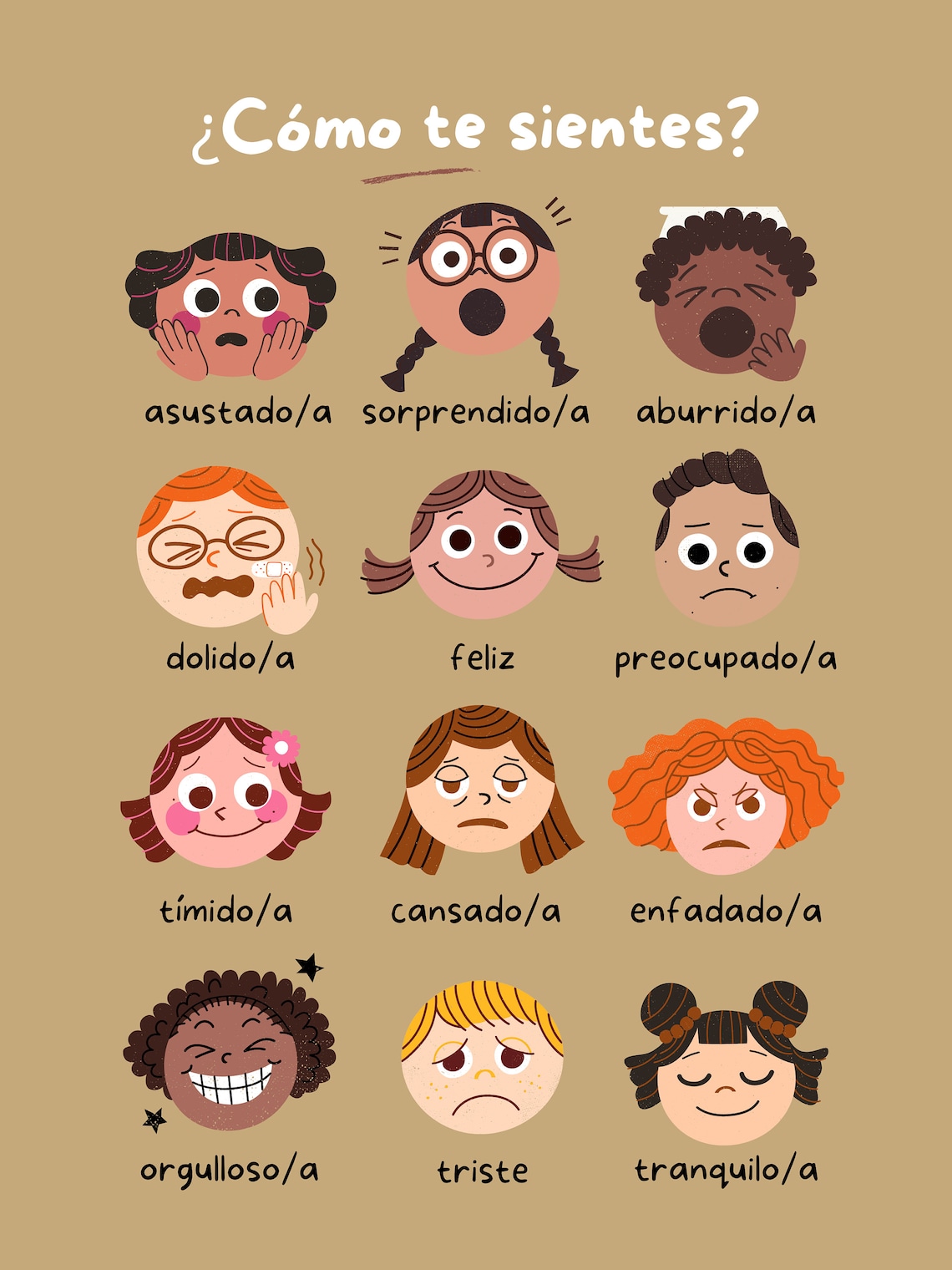
3. Practice for Real Life
How can you apply this? When you see your son is feeling something, you can name the emotion.
- Sees him yawning after a long day at the park: "Estás cansado." (You are tired.)
- Sees him smiling while opening a gift: "¡Estás feliz!" (You are happy!)
- Sees him crying because a toy broke: "Oh, estás triste." (Oh, you are sad.)
This simple act of naming the feeling is powerful for language acquisition and emotional connection.
Test your understanding!
For each situation, which of the four emotion words would you use? Remember to choose the correct -o or -a ending where needed.
- Your son is smiling and laughing while playing with blocks. He is _______.
- Your daughter didn't get the snack she wanted and is pouting. She is _______.
- It's late, and your son keeps rubbing his eyes. He is _______.
- Another child took your son's favorite toy car. He is _______.
Show answer
felizenfadada(ortriste, depending on the pout!)cansadoenfadado
4. Making it Fun: Learning with a Song
Children learn incredibly well through music. Here is a popular kids' song about emotions. It’s catchy and a perfect activity to do with your son. You can sing it together and make the faces for each feeling.
La canción de las emociones 😭🤢🤩 Canciones infantiles con Cleo y Cuquín
Let's learn a song! 'La canción de las emociones' by Cleo y Cuquín is designed for young children. It will help reinforce the words feliz, triste, and enfadado in a fun, memorable way.
Listen to the song. You don't need to understand every word, just focus on identifying the parts about: triste (sad): from 0:00 to 0:24 enfadado (angry): from 1:50 to 2:10 feliz (happy): from 2:31 to the end
Watching and singing this song together is a fantastic way to practice these new words in a low-pressure, playful context.
Conclusion
¡Muy bien! You've just learned one of the most important sets of vocabulary for connecting with your son in Spanish.
Key Takeaways:
- You can now name four basic emotions:
feliz(happy),triste(sad),enfadado(angry), andcansado(tired). - You learned that adjectives like
enfadadoandcansadochange their ending to-ofor masculine and-afor feminine. - You have practical tools, like the emotion chart and the children's song, to practice these words with your son.
Next Steps
In our next lesson, we will take this knowledge and put it into full sentences. You've had a small preview today with phrases like estoy feliz. Next time, we will officially learn how to use the verb estar (to be) to say how you are feeling (Estoy feliz) and to describe how others are feeling (Él está cansado).
¡Hasta luego