¡Hola! Welcome back.
In our last lesson, we focused on describing actions as they happen, using phrases like él corre (he runs) or yo dibujo (I draw). This was a great step towards narrating your playtime with your son.
Today, we'll build on that by learning how to direct the play. You'll learn how to give simple, friendly instructions, which is a crucial part of interacting with a young child. By the end of this lesson, you will be able to give key instructions during play, focusing on the phrases tira la pelota (throw the ball) and comparte los juguetes (share the toys), along with other useful commands to make your playtime in Spanish even more interactive.
1. Giving Instructions: The "Tú" Command
When you give a direct instruction to one person you know well, like your son, you use a special verb form called a command (or the imperative mood). In Spanish, these are often called tú commands.
Don't worry about complex grammar rules. For your purposes, we can learn these as simple, set phrases. A very common pattern for verbs ending in -ar (like hablar, mirar, saltar) is that the command form is the same as the él/ella form you learned in the last lesson.
-
él mira= he looks -
¡Mira!= Look! -
ella salta= she jumps -
¡Salta!= Jump!
We'll learn other verbs as vocabulary. The key is to see them as direct, friendly instructions.
2. Instruction #1: Throwing and Giving
Let's start with a classic playtime action: throwing a ball. The verb for "to throw" is tirar.
- Instruction:
¡Tira la pelota!(Throw the ball!)
This phrase combines the command tira with la pelota (the ball), a noun you'll remember from our early lessons.

A similar and often gentler instruction is to ask for something to be given to you. The verb for "to give" is dar.
- Instruction:
¡Dame la pelota!(Give me the ball!)
The following video shows a related phrase in action.
BASIC SPANISH PHRASES FOR PARENTS - SPEAK SPANISH WITH KIDS - SPANISH FOR BEGINNERS
The video 'BASIC SPANISH PHRASES FOR PARENTS' shows a parent instructing a child during play. It uses a variation of the phrase we just learned.
Watch the short clip from 01:43 to 01:54. You will hear the phrase Dale la pelota a tu hermana (Give the ball to your sister). Notice how the parent gives a clear, simple instruction.
By changing who receives the ball, you can create many useful phrases:
Dale la pelota a papá.(Give the ball to dad.)Dame la pelota.(Give me the ball.)
3. Instruction #2: Sharing is Caring (Compartir)
Sharing is a key social skill you're likely teaching your son, and saying it in Spanish will reinforce the concept. The verb for "to share" is compartir.
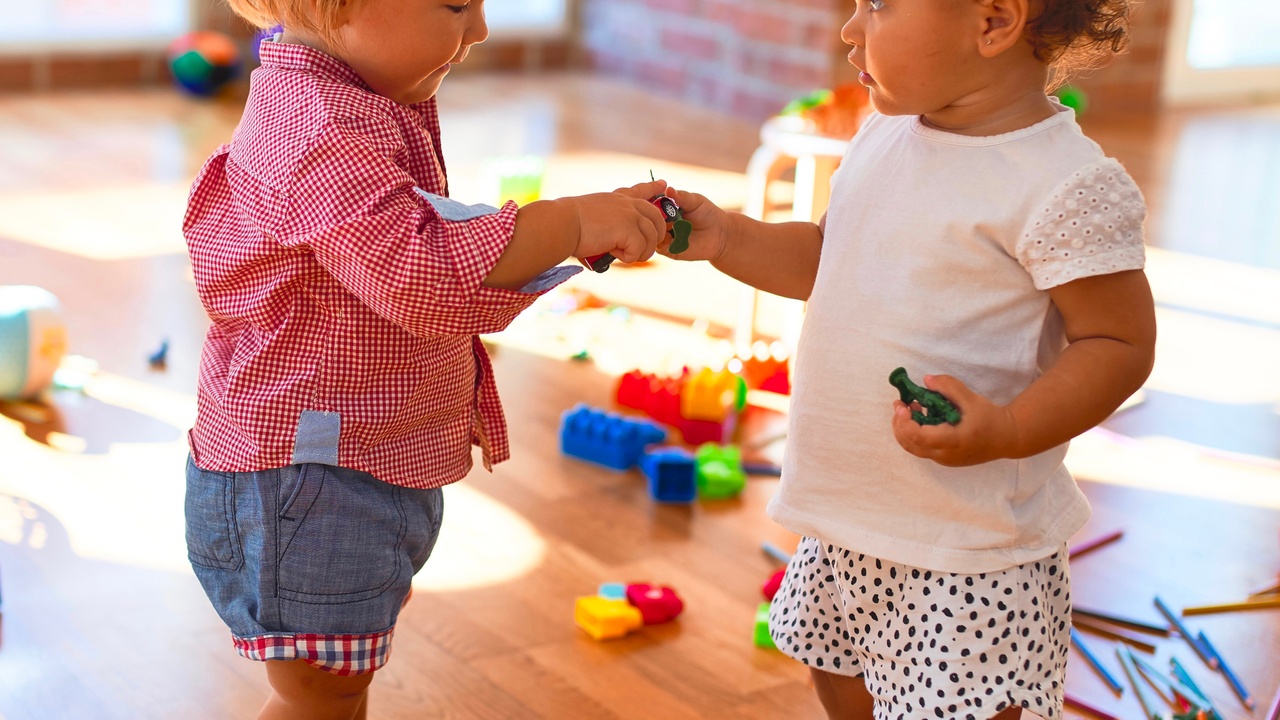
This next resource provides the exact phrases we need and explains the cultural context of sharing.
The article '+30 Phrases for Preschool Social Skills' is a great guide for exactly this topic. It introduces the vocabulary for sharing and taking turns.
Please read the section titled 'Palabras para Compartir (Words for Sharing)'. Focus on the words Compartir (To share) and Tomar Turno (To take turns). These are fundamental concepts for cooperative play.
The most direct way to encourage sharing is with this command:
- Instruction:
¡Comparte los juguetes!(Share the toys!)
You can find this exact phrase and others in the helpful list below.
The article '67 tú commands in Spanish' from Baselang provides clear, practical lists of commands for parents. We will focus on the list for use at home.
In the section 'At Home – En casa', look at the table under 'Affirmative tú commands'. Find the phrases Comparte tus juguetes (Share your toys) and Recoge tus juguetes (Pick up your toys). These are two of the most useful instructions you can learn for playtime.
Notice the use of tus juguetes (your toys). In our earlier lessons, you learned mi (my) and tu (your). Tus is simply the plural form, used when talking about more than one toy.
4. Expanding Your Playtime Instruction Toolkit
To round out your skills, let's add a few more one-word commands that are incredibly useful for getting attention, managing activities, and cleaning up.
The following video is for a classroom setting, but the commands are universal for directing a child's attention.
This video, 'Classroom language in Spanish', teaches essential commands. We will pick out the ones most useful for you at home.
Watch two short segments: From 0:55 to 1:45, you will learn Escucha (Listen), Mira (Look), and Para (Stop). From 5:49 to 6:20, you will learn Recoge (Pick up). Listen for how the presenter explains what they mean and how they can be used.
Here is a summary of your new toolkit:
| Spanish Command | English Meaning | When to use it |
|---|---|---|
¡Mira! |
Look! | To draw your son's attention to something interesting. |
¡Escucha! |
Listen! | When you want him to listen to a sound, music, or you. |
¡Para! |
Stop! | To pause a game or an action. |
¡Recoge! |
Pick up! | For cleaning up. You can say ¡Recoge los juguetes! |
¡Ven aquí! |
Come here! | To call your son over to you. (From the Spanish.academy article) |
Test your understanding!
Imagine you're playing with your son. What Spanish instruction would you use in these situations?
- The toys are all over the floor, and it's time to clean up.
- You have a ball, and you want him to play catch with you.
- He is about to run into the street while chasing a ball.
- Another child has arrived, and you want your son to let them play with the blocks too.
Show answer
¡Recoge los juguetes!(Pick up the toys!)¡Tira la pelota!(Throw the ball!) or¡Dame la pelota!(Give me the ball!) if he has it.¡Para!(Stop!) - This is also a key safety command.¡Comparte los juguetes!(Share the toys!)
Conclusion
¡Excelente! You've now learned a set of practical, essential commands to guide playtime and encourage positive behaviors like sharing and cleaning up.
Key Takeaways:
- You learned to give instructions using the informal command form (
túcommands). - Your two key phrases are
Tira la pelotaandComparte los juguetes. - You expanded your toolkit with versatile one-word commands:
Mira,Escucha,Para,Recoge, andVen aquí. - These phrases not only make playtime in Spanish more interactive but also help with teaching important social skills.
Next Steps
So far, we've focused on actions: suggesting them, describing them, and now directing them. But play also involves a lot of feelings. In our next lesson, we will shift our focus to emotions. You'll learn how to ask your son how he's feeling and to name basic emotions like feliz (happy), triste (sad), and enfadado (angry).
¡Hasta la próxima