¡Hola! Welcome back.
In our previous module, we built a great foundation with greetings and basic introductions. You can now start a simple conversation, which is a fantastic first step.
Today, we are starting a new module, "Our Family & Home." The goal of this first lesson is to identify immediate family members: mamá (mom), papá (dad), hijo (son), and hija (daughter). This vocabulary is at the heart of your goal to communicate with and about your son, allowing you to start naming the most important people in his world in Spanish.
1. Mamá and Papá: The Words for Parents
Let's begin with the most common and affectionate words for parents, which you'll use constantly with your son.
mamá(mom)papá(dad)
These are the words children use, making them perfect for your conversations at home.
The following video is designed for children, so it introduces these words in a simple, clear, and repetitive way. You might even find it helpful to watch with your son.
Family members in Spanish! | Spanish for kids
This video from 'happygolingo' is a fun way to hear mamá and papá used in a simple context. Listen for the question ¿Quién es? (Who is it?).
Watch the first part of the video, from the beginning to 01:05. Pay close attention to the pronunciation of mamá and papá.
Formal vs. Informal
Just as we saw with ¿Cómo estás? vs. ¿Cómo está?, Spanish has more formal words for parents:
madre(mother)padre(father)
You would typically use madre and padre in more formal writing or when speaking about parents in a more detached or respectful way. For everyday chat with your family, mamá and papá are your go-to words.
A crucial point to remember is the accent mark. Please read the following short text to understand why it's so important.
Family in Spanish: All the Essential Words & Phrases
This article from Preply clearly explains the use of both formal and informal words for parents. It also highlights the importance of the accent mark, which changes the meaning of the word.
Read the section titled 'Parents'. Focus on the difference between mamá/papá and madre/padre, and the note about the accent mark on the final syllable.
To summarize the key point from the reading:
papá(with an accent) means "dad".papa(without an accent) means "potato". A small detail with a big difference in meaning!
2. Hijo and Hija: The Words for Children
Now, let's learn the words for son and daughter.
hijo(son)hija(daughter)
You might notice a pattern here that connects back to our first module. Remember learning about el and la? Spanish nouns have a gender. Generally, masculine words end in -o and feminine words end in -a.
el hijo(the son)la hija(the daughter)
This image provides a simple visual for these four core family words.

To practice pronunciation for all four words, let's watch a short vocabulary video.
Spanish Vocabulary: family members in Spanish
The 'Spanish With Liliana' channel offers clear and concise pronunciation. This clip will allow you to hear and repeat the words for mother, father, son, and daughter.
Watch from 00:30 to 01:05. Listen carefully to the pronunciation of madre, mamá, padre, hija, and hijo, and try repeating them out loud.
Test your understanding!
Imagine you are at the park with your son and another parent asks you in English, "Is that your daughter?" You know from our previous lessons how to say "no." How would you correct them in Spanish, pointing to your son?
"No, es mi _______."
Show answer
"No, es mi hijo."
Since your son is male, you would use hijo.
A Practical Tip: Use Your Family Photos
One of the best ways to practice this new vocabulary is to make it personal. This idea is adapted from a lesson plan for teaching children, and it's perfect for your situation.
Grab your phone or a few printed photos of your family. As you look at them with your son, point to the people and say the Spanish words:
- Pointing to your wife/partner: "
la mamá" - Pointing to yourself: "
el papá" - Pointing to your son: "
el hijo"
This simple activity directly connects the words to the people they represent, making them easier to remember for both you and your son.
Key Takeaways
¡Buen trabajo! You've just learned the essential building blocks for talking about your family.
- The common, informal words for parents are
mamáandpapá. - The more formal words are
madre(mother) andpadre(father). - The word for son is
hijo, and the word for daughter ishija. - These words follow the general Spanish gender rule:
ofor masculine andafor feminine.
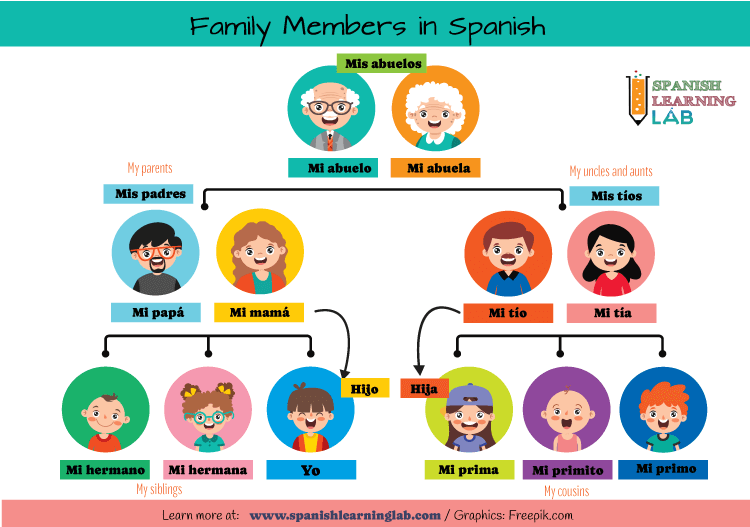
This family tree provides a nice visual summary of the words we learned today in the context of a whole family.
Next Steps
Now that you can identify your immediate family, the next logical step is to form simple sentences with these words. In our next lesson, we will learn how to use the verbs ser (to be) and estar (to be) for basic identification. You'll move from just saying "hijo" to forming the complete thought, "Es mi hijo" (He is my son).
¡Hasta la próxima