¡Hola! Welcome to your next lesson.
In our last session, we learned how to make introductions using Me llamo... (My name is...) and Se llama... (His/her name is...). This was a fantastic step towards being able to introduce yourself and your son in Spanish.
Today, we'll learn the natural follow-up to any introduction: asking how someone is. Our goal is to confidently say and respond to "¿Cómo estás?" with "bien, gracias". This simple exchange is the backbone of polite, everyday conversation and will be incredibly useful when you meet teachers at your son's school or other parents in the park.
1. Asking the Question: "¿Cómo estás?"
Just like in English, after saying hello, it's common to ask "How are you?". The most common way to say this in Spanish is:
¿Cómo estás?(How are you?)
This is the informal way to ask, which you would use with friends, people your age, and children—including your son!
However, when speaking to someone you want to show more respect to, like a teacher, an older person, or someone you've just met in a formal setting, you use a slightly different version:
¿Cómo está?(How are you? - formal)
Notice the only difference is the 's' at the end of estás. This is a small but important distinction in Spanish.
Let's look at a resource that lays this out clearly and lets you hear the pronunciation.
How to say "hello" and "goodbye" in Spanish
This page from The Spanish Experiment provides clear, simple explanations for the formal and informal ways to ask "How are you?". It also includes audio buttons so you can hear how each phrase is pronounced.
Scroll to the section titled 'How to say "how are you?"'. Read the explanations for ¿Cómo está? (formal) and ¿Cómo estás? (informal). Be sure to click the 'Play' button for each to practice your listening and pronunciation.
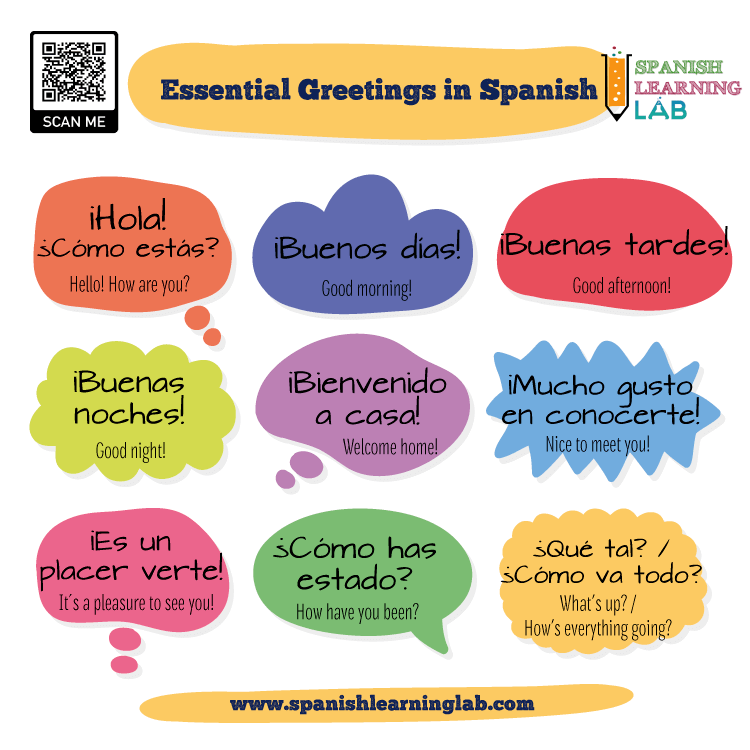
This visual can also help you remember the phrase as part of a standard greeting.
2. The Standard Response: "Bien, gracias."
When someone asks you ¿Cómo estás?, the most common and polite response is simple.
Bien, gracias.(Fine/Well, thank you.)
Just as in English, it's polite to ask the question back. You can do this by adding:
¿Y tú?(And you? - informal)
¿Y usted?(And you? - formal)
So, a full, polite exchange would be:
- Person A:
¿Cómo estás? - Person B:
Bien, gracias. ¿Y tú?
Let's watch a video that explains this exchange, and also gives you some extra context.
How are you? in Spanish || Responder ¿Cómo estás? en español.
The host of 'Why Not Spanish?' does a great job of explaining how to respond to ¿Cómo estás?. She also teaches you how to ask the question back naturally.
First, watch from the beginning (00:01) to 01:21. She will cover the question and the standard answers like bien. Then, watch the section from 02:57 to 04:15, where she explains how to use ¿y tú? to politely return the question.
As the video mentions, you will often hear people respond with Muy bien (Very well) or just Bien. For your purposes, Bien, gracias is the perfect, all-purpose reply.
Test your understanding!
You run into one of your son's teachers at the school entrance. She smiles and says, ¡Hola! ¿Cómo está?
What is the most appropriate and complete response?
Show answer
The best response would be: Bien, gracias. ¿Y usted?
You use Bien, gracias to answer her question, and ¿Y usted? (the formal "and you?") because she is a teacher and used the formal ¿Cómo está?.
3. Putting It All Together in a Conversation
Now you have all the pieces for a basic but complete introductory conversation! Let's combine what you learned in the last lesson with today's phrases.
Scenario: You meet your son's teacher for the first time.
- You:
¡Buenos días! Me llamo [Your Name]. Soy la mamá de [Son's Name].(Good morning! My name is [Your Name]. I am [Son's Name]'s mom.) - Teacher:
¡Buenos días! Mucho gusto. ¿Cómo está?(Good morning! Nice to meet you. How are you?) - You:
Muy bien, gracias. ¿Y usted?(Very well, thank you. And you?) - Teacher:
Bien, también. Gracias.(Well, also. Thank you.)
This short dialogue is realistic, polite, and accomplishes a key goal: a positive first interaction with your son's teacher.
To help you get used to the sound of these phrases, here is a short, fun video. It's designed for kids, which is perfect since you're learning to communicate in your son's new environment. You could even watch it with him!
Greetings in Spanish | Spanish for Kids
This 'happygolingo' video uses repetition and song to drill the phrases ¿Cómo estás? and bien, gracias. It's a simple and catchy way to get them stuck in your head.
Watch the segment from 01:16 to 01:51. Listen to the simple call and response between the characters.
Key Takeaways
¡Excelente trabajo! You've now mastered the next step in any basic Spanish conversation.
- To ask someone how they are, you say
¿Cómo estás?(informal) or¿Cómo está?(formal). - The standard, polite reply is
Bien, gracias(Fine, thank you) orMuy bien, gracias(Very well, thank you). - Always remember to ask back with
¿Y tú?(informal) or¿Y usted?(formal).
Practice these exchanges out loud. When you say ¡Hola! to your son, try adding ¿Cómo estás?. The more you use it, the more automatic it will become.
Next Steps
In our next lesson, we will begin Module 2, "Our Family & Home". We will start by learning the Spanish words for immediate family members: mamá (mom), papá (dad), hijo (son), and hija (daughter). This will build directly on phrases you already know, like él es mi hijo, and allow you to talk about your family with more confidence.
¡Hasta la próxima