¡Hola! Welcome back to our mealtime conversations module.
In our last lesson, you learned some essential phrases to manage mealtimes, like ¡a comer! (let's eat!), ¿tienes hambre? (are you hungry?), and ¿quieres más? (do you want more?). Now that you can get the meal started and offer food, it's time to talk about what you and your son actually think of it!
Today, we'll focus on how to express likes and dislikes in Spanish. This is a huge step in building conversation, as it allows you to share opinions and learn about your son's preferences. We will cover the core phrases me gusta (I like) and no me gusta (I don't like). You'll also learn how to ask him, ¿Te gusta? (Do you like it?), turning a simple statement into a real conversation.
1. The Basics: "I like" and "I don't like"
The most fundamental way to express a preference is with the phrase me gusta. Let's start with a clear explanation of how to use it for single items and for actions.
How to Talk About Your Likes and Dislikes in Spanish | Conversation Practice
The video 'How to Talk About Your Likes and Dislikes in Spanish' from the Español Talk channel gives a great introduction. We'll watch the first part where the presenters introduce the basic phrases and give examples.
Watch from 01:38 to 03:33. Pay attention to how 'me gusta' and 'no me gusta' are used with both nouns (like 'la paella') and actions/verbs (like 'ver películas').
As you saw in the video, the structure is straightforward:
Me gusta+ a singular noun:Me gusta la fruta.(I like fruit.)Me gusta+ an action (verb):Me gusta dibujar.(I like to draw.)- To make it negative, just add
no:No me gusta el frío.(I don't like the cold.)
A Common Mistake to Avoid
It’s very common for English speakers to mistakenly say "Yo gusto el chocolate." This is incorrect in Spanish. The verb gustar works a bit differently. A simple way to think about it is that the thing you like is the subject of the sentence. The video you just watched has a great segment explaining this.
How to Talk About Your Likes and Dislikes in Spanish | Conversation Practice
Let's watch one more short clip from the same video. This section focuses on common errors and is extremely helpful for sounding natural.
Watch from 09:02 to 10:27. Focus on the explanation for why you say 'Me gusta el chocolate' and not 'Yo gusto el chocolate'. This is a key point that will help you a lot.
The key takeaway: Always use me gusta, not yo gusto.
2. Liking More Than One Thing: Me gustan
What happens if you like something plural, like vegetables or apples? It's a small but important change: gusta becomes gustan.
Me gusta la manzana.(I like the apple.) - singularMe gusta**n** las manzanas.(I like the apples.) - plural
The same rule applies to the negative form:
No me gusta el guisante.(I don't like the pea.)No me gusta**n** los guisantes.(I don't like the peas.)
The BBC Bitesize article on food preferences explains this very clearly.
Talking about food in Spanish using 'me gusta'
This article, 'Talking about food in Spanish using 'me gusta'', clearly shows the difference between singular and plural forms.
First, read the initial section under 'Giving opinions on food', which introduces 'me gusta' and 'me gustan'. Then, scroll down to the section titled 'Plurals of food' for a specific focus on this rule.
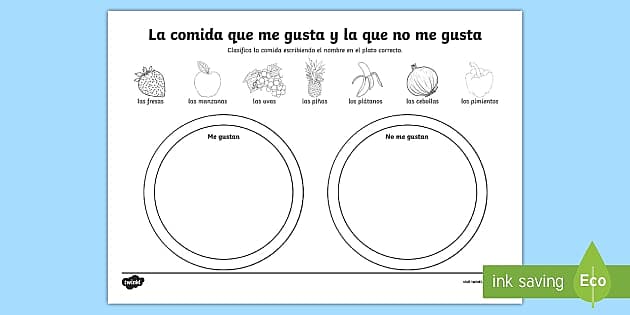
This worksheet provides a perfect visual for practicing the plural form, as it includes items like las fresas (strawberries) and los plátanos (bananas).
Test your understanding!
You want to say that you like the carrots (las zanahorias) your son is eating. What would you say?
Me gusta las zanahorias.Me gustan las zanahorias.
Show answer
The correct phrase is 2. Me gustan las zanahorias. because zanahorias is a plural noun.
3. Asking Your Son: ¿Te gusta?
Now for the conversational part! To ask your son if he likes something, you simply change me (me) to te (you).
¿Te gusta la sopa?(Do you like the soup?)¿Te gustan los bloques?(Do you like the blocks?)
He can then respond with Sí, me gusta(n) or No, no me gusta(n).
Let's return to our first video to see a short dialogue using this question.
How to Talk About Your Likes and Dislikes in Spanish | Conversation Practice
This last clip from the Español Talk video demonstrates how to ask '¿Te gusta?' and carry on a simple conversation about preferences.
Watch from 03:33 to 04:32. Listen for the question '¿Te gusta...?' and the simple 'Sí, me gusta' or 'No, no me gusta' responses.
This simple exchange is the foundation of many conversations you can have with your son about food, toys, activities, and more.
4. Practice for You and Your Son
The best way to master these phrases is to use them in a fun, low-pressure way. Given your goal of communicating with your 3-year-old, turning this into a game is a perfect strategy.
You can create a simple activity like the one shown in the image below. You don't need a fancy worksheet; a piece of paper with a circle drawn on it works just as well!

As you play, you can model the language:
- You: "El pollo... Mmm, me gusta el pollo." (pointing to the 'me gusta' side)
- You: "Ahora tú. ¿Te gusta el pollo?"
- Your son can point, and you can help him with the phrase: "¡Ah, te gusta el pollo!" or "Ah, no te gusta el pollo."
To make it even more engaging, you can sing a song together. This video is designed for young children and is very repetitive and catchy.
The video 'Food (English /Spanish)' from Learning Spanish with Johanna uses a simple song to practice 'me gusta' and 'no me gusta' with different foods. It's perfect for a young child.
Watch this short video (about 2.5 minutes) with your son. The repetition of 'me gusta' and 'no me gusta' will help you both remember the phrases.
Conclusion
¡Excelente! You've just learned one of the most useful and common structures in Spanish.
Key Takeaways:
- To say you like one thing or an action:
Me gusta(e.g.,Me gusta la leche,Me gusta jugar). - To say you like multiple things:
Me gustan(e.g.,Me gustan las frutas). - To make it negative, add
nobefore the phrase:No me gusta(n). - To ask someone else, use
te:¿Te gusta(n)...?. - Remember the key rule: It's
Me gusta el chocolate, neverYo gusto el chocolate.
Start using these phrases at your next meal. Ask your son ¿Te gusta el pan? or ¿Te gustan las verduras?. Sharing opinions is a wonderful way to connect.
Next Steps
In our next lesson, we'll stay at the dinner table but shift our focus to simple instructions. You will learn how to say polite commands like siéntate (sit down) and come despacio (eat slowly), giving you more tools to guide your son during meals.
¡Hasta luego