¡Hola! Welcome back.
In our last lesson, we started our journey into mealtime conversations by learning how to name essential foods like el pan, la leche, el pollo, la fruta, and el agua. Being able to name things is the first step. Today, we'll build on that foundation by learning how to use key phrases to manage the entire mealtime interaction, from calling your son to the table to asking if he wants more.
Your goal for this lesson is to confidently use three crucial mealtime phrases: ¿tienes hambre? (are you hungry?), ¿quieres más? (do you want more?), and ¡a comer! (let's eat!). These are phrases you will use every single day, making them incredibly powerful tools for building your conversational ability and connecting with your son in Spanish.
1. Calling Your Son to the Table
Let's start with the phrase that kicks off every meal. There are a few ways to say "It's time to eat," but we'll focus on the most common and child-friendly options.
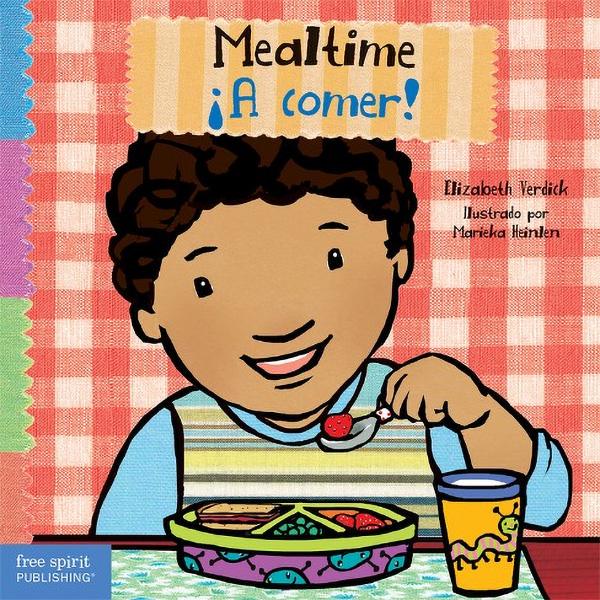
The simplest and most direct way is: ¡A comer! (ah koh-MEHR). This literally means "To eat!" but is used exactly like "Let's eat!" or "Time to eat!". It's short, energetic, and very common.
Another excellent option you will hear is ¡Vamos a comer! (VAH-mohs ah koh-MEHR), which means "Let's go eat" or "We are going to eat."

To see these phrases listed with other useful mealtime expressions, a great resource is the "Common Spanish phrases to use with kids" list from Spanish Playground.
A printable list of common Spanish phrases to use with kids.
The article 'A printable list of common Spanish phrases to use with kids' offers a fantastic, practical list for parents. We will focus on the 'Mealtime' section.
Please read the short 'Mealtime' section of the list. Notice the phrases A comer, Es hora de comer (It's time to eat), ¿Tienes hambre?, and ¿Quieres más?. We will cover the last two in the next sections of this lesson.
Your takeaway: You can use ¡A comer!, ¡Vamos a comer!, or Es hora de comer. Choose one that feels most natural to you and start using it consistently.
2. Asking "Are you hungry?"
Once your son is at the table, a natural question to ask is if he is hungry. In English, we say "I am hungry," but in Spanish, the structure is different. You say you have hunger.
Tengo hambremeans "I have hunger" (I am hungry).¿Tienes hambre?means "Do you have hunger?" (Are you hungry?).
This use of the verb tener (to have) for feelings and states is common in Spanish.
Let's watch a short video designed for children. The main character constantly repeats "Tengo hambre." This will help you get the sound and rhythm of the phrase into your head.
¡TENGO HAMBRE¡ Spanish FOOD VOCABULARY for Kids | Mi Camino Spanish
The video '¡TENGO HAMBRE¡' is a fun way to hear the key phrase 'tengo hambre' used repeatedly in a natural context for a child.
Watch the first 53 seconds of the video. Listen for the repeated phrase 'tengo hambre' (I am hungry). While the video focuses on the child's perspective, it's perfect for you to hear the core expression you will be asking about.
After watching, practice asking the question form: ¿Tienes hambre? (tyeh-ness AHM-breh?). Try to raise the pitch of your voice at the end, as you would when asking a question in English.
3. "Do you want more?"
This is perhaps one of the most useful phrases during a meal. When your son finishes what's on his plate, you can ask him: ¿Quieres más? (KYEH-res mahs?).
This phrase is very direct:
Quieresmeans "you want".Másmeans "more".
A fantastic way to teach this, especially with a young child, is to model the phrase yourself first. This practical tip will help your son understand the meaning through context.
Speak Spanish with your child during meals
The article 'Speak Spanish with your child during meals' provides an excellent strategy for teaching phrases through modeling. It also lists our key phrases in a clear format.
First, read the paragraph that starts 'Comment on what you are doing before you ask your child a question in Spanish.' It gives the specific example of saying 'Quiero más' (I want more) for yourself before asking '¿Quieres más?'. Then, look at the list of phrases that begins with 'Try to use these Spanish phrases at the table:' to reinforce your learning.
By saying Quiero más and serving yourself, and then asking ¿Quieres más? while gesturing towards your son's plate, you make the meaning perfectly clear without needing any translation. This is a core principle of language immersion at home.
Test your understanding!
Let's walk through a mealtime scenario. Put these three phrases in the correct order for a typical meal.
¿Quieres más?¡A comer!¿Tienes hambre?
What order would you use them in?
Show answer
The most logical order would be:
¡A comer!(You call your son to the table.)¿Tienes hambre?(You ask if he's hungry as he sits down.)¿Quieres más?(You ask if he'd like another helping after he's eaten some of his food.)
Key Takeaways
¡Muy bien! You now have the essential phrases to structure a mealtime conversation in Spanish.
- To start the meal:
¡A comer!or¡Vamos a comer! - To check if your son is hungry:
¿Tienes hambre? - To offer another serving:
¿Quieres más?
The key to making these phrases stick is to use them every day. The article "A printable list of common Spanish phrases to use with kids" (resource LINK) has a link to a printable PDF. You could print it and stick it on your fridge as a daily reminder. Repetition in a real-world context is the fastest way you'll internalize these expressions.
Next Steps
Now that you can offer food, the next logical step is to ask if your son likes it. In our next lesson, we will learn how to express likes and dislikes using me gusta (I like it) and no me gusta (I don't like it), and how to ask him ¿Te gusta? (Do you like it?).
¡Hasta la próxima