Welcome to the first lesson of Module 2. In our last session, we focused on the internal work of emotional intelligence, specifically how to identify your triggers and manage your reactions under pressure. That ability to maintain composure is a cornerstone of professionalism and serves as a direct bridge to today's topic.
This lesson kicks off our exploration of how you are perceived by others. We will focus on identifying the key behaviors that build credibility and trust in professional relationships. Trust is the fundamental currency of collaboration. In your current role, it's about the confidence others have in your accuracy and discretion. As you move into the tech and AI space, it will be about the confidence they have in your technical judgment, your reliability in team projects, and your commitment to solving the right problems. Your goal is to understand the components of trust so you can consciously cultivate it.
Deconstructing Trust: The Trust Equation
Trust can feel like an abstract quality, but several powerful models break it down into observable components. One of the most effective is the Trust Equation, developed by David Maister, Charles Green, and Robert Galford. It provides a simple, analytical framework that should appeal to your interest in structured systems.
The equation is formulated as:
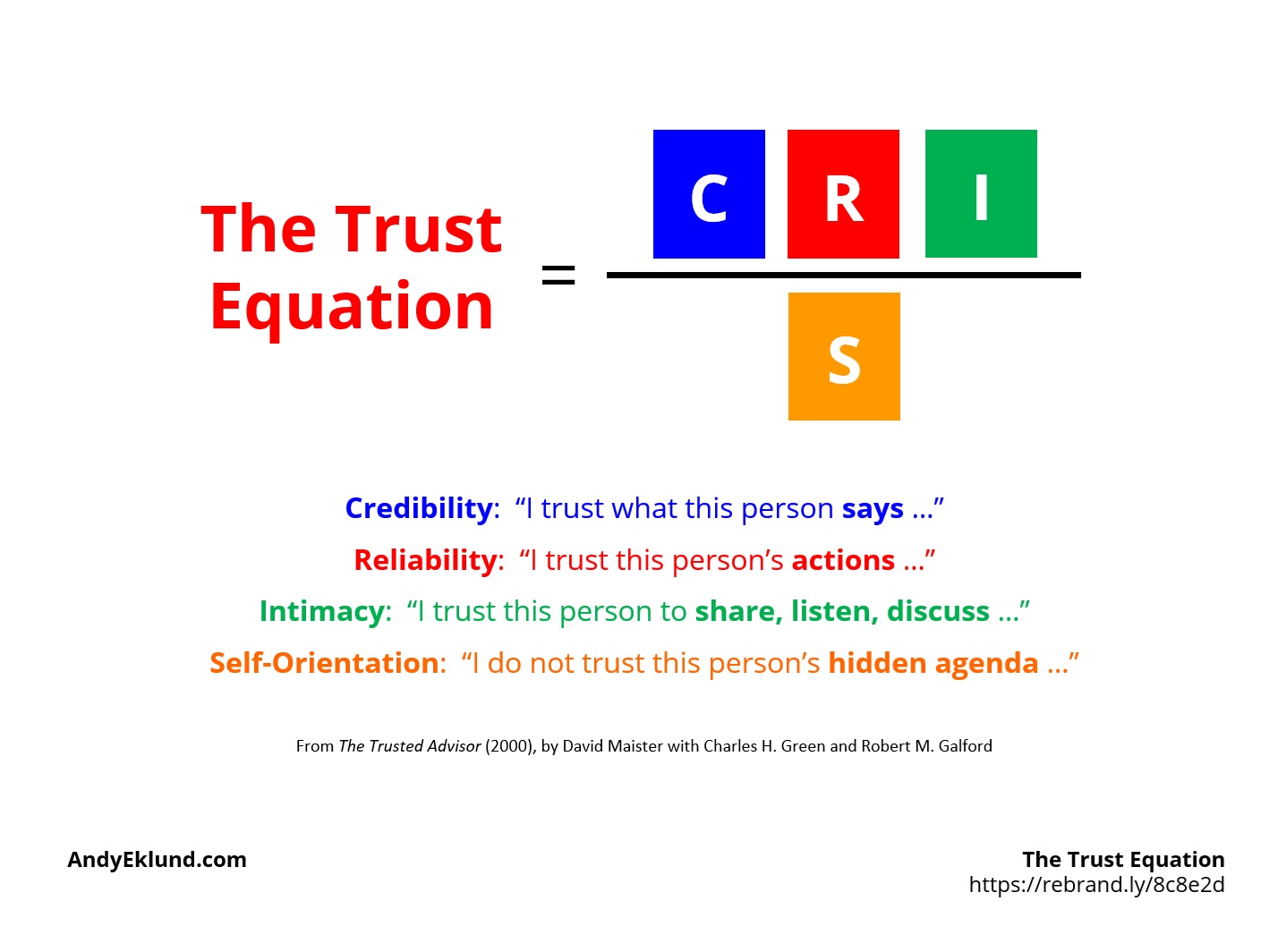
To understand each of these variables in depth, let's hear from one of the co-authors, Charles Green.
Understanding The Trust Equation for Professional Relationships
This video, "Understanding The Trust Equation for Professional Relationships," provides an authoritative overview of the model from its source. Pay close attention to how the four components are distinct but interconnected.
Please watch the entire video (The Trust Equation Explained). As you watch, consider how each component might manifest in both your current payroll duties and a future AI project setting. Credibility: The words we say, our expertise. Reliability: The actions we take, our dependability. Intimacy: The safety others feel when confiding in us. Self-Orientation: Our focus—on ourselves or on others. Note that this is the denominator; a high self-orientation destroys trust, regardless of the other factors.
The video makes a crucial point: trustworthiness is something you build within yourself, which then invites others to take the risk of trusting you. It also highlights that while Credibility and Reliability are rational and easier to demonstrate, Intimacy and Self-Orientation are emotional and often have a greater impact. This directly connects to our previous module on Emotional Intelligence.
To translate this model into concrete actions, let's review a resource that provides practical tips for each variable.
ModelThinkers - Trust Equation
This article offers a concise summary of the Trust Equation and, most importantly, a table of actionable advice for improving each component.
Please read the following sections: Focus on the table that begins under the heading "IMPROVING YOUR TRUSTWORTHINESS." This gives you specific behaviors for each variable. Then, read the section "THE 'HEART' WILL BEAT 'HEAD' FOR IMPACT." This reinforces the importance of the emotional elements of the equation.
A Complementary View: The Three Pillars of Trust
Another valuable perspective comes from Harvard professor Frances Frei, who simplifies the components of trust into three core pillars: Authenticity, Logic, and Empathy. When all three are strong, trust is high. If any one of them "wobbles," trust is threatened.
How to build (and rebuild) trust | Frances Frei
In her TED Talk "How to build (and rebuild) trust," Frances Frei presents a memorable and highly practical framework.
Watch the following segments to understand her three pillars: The Three Pillars: Frei introduces Authenticity, Logic, and Empathy. The Empathy Wobble: Notice how she links a lack of empathy to self-distraction—a concept very similar to "high self-orientation." The Logic Wobble: This covers both the quality of your reasoning and your ability to communicate it. The Authenticity Wobble: This is a powerful point about the importance of bringing your genuine self to your work, which is especially relevant as you craft your new career narrative.
You can see the overlap and interplay between these two models:
- Frei's Logic is a close cousin to the Equation's Credibility.
- Her concept of Empathy combines the ideas of Intimacy and low Self-Orientation.
- Authenticity adds a vital dimension, reminding us that trust requires us to be genuine, not just proficient and well-intentioned.
Synthesizing Models into Key Behaviors
Let's bring these concepts together into a unified framework. Stephen M.R. Covey's model, "The Foundations of Trust," organizes trust-building elements into two categories: Character and Competence.
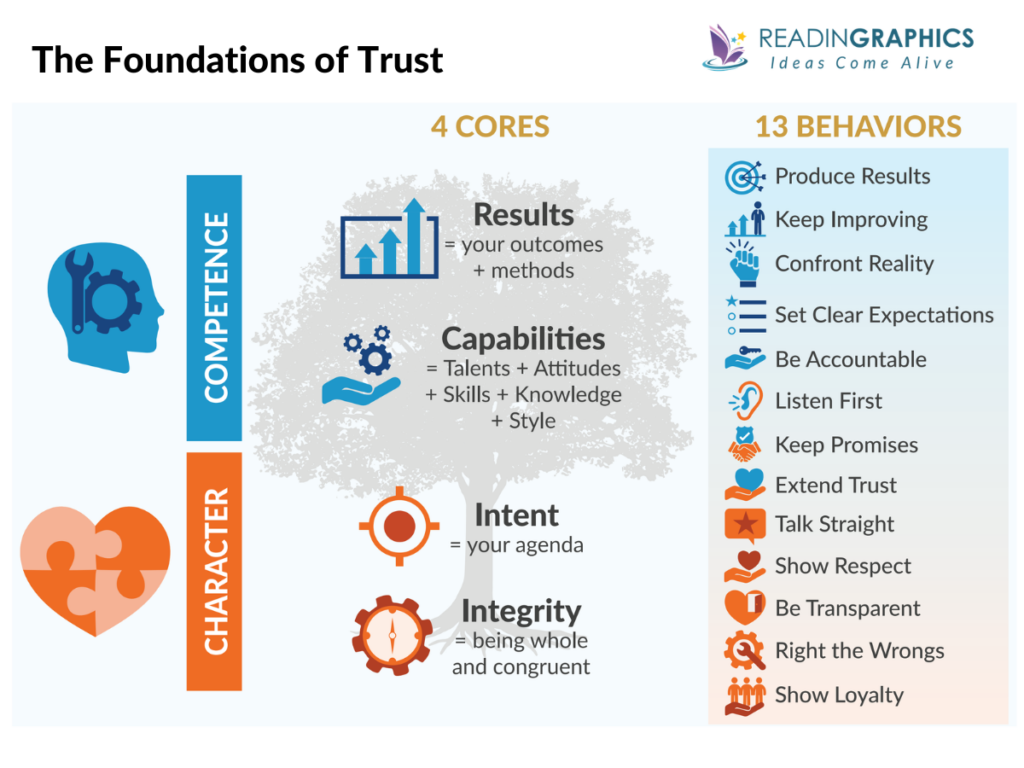
This structure helps synthesize what we've learned:
- Competence (Capabilities & Results): This aligns with Credibility and Logic. Do you have the skills? Can you deliver? In your context, this means both flawless payroll processing and, in the future, building effective Python scripts or LLM applications.
- Character (Integrity & Intent): This aligns with Reliability, Empathy, Intimacy, low Self-Orientation, and Authenticity. Are you honest? Do you do what you say you will? Do you genuinely care about the other person's success?
To round this out with a final set of actionable behaviors, the "Great Place to Work" framework provides clear, practical examples organized around Credibility, Respect, and Fairness.
Leadership and Trust: Strategies for Credibility, Respect, and ...
This article provides concrete examples of trust-building behaviors in a workplace context.
Please read the three "How to Build" sections: How to Build Credibility How to Build Respect How to Build Fairness Focus on the examples provided. They transform the abstract concepts of the models into everyday professional conduct. The dimension of Fairness, in particular, is a critical component of trust within a team.
Conclusion
In this lesson, we have demystified the concept of trust by examining it through several powerful frameworks. You've learned that trust is not an amorphous feeling but the result of consistent, observable behaviors.
Key Takeaways:
- Trust can be broken down into core components, as seen in the Trust Equation ( / ).
- The emotional factors of trust (low Self-Orientation, Intimacy, Empathy) are often more powerful than the rational ones (Credibility, Reliability).
- Frances Frei’s three pillars—Authenticity, Logic, and Empathy—provide another memorable lens for assessing and building trust.
- Ultimately, these behaviors can be grouped under two main pillars: Character (your integrity and intent) and Competence (your capabilities and results).
- Actions like being transparent, following through, admitting mistakes, showing respect, and acting with fairness are the practical building blocks of trustworthiness.
In our next lesson, we will zoom in on one of the most critical of these behaviors: Reliability. We'll move from identifying behaviors to applying a proactive framework for managing your commitments and expectations, ensuring your actions consistently match your words.