In our last lesson, we focused on crafting clear, concise, and professional digital messages to ensure your communication is easily understood and acted upon. We established that structure and clarity are fundamental to getting things done. Now, we'll apply those communication skills to one of the most challenging, yet crucial, professional situations: constructively pushing back on unreasonable requests.
This lesson is designed to help you say "no," or "not now," in a way that not only protects your time and focus but also strengthens your professional relationships and credibility. Mastering this skill is vital in any role, and particularly in the fast-paced tech environments you're aiming for, where managing your workload directly impacts the quality of your output and your reputation as a reliable contributor. We will explore both the mindset and the specific language needed to navigate these conversations with diplomacy and confidence.
The Strategic Value of Saying "No"
Many of us are conditioned to say "yes" to avoid conflict or to be seen as a team player. However, reflexively agreeing to every request can lead to burnout, decreased work quality, and resentment. Saying "no" isn't about being unhelpful; it's a strategic decision to protect your most valuable resources: your time, energy, and focus.
Before we dive into the "how," let's explore the "why." Understanding the benefits of setting boundaries can give you the confidence to do so.
What Saying No at Work Gives You and How to Say No at Work
This video from Enhance.training, "What Saying No at Work Gives You," reframes saying "no" from a negative act to a powerful career-enhancing skill.
Please watch the section from the beginning to the discussion of relationships. As you watch, pay attention to the eight benefits the speaker outlines, such as enhancing your reputation, increasing respect from colleagues, and progressing your career faster.
As the video highlights, when you learn to say "no" effectively, you demonstrate that you can manage your commitments and maintain high standards—qualities that are highly valued in any professional, especially in demanding technical roles.
A Professional Playbook for Pushing Back
Saying "no" effectively isn't about a blunt refusal. It's a negotiation. The goal is to turn a potential conflict into a collaborative problem-solving session. A structured approach is key.

This playbook provides a simple but powerful sequence. Let's see it in action and hear an expert break it down.
How to Say No at Work | Christine vs. Work
This Harvard Business Review video, "How to Say No at Work," demonstrates a practical framework and shows it being applied in a realistic role-play scenario.
Watch these key segments: The expert's framework: Ruchika Tulshyan outlines a four-part strategy: consider the request, acknowledge your manager, use evidence, and reinforce or renegotiate. Notice how this aligns with the playbook image. The role-play: Observe how Christine applies this framework when her boss tries to add more projects to her plate. Note her use of phrases like "I totally get it" (acknowledge) and "If this is a shift in priorities, I would have to take something off my plate" (renegotiate). The reflection: The debrief between Christine and her boss highlights the importance of confidence and having a healthy manager relationship.
The core of this approach is shifting the conversation from "I can't do that" to "Here's what I'm currently working on. How does this new request fit in, and what should we de-prioritize to make it happen?" This transforms you from a blocker into a strategic partner.
The DEARMAN Framework: A Deeper Dive
For particularly high-stakes situations, or when you want a more robust model, the DEARMAN framework is an excellent tool. It originates from Dialectical Behavior Therapy (DBT) and is designed to help you be effective in interpersonal interactions while balancing your objectives, the relationship, and your self-respect. This aligns perfectly with your preference for both practical steps and underlying models.
DEARMAN is an acronym that guides you through the conversation:
- Describe the situation factually.
- Express your feelings or opinions about it.
- Assert your needs or say "no" clearly.
- Reinforce why your proposed course of action is positive.
- Stay Mindful and on topic (don't get sidetracked).
- Appear confident in your body language and tone.
- Be willing to Negotiate a solution.
Let's explore this framework in more detail.
#5: Using the DEARMAN Framework to Say No - Bay Area DBT ...
This article from the Bay Area DBT & Couples Counseling Center provides a thorough breakdown of the DEARMAN framework and its application.
Please read the following sections: First, read the introduction from the beginning to understand the three competing goals in any interaction: meeting objectives, maintaining the relationship, and maintaining self-respect. Next, jump to the section that explains the acronym itself, starting from the DEARMAN breakdown. This part details what each letter stands for. Finally, read the professional role-play example starting from the work scenario. This demonstrates how to use the framework, including staying mindful when you receive pushback.
The DEARMAN framework gives you a script to prepare, helping you remain calm, clear, and respectful, even when the person you're speaking to becomes defensive.
Finding the Right Words: Diplomatic Language and Scripts
Having a framework is essential, but you also need the right words. Diplomatic language softens your message without weakening it. The goal is to be firm but respectful, clear but collaborative.
The following resource is an excellent guide to the specific phrases that make this possible.
Negotiating Deadlines and Responsibilities at Work - Aula54
This lesson from Aula54 provides a masterclass in diplomatic negotiation language, with practical examples and exercises.
We will focus on two key sections: Read the section Noticing diplomatic negotiation phrases. Pay close attention to the table that groups phrases by function (Explaining workload, Pushing back, Offering alternatives). This helps you build a personal phrase bank. Next, work through the section Transforming direct messages. This is a crucial exercise. Notice the patterns used to rephrase a direct "I can't" into a collaborative "I'm afraid that will be difficult, but one option could be..."
To supplement this, here is a helpful collection of scripts for various common scenarios. You can use this as a quick reference when you find yourself facing an unreasonable request.
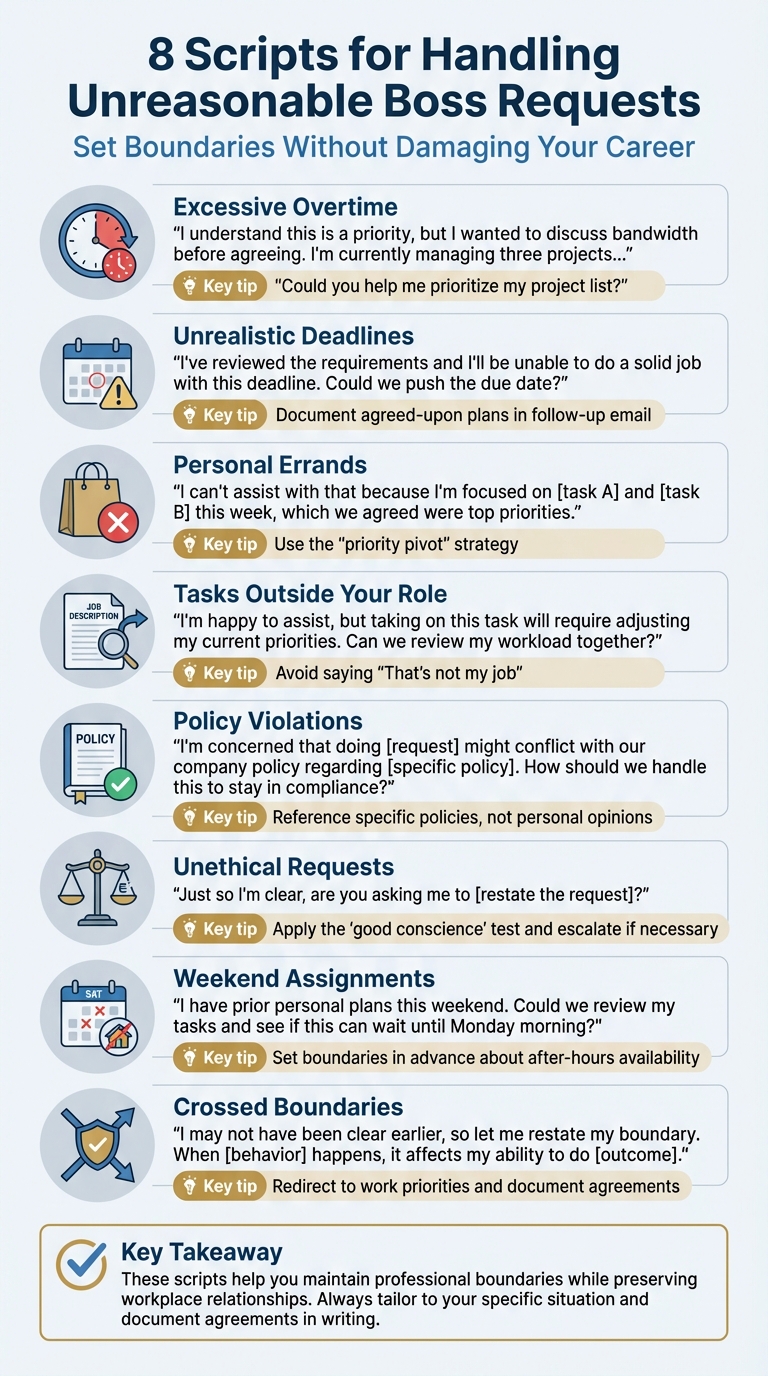
By combining a framework like DEARMAN with these diplomatic phrases, you can prepare for these conversations, state your position clearly, and guide the discussion toward a mutually agreeable outcome.
Conclusion
In this lesson, we moved from the mechanics of clear communication to the art of diplomatic negotiation. You've learned that pushing back on unreasonable requests is not a confrontational act but a strategic one that protects your ability to deliver high-quality work.
Key Takeaways:
- Saying "No" is Strategic: It's a tool for managing your workload, ensuring quality, and building a reputation for reliability and good judgment.
- Use a Framework: A structured approach (like the 4-step playbook or DEARMAN) helps you stay calm, focused, and collaborative.
- Acknowledge, then State Reality: Always start by validating the request's importance before explaining your constraints (e.g., "I understand this is a priority. Currently, my focus is on X and Y...").
- Shift from "No" to "How": Frame the conversation around solutions. Instead of refusing, ask questions that force prioritization: "To do this, what should I put on the back burner?" or "Could we extend the deadline to ensure a high-quality result?"
- Master Diplomatic Language: Small changes in phrasing—from "I can't" to "I'm afraid that will be difficult"—can transform the entire tone of the conversation.
In our next lesson, we will continue building on this theme of relational intelligence by focusing on empathetic listening. While this lesson was about expressing your own needs, the next will be about deeply understanding the needs of others to build stronger rapport and trust.