Introduction
In our last lesson, we focused on empathetic listening, a skill for building trust by deeply understanding others. Today, we'll address the other essential pillar of credibility: managing yourself. Being a trusted professional means not only understanding others' perspectives but also being consistently reliable in your own actions. This is where personal accountability comes in.
This lesson is designed to help you create a personal accountability plan to ensure you consistently follow through on your commitments. For your goal of transitioning into the tech/AI field, this is a non-negotiable skill. The ability to define a goal, break it down into manageable actions, anticipate obstacles, and reliably execute is the very essence of project work in technology. We will treat accountability not as a matter of raw willpower, but as an engineering problem: you'll learn to build a robust system for execution.
Why Willpower Isn't Enough: The Intention-Behavior Gap
We've all experienced it: setting a goal with great enthusiasm, only to see it fall by the wayside weeks later. It's tempting to blame a lack of discipline, but research suggests the issue is more systematic. Psychologists refer to the "intention-behavior gap"—the consistent and predictable space between what we plan to do and what we actually do.
This gap is caused by several well-documented psychological barriers:
- Vague Intentions: Goals like "learn Python" are too abstract for your brain to act on without a specific trigger.
- The Planning Fallacy: We tend to overestimate our future time, energy, and motivation, and underestimate the obstacles that will arise.
- Decision Fatigue: Self-control is a finite resource. After a long day of making decisions at work, the willpower to choose a difficult, goal-oriented task over relaxation is often depleted.
- Future-Self Discounting: Our brain treats our "future self" (who gets the benefit of the goal) almost like a stranger, while our "present self" feels the immediate cost of the effort. The present cost often wins.
Because these barriers are predictable, we can design a system to overcome them. Relying on motivation alone is like trying to cross a river without a bridge—it might work when the water is low, but it's not a reliable strategy. An accountability plan is your bridge.
A Professional Framework for Execution
Before we build your personal plan, let's examine a powerful framework used by organizations to execute on their most important goals in the face of daily distractions. The book The 4 Disciplines of Execution provides a clear model that we can adapt for personal use. It's built to counteract what the authors call the "whirlwind"—the constant storm of urgent but less important tasks that consume our attention.
THE 4 DISCIPLINES OF EXECUTION by C. McChesney, S. Covey, and J. Huling
This animated summary of "The 4 Disciplines of Execution" introduces a system for achieving goals in a chaotic environment. It provides the high-level strategic thinking that will structure our personal plan.
Please watch the full video. As you watch, pay close attention to these four key concepts: Discipline 1: The WIG (Wildly Important Goal). Notice the "from X to Y by Z" format for creating focus. Discipline 2: Lag vs. Lead Measures. This is a crucial distinction. A lag measure is the result you want (e.g., lose 10kg), while a lead measure is a high-impact action you directly control that influences the result (e.g., calories consumed per day). Discipline 3: A Compelling Scoreboard. This is about making your progress visible to stay motivated. Discipline 4: A Cadence of Accountability. This is the rhythm of regular review and commitment.
This framework gives us our strategic pillars: a focused goal, controllable actions to measure, a way to track progress, and a routine for review. Now, let's translate this into a step-by-step process for building your personal plan, integrating evidence-based psychological tools.
Building Your Personal Accountability Plan: A Step-by-Step Framework
We will now walk through a practical, multi-step process for creating your plan. This approach, detailed in the article "How to Actually Follow Through on Goals," combines several proven techniques into a single, cohesive system.
How to Actually Follow Through on Goals (Framework for Quitters)
This article provides an excellent step-by-step guide for creating a robust system for goal achievement. It directly addresses the psychological barriers we discussed earlier.
Please read the section titled Your Step-by-Step Follow-Through Framework. We will be using these steps as the core of our lesson. Pay close attention to the concrete formulas and examples provided for each step.
Let's integrate the steps from the article you just read with the 4 Disciplines framework.
Step 1: Define Your WIG (Wish & Outcome)
This is your Wildly Important Goal. Be specific. Instead of "Transition to a tech role," you might frame it as "Complete three AI-focused Python projects and build a portfolio website by [Date]."
Step 2: Define Your Lead Measures (Implementation Intentions)
These are the specific, controllable behaviors that will drive your progress. The best way to define them is with implementation intentions, using an "if-then" structure.
- Goal: Learn a new AI concept.
- Vague intention: "I will study AI this week."
- Implementation Intention (Lead Measure): "If it is 7 AM on a weekday, then I will spend 45 minutes on my data science course before starting my workday."
Step 3: Plan for Obstacles (WOOP)
The article you read introduced the WOOP framework: Wish, Outcome, Obstacle, Plan. This is where you proactively address the "planning fallacy." You identify your most likely internal obstacle and create an if-then plan for it.
- Wish: Complete 45 minutes of AI study each morning.
- Outcome: Feeling knowledgeable and making tangible progress on my projects.
- Obstacle: Feeling too tired or unmotivated in the morning.
- Plan: "If I feel too tired to study, then I will commit to just 10 minutes, and review my career transition goals to reconnect with my motivation."
Step 4: Create Your Scoreboard & Accountability Cadence
This is where you make progress visible and build a review habit.
- The Scoreboard: This can be as simple as a calendar where you check off each day you complete your lead measure, or a spreadsheet tracking hours studied. The key is that it's visible and you can tell if you're "winning" or "losing" at a glance.
- The Cadence: This is your weekly review. Schedule a recurring 30-minute block in your calendar (e.g., Sunday evening) to review your scoreboard, celebrate wins, diagnose what went wrong, and plan your commitments for the upcoming week.
What Does the Plan Look Like?
The process of creating this plan can be captured in a simple worksheet. This helps you clarify your thinking around your behaviors, triggers, and goals.
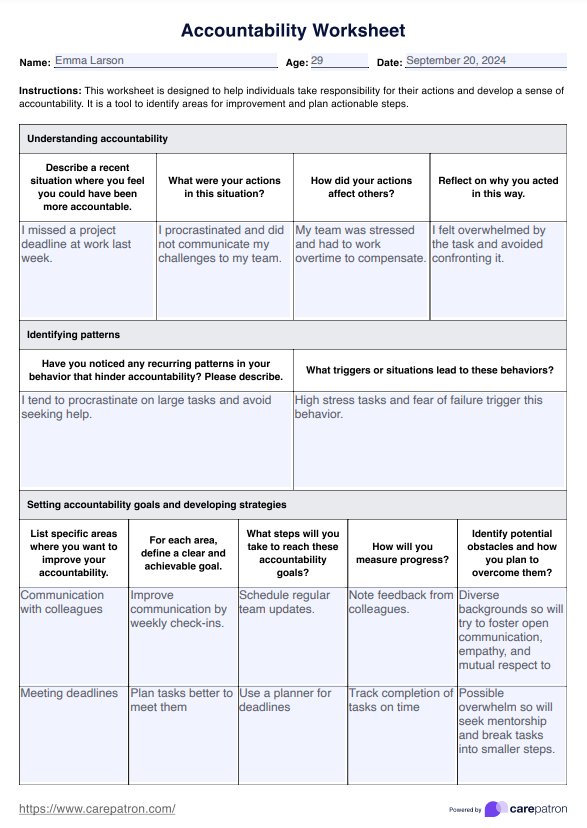
Once you've defined these elements, you can assemble them into a more comprehensive document. An Individual Development Plan (IDP) is a perfect format for this, especially for a career-focused goal. It acts as your formal, written commitment to yourself.

Notice how the IDP example contains all our elements:
- Business goal match: The overarching "Why" or WIG.
- My options: The list of specific actions, or your Lead Measures.
- My way forward: The specific commitments and implementation intentions.
- Progress summary / review sessions: The Scoreboard and Accountability Cadence.
By formalizing your goals in this way, you move them from abstract desires to a concrete project plan that you are accountable for executing.
Conclusion
Today we've dismantled the idea that follow-through is purely about willpower. Instead, we've treated it as a systems challenge and built a robust, evidence-based plan for execution. Creating and maintaining an accountability plan is one of the most powerful signals of professionalism you can send, building deep credibility with colleagues and, most importantly, with yourself.
Key Takeaways:
- Accountability is a System, Not a Trait: Goal failure is often due to a poor system, not poor character. Address the intention-behavior gap with a structured plan.
- Focus on Lead Measures: Don't just track the outcome (the lag measure). Identify and track the daily/weekly actions you have direct control over (the lead measures).
- Plan for Failure with WOOP: The most effective plans don't assume perfect conditions. Use the Wish, Outcome, Obstacle, Plan framework to prepare for moments of low motivation.
- Make It Visible and Rhythmic: Use a simple "scoreboard" to track your lead measures, and establish a non-negotiable weekly "cadence of accountability" to review progress and recommit.
- Formalize Your Commitment: Translate your planning into a written document, like an IDP, to increase your commitment and clarify your path forward.
In our next module, we will move into Navigating Difficult Conversations. The self-discipline and clarity you cultivate through your personal accountability plan will provide the firm foundation you need to address challenging topics with others confidently and constructively.