Introduction
Welcome to our first lesson on navigating difficult conversations. In our previous lesson, we built a framework for personal accountability, treating follow-through as a system to be designed rather than a matter of willpower. We will now apply that same systematic, proactive mindset to interpersonal challenges. Just as a well-designed plan is crucial for managing your own commitments, a structured approach is the key to managing challenging conversations constructively.
The goal for this lesson is to learn how to use a structured template to prepare for a difficult workplace conversation. Many people avoid these conversations or handle them poorly because they rely on improvisation, which often leads to emotional reactions and poor outcomes. By preparing methodically, you can reduce your own anxiety, clarify your objective, and significantly increase the chances of a productive discussion. This skill is foundational for building trust and influence, especially as you navigate your career transition into the collaborative and project-driven tech world.
The Foundation: Why and How to Prepare
Before we dive into a specific template, it's essential to understand why preparation is so critical. Unplanned confrontations often feel like personal attacks, immediately putting the other person on the defensive. Thoughtful preparation allows you to frame the conversation around facts and behaviors, not personality, which creates the "psychological safety" necessary for the other person to actually hear what you're saying.
How To Use DISC and DESC for Difficult Conversations
This article from The Retired Spy blog effectively argues that avoiding difficult conversations is often more damaging than the conversations themselves. It introduces the vital concept of creating psychological safety as the first step.
Please read from the beginning of the article down to the end of the section titled Creating Psychological Safety First. Pay close attention to the idea that a structured framework helps you stay factual, regulate emotion, and reduce defensiveness.
As the article highlights, structure is your best tool for creating a safe, productive environment. So, what does a well-structured preparation process look like? It involves several key steps you take before you even think about what to say.
How To Manage Difficult Conversations At Work
The video "How To Manage Difficult Conversations At Work" by Enhance.training breaks down the process into clear, actionable steps. We will focus on the steps that are part of the preparation phase.
Please watch the following segments. As you watch, consider how each step contributes to building a solid foundation for the conversation: Don't put it off: Understand the cost of delay. Put yourself in a positive mindset: Prepare yourself mentally for a constructive outcome. Start with the end in mind: Define a specific, measurable goal for the conversation. Prepare evidence or examples: Ground the conversation in objective facts, not subjective opinions. Plan, but don't script: Create a roadmap, not a rigid script you read from.
The Preparation Template
The steps from the video provide the essential ingredients for your preparation. Now, let's organize them into a simple, reusable template. The "Difficult Conversations Preparation Map" is a fantastic tool for this. It prompts you to think through the key domains of a conversation before you're in the heat of the moment.
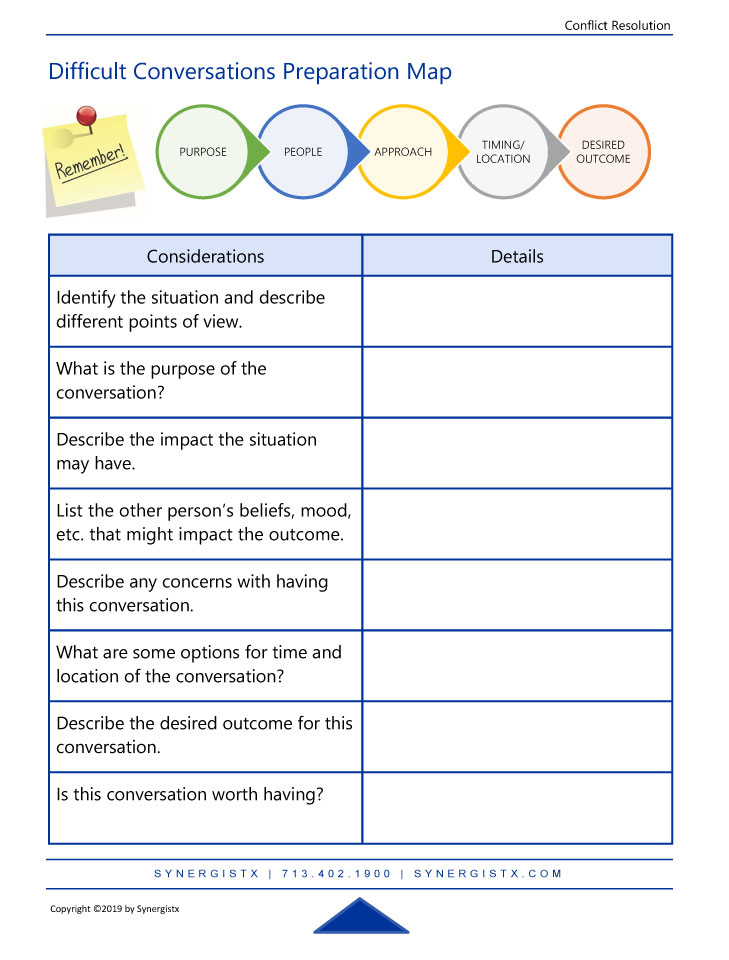
Let's break down how this map aligns with what we've learned:
- Purpose & Desired Outcome: This directly relates to the video's step, "Start with the end in mind." What is the point of this conversation? What would a successful resolution look like?
- Considerations (Identify the situation, Describe the impact): This is where you "Prepare evidence." You gather the specific, factual examples of the behavior and articulate its tangible effects.
- People: This section prompts you to consider the other person's perspective, their mood, and their potential reaction. This is a crucial step for building empathy and anticipating how your message might land.
- Approach: This is where you plan your communication strategy. You'll think about your opening lines, the key points you need to make, and the questions you'll ask.
- Timing/Location: This practical step ensures the conversation happens in an appropriate, private setting, as recommended in the video.
Structuring Your Approach with the DESC Model
The "Approach" section of the preparation map is where you can add another layer of structure. A highly effective model for planning your key talking points is DESC: Describe, Express, Specify, Consequences. While we will cover how to use this model in a live conversation later, it is an invaluable tool for planning what you want to say.

- Describe: State the specific, observable behavior factually. (e.g., "I noticed you arrived 20 minutes late to our last three team meetings.")
- Express: Explain the impact the behavior has, using "I" statements. (e.g., "I feel concerned because it disrupts the meeting's flow and we have to repeat information.")
- Specify: Clearly state the change you would like to see. (e.g., "I need you to arrive on time for future meetings.")
- Consequences: Outline the positive outcome if the change is made. (e.g., "This will help us start on time and ensure everyone is aligned from the beginning.")
By scripting your DESC points during preparation, you create the core message for your "Approach." To see how this works in practice, let's review some detailed examples.
This document provides excellent, fully scripted examples of using the DESC model for common workplace situations. It shows how preparation translates into the exact words you might use.
Please review at least three of the following scenarios. As you read, imagine you are filling out the "Difficult Conversations Preparation Map" for each one. The script itself would be the output for the "Approach" section. Addressing disrespectful non-verbal behavior (Problem #1) Addressing repeated lateness (Problem #3) Pushing back on a manager's risky plan (Problem #4) Addressing missed deadlines (Problem #11)
By using the Preparation Map to organize your thoughts and the DESC model to structure your message, you transform a potentially chaotic and emotional encounter into a well-planned, professional interaction.
Conclusion
In this lesson, we established that successful difficult conversations are won or lost long before they begin. The quality of your preparation is the single biggest predictor of a constructive outcome. By moving from a reactive to a proactive stance, you can take control of the process and guide it toward a resolution.
Key Takeaways:
- Preparation is a System: Treat preparing for a difficult conversation like planning a project. It requires clarifying your goals, gathering data (facts), considering your stakeholders (the other person), and designing your execution (your approach).
- Use a Structured Template: Employ a tool like the "Difficult Conversations Preparation Map" to ensure you cover all critical aspects: the purpose, the people, the approach, the logistics, and the desired outcome.
- Plan Your Message with DESC: Use the Describe, Express, Specify, Consequences model as a framework to structure your key talking points during preparation. This helps you stay factual, clear, and assertive.
- Facts, Not Feelings: The core of good preparation is grounding the conversation in specific, observable behaviors and their tangible impacts, rather than vague feelings or personal judgments.
We have now laid the groundwork by focusing on preparation. In our next lesson, we will build on this foundation and shift to execution, covering techniques for initiating difficult conversations with confidence and clarity.