Introduction
In our last lesson, you learned how to craft tailored value propositions by identifying your key stakeholders and speaking to their specific "currencies"—be it the CFO's focus on ROI or the end-user's concern for usability. You now have the right message for the right person. This lesson addresses the next crucial step: making that message not just understood, but truly memorable and persuasive.
Our focus today is on constructing analogies and stories to make complex technical ideas accessible. As someone interested in the technicalities of LLMs and AI, you know that concepts like vector embeddings or fine-tuning can be opaque to outsiders. This isn't about "dumbing down" your ideas; it's about translating them intelligently so their value shines through. By the end of this lesson, you will be able to transform technical facts into compelling narratives that resonate with any audience.
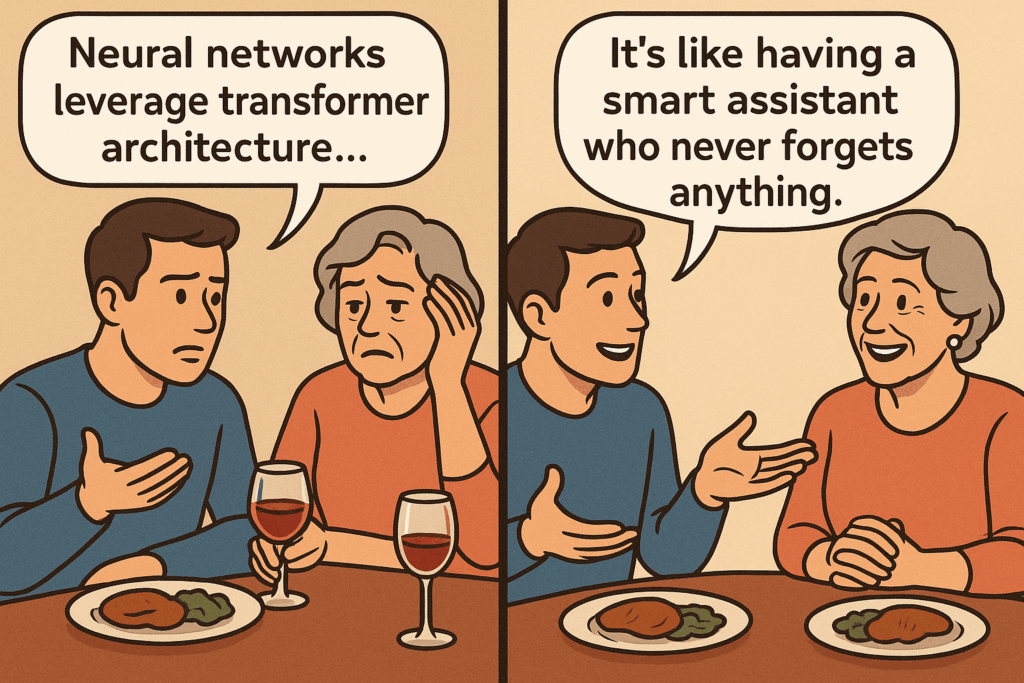
The Power of Analogy: Building Bridges of Understanding
At its core, an effective analogy is a bridge. It connects the complex, abstract, or unknown concept you're explaining to a simple, concrete, or familiar idea that already exists in your audience's mind. Your goal is not to be perfectly precise in a technical sense, but to convey the essence of the idea and its implications.
To do this well, you must first know your audience—a principle we've emphasized throughout this course. The best analogies tap into shared, common experiences.
Let's watch a short video that gives excellent, real-world examples of this in action.
Explaining Technical Information to Non-Technical People
The "Engineer Man" video provides clear, practical examples of how to translate technical jargon into simple, effective analogies for a completely non-technical audience.
Watch the segment covering these examples. Pay close attention to how he rephrases complex ideas like database indexes, load balancers, and API errors into concepts anyone can understand (bookmarks in a book, combining multiple machines, a partner's system reporting an error).
As the video demonstrates, the key is to strip away the "how" (the B-tree indexes, the round-robin load balancer) and focus on the "what" (finding things faster, handling more orders).
How to Create Your Own Analogies
Coming up with good analogies on the spot can be difficult. Luckily, there are simple conversational frames you can use to trigger this way of thinking.
How to Explain Technical Concepts to Non-Technical Audiences
This article from Leapica offers practical frameworks for creating analogies and provides a rich library of examples directly relevant to your interests in data and AI.
First, read the section that introduces three simple but powerful methods for creating analogies: The “Kinda Like” Bridge, The “Imagine That” Approach, and The “You Know How” Method. Then, review the list of examples under the heading More Examples of Analogies. Given your interests, focus on the analogies for Machine Learning, Data Lakes, and Data Analytics. These will be valuable for your future career transition.
Let's put this into practice with a topic you're interested in: Large Language Models (LLMs). How could you explain an LLM to someone in your current payroll department?
Using the "kinda like" bridge, you might say:
"An LLM is kinda like a super-powered autocomplete for language. You know how when you're writing an email, your phone suggests the next few words? Imagine a system that has read almost the entire internet. It's so good at predicting the next word that it can write entire coherent paragraphs, answer complex questions, or even summarize a long report for you."
This analogy works because it connects to a technology everyone has used (autocomplete) and then scales it up to explain the power of the new concept.
The Art of Storytelling: Making Your Message Stick
While analogies clarify a concept, stories make it memorable and drive action. When you present facts and figures, you activate the language-processing parts of your audience's brain. But when you tell a story, their brain activity starts to mirror yours in a phenomenon called "neural coupling." They don't just hear your message; they experience it.
A simple yet powerful structure for any story, whether in a novel or a business presentation, is: Setup, Conflict, Resolution.
Telling Stories with Data in 3 Steps (Quick Study)
This video from Harvard Business Review breaks down how to find and tell a story using data, employing the simple but effective three-act structure.
Watch the first two parts of the video. Start with the introduction to the Setup, Conflict, Resolution framework. Then, pay close attention to how the presenter applies this framework to find stories within a complex data chart. Notice how he identifies a "setup" (the baseline reality), a "conflict" (an event that changes that reality), and a "resolution" (the new reality).
This structure is a powerful tool for framing the "why" behind a technical project.
- Setup: What is the current state? Describe the world as it is today.
- Conflict: What is the problem or opportunity? Introduce the challenge or change that makes the current state unsustainable or undesirable.
- Resolution: How does your solution create a new, better reality? This is where you introduce your project or idea.
Advanced Storytelling for Business Impact
While Setup-Conflict-Resolution is a great start, other frameworks are specifically designed for business contexts. Mastering these will elevate your persuasiveness, especially with executive audiences.

One of the most effective and concise frameworks is ABT (And, But, Therefore). It forces you to distill a complex situation into a logical, three-part flow.
Another critical technique is to connect your story directly to your audience's world. The Protagonist-Stakes Method does this by making your stakeholder the hero of the story.
Presentation Storytelling That Drives Decisions
This article moves from simple story structures to proven frameworks used in high-stakes business presentations. It directly connects the art of storytelling to the stakeholder analysis you did in the last lesson.
Read two key sections. First, review the different story frameworks, paying special attention to the ABT (And, But, Therefore) framework for its simplicity and power. Second, read the section on advanced techniques, specifically The Protagonist Stakes Method. Notice how this directly connects to our previous lesson on tailoring messages. The "protagonist" is your stakeholder, and the "stakes" are the gains and pains you identified for them.
Your Turn: Weaving It All Together
Let's revisit the AI payroll tool from our last lesson and enhance your tailored pitches with analogies and storytelling.
Recall the scenario: An AI tool that automates data entry, detects anomalies, and includes an employee-facing chatbot for payroll questions.
1. Pitch to the CFO (Economic Buyer)
- Framework: ABT + Analogy
- Pitch: "We have a stable payroll process AND a dedicated team, BUT our reliance on manual data entry exposes us to costly errors and consumes hundreds of hours per year. THEREFORE, by implementing this AI tool, we can capture a projected ROI of over 200% within two years. It's kinda like hiring a tireless, expert auditor who checks every single entry in real-time, preventing financial leaks before they happen."
2. Pitch to the HR Director (Operator)
- Framework: Setup-Conflict-Resolution
- Pitch:
- (Setup): "Currently, our HR and payroll staff spend a significant portion of their week fielding the same set of payroll questions from employees."
- (Conflict): "This reactive work prevents them from focusing on more strategic initiatives, and it creates a frustrating bottleneck for employees who just want a quick answer about their pay stub."
- (Resolution): "This AI tool's chatbot resolves over 80% of these queries instantly, 24/7. This frees our team to be proactive and dramatically improves the employee experience."
3. Pitch to the Payroll Team (End-Users)
- Framework: Imagine That + Analogy
- Pitch: "Imagine that instead of spending the first two days of every pay cycle manually keying in timesheets, you simply had to review a list of exceptions the system flagged for you. This tool works like a junior assistant for the whole team; it does all the tedious data entry, so you can focus on the expert work of solving problems and ensuring accuracy."
Notice how each pitch uses a different combination of techniques to make the same product's value clear and compelling to its specific audience.
Conclusion
You've now added two of the most powerful tools to your communication arsenal: analogy and story. You understand that simplifying a technical concept isn't about reducing its importance, but about building a bridge to your audience's understanding. You also have practical frameworks to structure your message as a compelling narrative that sticks.
Key Takeaways:
- Analogies are bridges: Use frameworks like "kinda like" or "imagine that" to connect complex technical ideas to familiar, everyday concepts.
- Stories drive action: Structure your message using simple frameworks like Setup-Conflict-Resolution or the more concise ABT (And, But, Therefore) to make your point memorable and persuasive.
- Make the stakeholder the hero: Use the Protagonist-Stakes method to frame your story around the problems and goals of your audience, making your message immediately relevant to them.
In our next lesson, we will take these building blocks of tailored messages, analogies, and stories, and learn how to assemble them into a full, structured presentation for a non-technical audience, complete with effective visual aids.