Welcome to the first lesson of your course on professional effectiveness. In your journey to transition into the tech and AI world, the ability to communicate with clarity and confidence is just as critical as your technical skills. This course is designed to build those communication and influence skills, starting with the very foundation.
Today's lesson addresses the fundamental models of interpersonal communication. We will distinguish between passive, aggressive, and assertive communication styles. We'll also explore a common fourth style, passive-aggressive, to give you a complete picture. By the end of this lesson, you will be able to identify these styles in workplace scenarios, setting the stage for you to consciously choose the most effective approach in your own interactions.
The Communication Spectrum
Think of communication styles as existing on a spectrum. On one end, we have the passive style, where one's own needs and rights are often neglected in favor of others. On the opposite end is the aggressive style, which champions one's own needs at the expense of others. The goal is to find the balance in the middle: the assertive style, which respects the needs and rights of everyone involved.

While this spectrum is a useful model, a fourth common style, passive-aggressive, combines elements of the other styles in a particularly counterproductive way. It appears passive on the surface but has an aggressive, undermining intent.
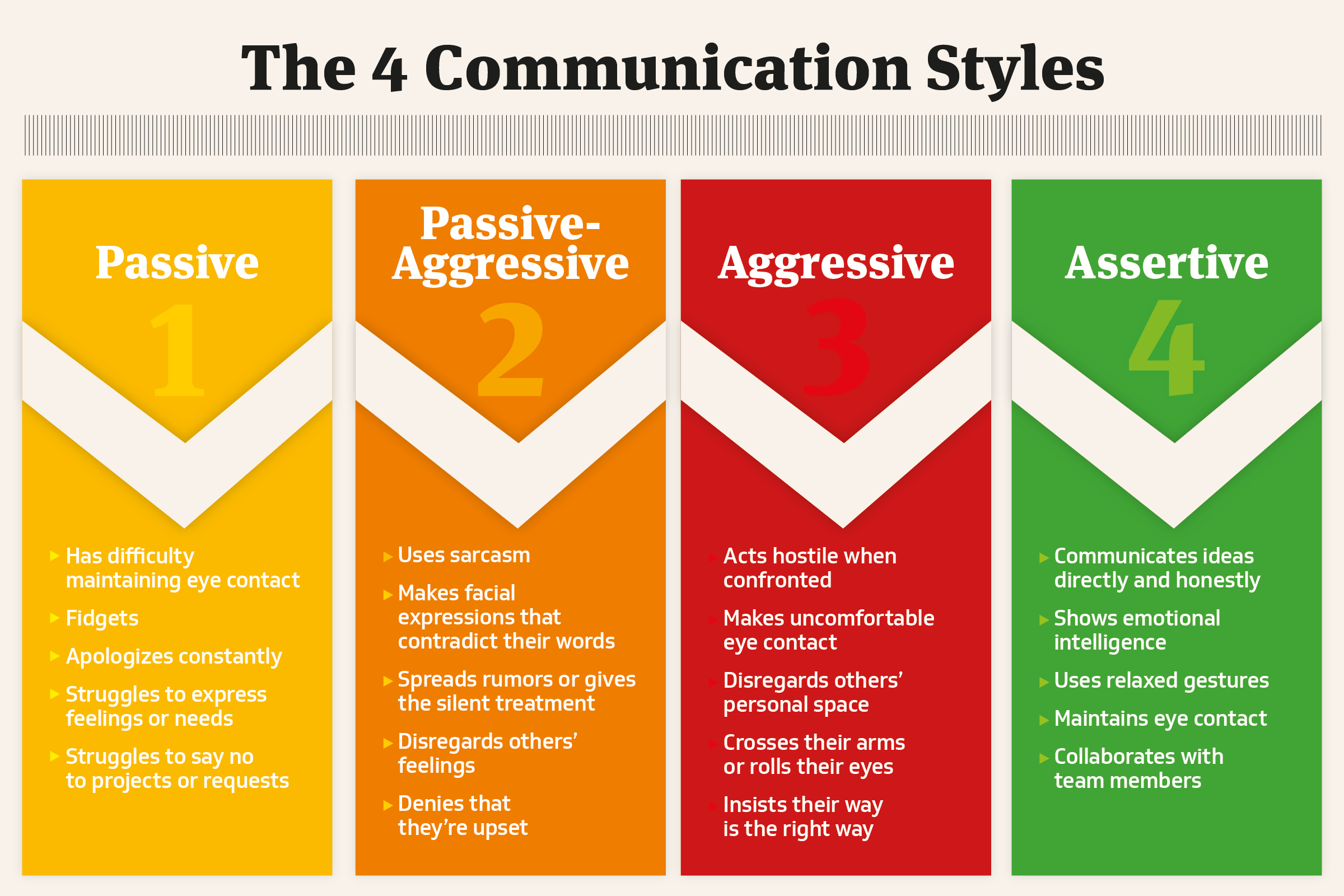
Defining the Four Styles
To begin, let's establish clear definitions for each style. The following video provides a concise and effective overview of passive, aggressive, and assertive communication, and then adds the passive-aggressive style to the mix. It also explains why assertive communication is the most effective approach.
How to Communicate Assertively 4 Tips
This video from Communication Coach Alexander Lyon will introduce the theoretical framework for the four main communication styles.
Please watch the following segments: First, watch the section that defines the three core styles: passive, aggressive, and assertive. Notice the emphasis on "I" language for assertive communicators. Next, watch the explanation of the passive-aggressive style. Pay attention to how it differs from being directly passive or aggressive. Finally, watch the segment on why assertiveness is most effective. The concept of "emotional noise" is a key takeaway here.
To reinforce these definitions and give you a reference you can look back on, the following article provides detailed descriptions and clear signs for identifying each style in a workplace context.
Identifying 8 Workplace Communication Styles - MTD Training
This article from MTD Training, "Identifying 8 Workplace Communication Styles," breaks down the characteristics of each style. We will focus on the first four.
Please read the following sections, focusing on the bulleted lists of signs for each style: Start with the section on the Passive Style. Then, read about the Aggressive Style. Continue to the Passive-aggressive Style. Finally, read the description of the Assertive Style.
Distinguishing the Styles in Action
Definitions are useful, but seeing these styles play out in realistic scenarios makes the distinctions tangible. This is especially true when differentiating between assertive and aggressive communication, as they can sometimes be confused.
The key difference often comes down to intention. Aggressive communication intends to control, blame, or attack, often stemming from anger. Assertive communication intends to express one's thoughts and needs clearly and confidently, while showing consideration for the other person.
The next video demonstrates this distinction powerfully using several workplace examples.
How to Be Assertive at Work WITHOUT Being Aggressive (Be Assertive NOT Aggressive)
This video by leadership coach Kara Ronin provides clear, side-by-side comparisons of aggressive versus assertive communication in common work situations.
Please watch the following two parts: First, watch the segment that contrasts the intention behind aggression and assertion, using the example of a colleague who is repeatedly late. Notice how the assertive approach uses factual observations and opens a dialogue. Then, skip ahead and watch the three workplace examples. These scenarios—dealing with an employee's mistake, delegating a task, and reacting to a coworker stealing an idea—provide excellent models of how the same situation can be handled aggressively versus assertively.
Synthesis and Reflection
To bring everything together, here is a summary of the four styles. As you review it, think about your own experiences.
| Style | Mindset / Goal | Behavior & Language | Impact on Others |
|---|---|---|---|
| Passive | Avoid conflict; please others. "My needs don't matter." | Apologetic, soft-spoken, avoids eye contact. "It's fine, whatever you decide." | Can cause frustration, resentment; others may lose respect or ignore their input. |
| Aggressive | Win; control others. "My needs are all that matter." | Blaming, loud, interrupts, intense eye contact. "This is your fault. You need to fix it." | Creates fear and resentment; damages relationships and trust; shuts down collaboration. |
| Passive-Aggressive | Indirectly express anger; punish others without confrontation. | Sarcasm, muttering, procrastination, "silent treatment." "Sure, I'll do it. Not like I'm busy." | Creates confusion, anxiety, and mistrust; erodes team morale. |
| Assertive | Communicate respectfully and effectively. "My needs matter, and so do yours." | Clear, direct, calm tone, collaborative, uses "I" statements. "I feel concerned about the deadline. Let's discuss a plan." | Builds trust, respect, and collaboration; problems are solved more effectively. |
Your goal of moving into tech involves extensive collaboration, often in cross-functional teams where you may be the expert on a particular system (like an LLM or a new marketing automation tool).
- A passive approach might mean your expert opinion is never heard, leading to poor project decisions.
- An aggressive style might get your way initially but will alienate colleagues from other departments, making future collaboration difficult.
- An assertive style allows you to advocate for the best technical solution while respecting the business constraints shared by your marketing or finance colleagues, leading to better outcomes and stronger professional relationships.
Conclusion
In this lesson, we have laid the essential groundwork for effective communication. You can now distinguish between passive, aggressive, passive-aggressive, and assertive communication styles, and you have seen how they manifest in workplace examples.
Key Takeaways:
- The four primary communication styles are passive, aggressive, passive-aggressive, and assertive.
- Assertiveness is the balanced and most effective style, as it respects the rights and needs of all parties.
- The core difference between assertiveness and aggressiveness lies in intent: assertiveness aims for mutual respect and clear expression, while aggression aims to dominate or attack.
- Recognizing these styles in yourself and others is the first step toward more productive and positive professional interactions.
In our next lesson, we will move from theory to practice. Now that you can identify these styles, we will focus on how to apply assertive communication techniques to express your own needs and set boundaries respectfully.