Hello! Welcome to the first lesson in our new module on Rate-Based Applications.
In our previous module, we mastered concepts of averages and mixtures, culminating in the powerful Rule of Alligation. You saw how a single technique could solve various problems involving weighted averages. We'll find that the idea of weighted averages reappears in today's topic, but in a new and exciting context.
This lesson marks our entry into the world of Time, Speed, and Distance (TSD), a cornerstone of the CAT quantitative section. Our goal today is to solve problems using the core relationship between Time, Speed, and Distance, including average speed calculations. We will build a solid foundation by understanding the fundamental formulas and then learn specific, time-saving shortcuts for average speed problems that are frequently tested.
1. The Fundamental Relationship: Distance, Speed, and Time
Everything in this topic boils down to one simple, intuitive relationship. Speed is the rate at which distance is covered over time. From this, we can derive three interconnected formulas.
To help you recall these formulas instantly—a crucial skill under exam pressure—we can use a simple visual aid known as the DST triangle.
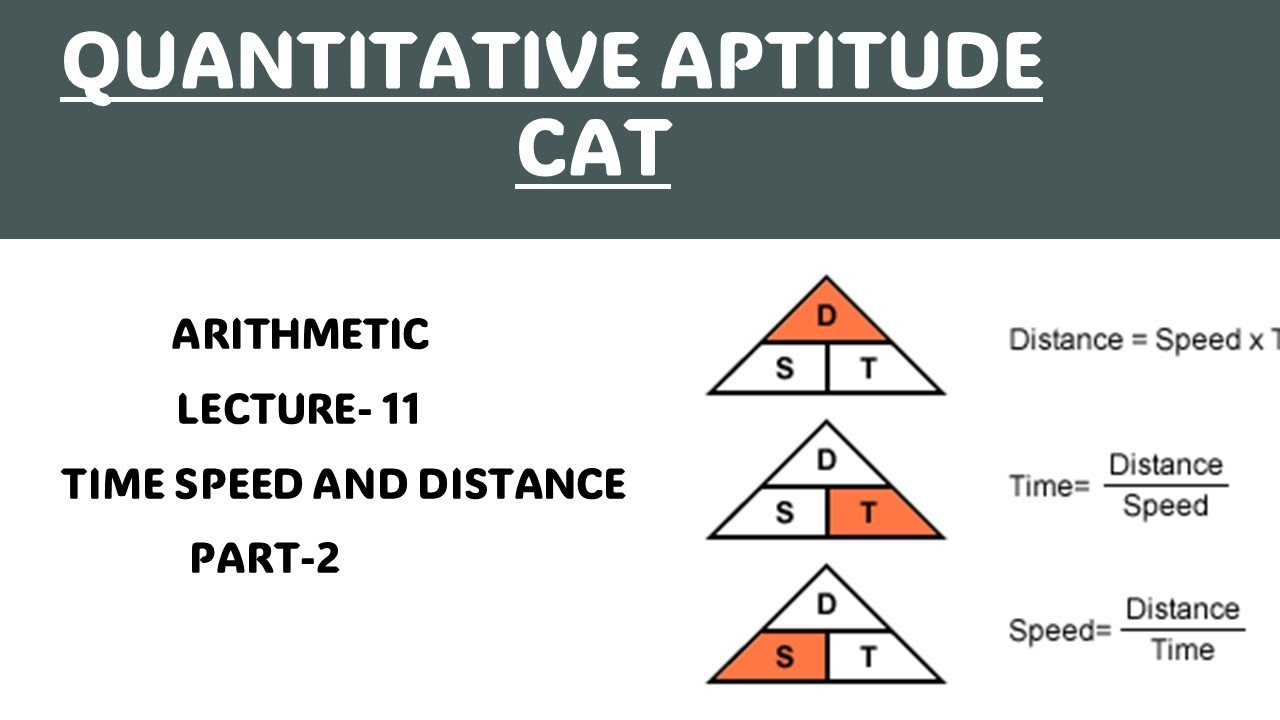
The three core formulas are:
- Distance = Speed × Time
- Speed = Distance / Time
- Time = Distance / Speed
A Note on Units
A common trap in TSD questions is inconsistent units. Speed might be in km/hr, but time is in minutes or seconds. Always ensure your units are consistent before applying any formula.
- Time: seconds (s), minutes (min), hours (hr)
- Distance: meters (m), kilometers (km)
- Speed: m/s, km/hr
The two most important conversions to memorize for speed are:
- To convert from km/hr to m/s, multiply by .
- To convert from m/s to km/hr, multiply by .
Think about it: 1 km/hr = 1000m / 3600s = 10/36 m/s = 5/18 m/s. Understanding the derivation helps if you forget the factor.
The Inverse Proportionality Rule
One of the most useful shortcuts comes from the relationship Time = Distance / Speed. If the distance is constant, notice that Speed and Time are inversely proportional.
- If you double your speed, you'll take half the time.
- If you travel at of your usual speed, you'll take of your usual time.
This means if the ratio of speeds of two journeys is , the ratio of the time taken for those journeys will be .
Speed, Time & Distance – Introduction & Concept
Let's review this core concept in the article 'Speed, Time & Distance – Introduction & Concept' from BYJU'S. It provides a good foundation and an example of how this inverse relationship is used.
First, read the sections 'Relationship Between Speed, Time & Distance' and 'Units of Speed Time & Distance' for a quick recap. Then, jump to the section 'Inverse Proportionality of Speed & Time' and read through Example Q.2 from the 'Average Speed' section. Notice how they solve it by stating if Speed is 3/4 * S1, then Time is 4/3 * T1.
2. The Concept of Average Speed
A very common question is to find the average speed of a journey that has multiple parts, each with a different speed. A frequent mistake is to simply take the arithmetic mean of the speeds. This is incorrect.
The fundamental, always-true formula for average speed is:
This is essentially a weighted average of speeds, where the times taken for each part of the journey are the weights. Let's look at the common scenarios.
Scenario 1: Covering Equal Distances at Different Speeds
Imagine going from home to the office and back, covering the same distance d each way.
- Going speed:
- Returning speed:
Total Distance =
Total Time =
This is a very important shortcut formula for a two-part journey with equal distances.
What if the journey has three equal parts? You could derive a more complex formula, but it's much safer and more intuitive to revert to the fundamental principle.
Objective Question Answer for Average Speed Quiz
Let's see how this works in practice. This quiz from Testbook provides multiple examples. We will look at a two-part and a three-part journey with equal distances.
First, read 'Average Speed Question 3', which is a classic round-trip problem perfectly solved by the 2*s1*s2 / (s1+s2) formula. Then, look at 'Average Speed Question 1'. Notice how for a three-part journey, they don't use a complicated formula. They simply assume a convenient distance (1 unit or the LCM of speeds), calculate the time for each part, and then apply Total Distance / Total Time.
Scenario 2: Travelling for Equal Times at Different Speeds
Now, what if you travel for 1 hour at speed and then another 1 hour at speed ?
- Time for each part:
- Speeds: and
Total Time =
Total Distance =
When the time intervals are equal, the average speed is simply the arithmetic mean of the individual speeds.
Objective Question Answer for Average Speed Quiz
Let's confirm this with another example from the Testbook quiz.
Read 'Average Speed Question 10'. The journey has two parts, each lasting 33 minutes. Observe how the solution simplifies to the arithmetic average of the two speeds.
Scenario 3: The General Case (Unequal Distances and Times)
If neither the distance nor the time is equal for all parts of the journey, you must use the fundamental formula: Total Distance / Total Time. There are no shortcuts.
You'll need to calculate the distance and time for each segment of the journey and then sum them up.
Test your understanding!
A man travels from town A to town B. He covers the first 50 km at 40 km/hr. For the remaining 120 km, he takes 2 hours. What is his average speed for the entire journey?
Show answer
This is a general case problem because the distances (50 km and 120 km) are not equal. We must use the fundamental formula: Average Speed = Total Distance / Total Time.
-
Find Total Distance:
Total Distance = 50 km + 120 km = 170 km. -
Find Total Time:
- Time for the first part (T1): Time = Distance / Speed = 50 km / 40 km/hr = 1.25 hours.
- Time for the second part (T2): Given as 2 hours.
- Total Time = T1 + T2 = 1.25 hours + 2 hours = 3.25 hours.
-
Calculate Average Speed:
Average Speed = Total Distance / Total Time = 170 km / 3.25 hours.
To simplify the calculation: 170 / (13/4) = (170 * 4) / 13 = 680 / 13.
Average Speed ≈ 52.3 km/hr.
Conclusion
Today we've laid the groundwork for an entire category of problems. Mastering these fundamentals is non-negotiable for success in the CAT.
Key Takeaways:
- The DST Triangle is your best friend: It helps you instantly recall the three core formulas: , , and . Always check for unit consistency.
- Average Speed is Total Distance / Total Time: This is the universal truth. Do not simply average the speeds unless the time intervals are equal.
- Know the Shortcuts:
- For two equal distances: Average Speed = .
- For equal time intervals: Average Speed = (simple average).
- Embrace Proportionality: When distance is constant, speed and time are inversely proportional. This is a powerful tool for solving problems without calculating the actual distance.
In our next lesson, we will build directly on these concepts to tackle problems involving relative speed. We'll analyze scenarios like two trains moving on parallel tracks or a boat moving in a flowing river, adding another layer to our understanding of TSD.