Hello! Welcome to the final lesson in our module on Averages and Mixtures.
In our last session, we explored the two main types of mixture problems: blending and replacement. We also got our first look at the Rule of Alligation as a handy shortcut for solving blending problems. You saw how it could quickly determine the ratio needed to mix two ingredients to achieve a target price.
Today, we're going to unlock the full potential of that shortcut. Our learning outcome is to apply the rule of alligation to quickly solve problems on mixtures and weighted averages. We'll see that this rule isn't just for mixtures of rice and milk; it's a powerful and versatile tool for any situation involving weighted averages. This is a crucial technique for the CAT, where speed and accuracy are paramount.
From Weighted Average to Alligation: A Quick Recap
As we briefly touched upon last time, the Rule of Alligation is not a magic trick but a clever visual rearrangement of the weighted average formula. Given your background in Computer Science, appreciating this logical foundation can make the method more intuitive and easier to remember.
An average is "weighted" when some components contribute more than others. The formula is:
where and are the values of the two components, and and are their respective weights (or quantities).
The Rule of Alligation is what you get when you algebraically solve this equation for the ratio of the weights, .
Mixture and Alligation Concepts | Tricks | Formulas for CAT ...
Let's quickly revisit the derivation from the article 'Mixture and Alligation Concepts' by Bodheeprep. This will solidify the connection between the familiar weighted average formula and the alligation shortcut.
Briefly review the first part of the article, focusing on the derivation that starts with m = (ax + by) / (x + y) and ends with the alligation rule x/y = (b-m)/(m-a). This confirms that the rule is mathematically sound.
This derivation leads us to the fast and visual "criss-cross" method.
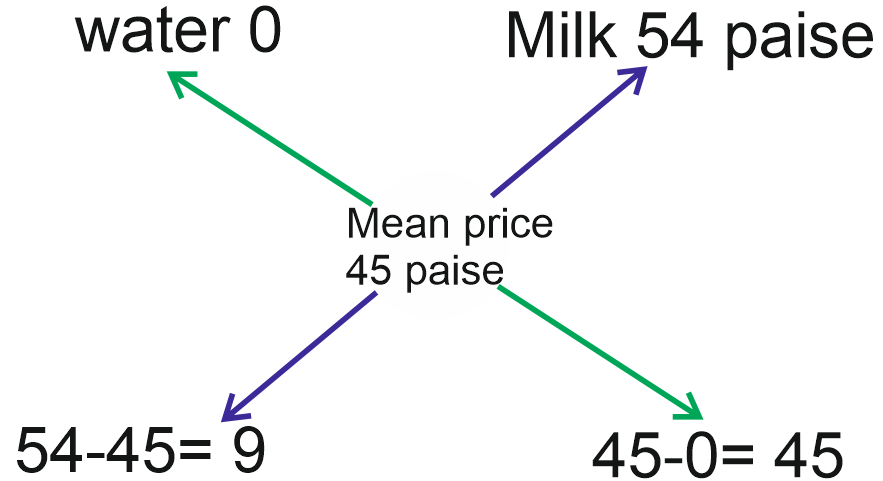
The structure is always the same:
- Place the value of the 'cheaper' or 'lower value' component on the left.
- Place the value of the 'dearer' or 'higher value' component on the right.
- Place the desired 'mean' or 'average' value in the center.
- Subtract along the diagonals (always the larger number minus the smaller) and place the results below the opposite components.
- These results give the ratio of the weights (quantities) of the two components.
Alligation in Action: Beyond Simple Mixtures
Now, let's apply this powerful tool to various weighted average scenarios you'll encounter in the CAT exam. The key is to correctly identify the 'components', their 'values', and the 'mean value'.
1. Problems on Averages of Groups
Alligation is perfect for problems involving the average of two groups that are combined.
Scenario: A class has boys and girls. You know the average marks of the boys, the average marks of the girls, and the overall average of the class. You can use alligation to find the ratio of the number of boys to girls.
Here, the components are 'Boys' and 'Girls', the 'values' are their average marks, and the 'weights' are the number of students in each group.

This same logic applies to any problem with two groups and a combined average, like average salaries.
Mixture and Alligation: Concept, Formulas, Tips & Solved ...
Let's look at a solved example from Unstop involving average salaries. This will show you the exact same pattern we just discussed.
Read 'Question 1' in the 'Selected Questions With Answers For Practice' section. See how they use the average salaries of Grade A and Grade B workers and the overall average salary to find the ratio of the number of workers.
2. Problems on Profit & Loss
You can use alligation to solve problems where items with different profit margins are sold, and you know the overall profit.
Scenario: A merchant sells two items, A and B. He makes a 20% profit on A and a 40% profit on B. His overall profit from selling both is 25%. Alligation can find the ratio of the cost prices of items A and B.
Here, the 'values' are the profit percentages, the 'mean value' is the overall profit percentage, and the 'weights' are the cost prices of the items.
Mixture and Alligation: Concept, Formulas, Tips & Solved ...
The 'Unstop' article has a perfect example of this. Pay close attention to how the result of the alligation is a ratio of the cost prices.
Read 'Question 4' in the 'Selected Questions With Answers For Practice' section. Notice how the profit percentages (20% and 40%) and the overall profit (25%) are used to find the ratio of the cost price of the table to the chair.
3. Problems with Pre-existing Mixtures
Sometimes, you need to mix two solutions that are already mixtures themselves.
Scenario: You have two alloys. Alloy A is 5/7 zinc, and Alloy B is 3/7 zinc. In what ratio should you mix them to create a new alloy that is 1/2 zinc?
Here, the 'values' are the concentrations (or fractional parts) of the substance of interest (zinc). The 'weights' are the total quantities of each alloy.
Mixture and Alligation Concepts | Tricks | Formulas for CAT ...
Let's go back to the Bodheeprep article, which has an excellent worked example for this type of problem. This is a common and slightly more advanced application.
Read 'Problem 5' under the heading 'Mixing Two different Mixtures'. Observe how the fractional content of just one element (zinc) is used to represent each alloy in the alligation diagram.
A key principle here is consistency: you must use the same unit for all three values in the alligation diagram (e.g., all cost prices, all profit percentages, or all concentrations of the same component).
Test your understanding!
A shopkeeper buys two types of sugar. Type A costs ₹80/kg and Type B costs ₹110/kg. He has 30 kg of Type A. How many kgs of Type B should he mix with it so that by selling the mixture at ₹108/kg, he makes a 20% profit?
Hint: Alligation works on cost prices. First, find the cost price of the mixture from the given selling price and profit percentage.
Show answer
-
Find the Cost Price (CP) of the mixture:
The selling price (SP) is ₹108/kg, and the profit is 20%.
We know that SP = CP \times (1 + \frac{\text{Profit %}}{100}).
So, .
. This is our 'Mean Price' for the alligation. -
Apply Alligation:
- Cheaper (A): 80
- Dearer (B): 110
- Mean: 90
Cheaper(80) Dearer(110) \ / \ / Mean(90) / \ / \ (110 - 90) = 20 (90 - 80) = 10 -
Find the Ratio:
The ratio of the quantity of Type A to Type B is20 : 10, which simplifies to2 : 1. -
Calculate the quantity:
We are given that there are 30 kg of Type A sugar.
Quantity of B = kg.He should mix 15 kg of Type B sugar.
Conclusion
Today we've seen that the Rule of Alligation is far more than just a mixture trick; it's a universal method for solving weighted average problems quickly.
Key Takeaways:
- Alligation is a Visual Weighted Average Solver: It's a direct, algorithmic application of the weighted average formula.
- Identify the Structure: For any given problem, the key is to identify the two 'components', their individual 'values' (cost, percentage, average score), and the final 'mean value'.
- The Result is a Ratio of Weights: The alligation process gives you the ratio of the quantities, cost prices, or number of items that make up the whole.
- Versatile Applications: This method can be applied to averages, profit/loss, concentrations, and more, making it an invaluable tool for your CAT preparation.
This lesson concludes our module on Averages and Mixtures. You now have a solid understanding of averages, weighted averages, mixture logic, and the powerful Rule of Alligation.
In our next lesson, we will begin a new module: Rate-Based Applications. We'll start with the fundamental relationship between Time, Speed, and Distance, another essential topic for the CAT quantitative section.