Hello! Welcome to the final lesson in our "Combinatorics and Probability" module.
In our last session, we explored the multiplication rule for compound events. Specifically for dependent events, we used the formula . That term, , which reads "the probability of B given A," is the core concept for today.
Today's learning outcome is to solve basic problems involving conditional probability. We will formalize the idea of , understand its formula, and see how it's used to solve problems where we have partial information. This concept is about updating our assessment of probability as new information comes to light—a fundamental idea in fields from statistics to computer science.
1. What is Conditional Probability?
At its heart, conditional probability is the chance of an event happening, given that another event has already occurred. This "given" part is crucial—it reduces our "universe" of possibilities, changing the calculation.
Imagine a bag of marbles. The probability of picking a red marble changes if you know that a blue marble has already been picked and not replaced.
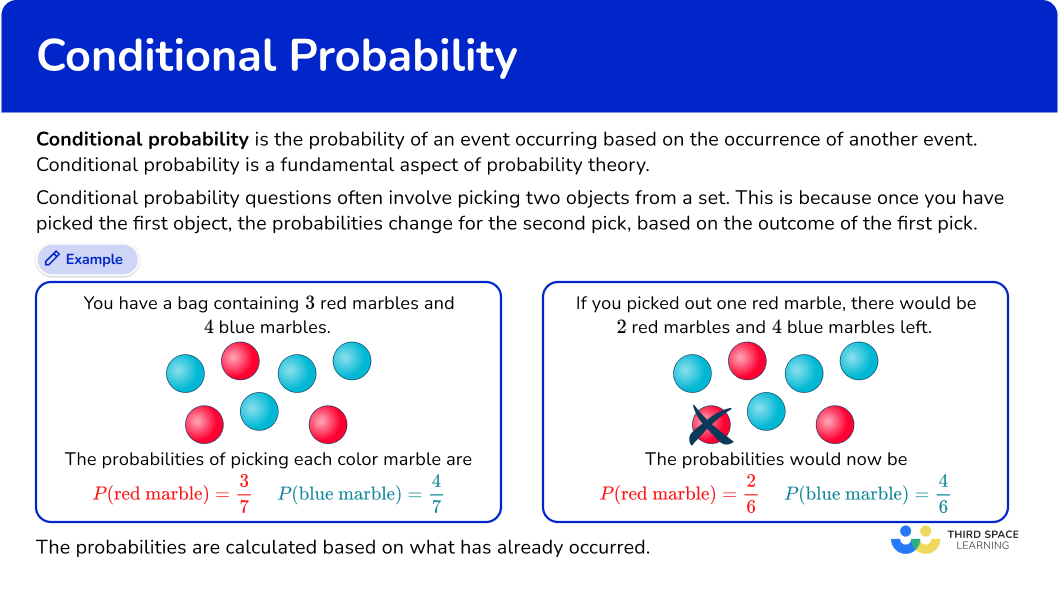
The notation for conditional probability is , which we read as "the probability of event A happening, given that event B has happened."
- Event A is the event we are interested in.
- Event B is the condition that we know to be true.
When we know B has happened, we are no longer considering all possible outcomes. We are only looking at the outcomes where B is true. This is called reducing the sample space.
2. The Formula and Key Approaches
From our last lesson, we know the multiplication rule for dependent events:
If we simply rearrange this formula to solve for , we get the formal definition of conditional probability:
Provided that .
This formula is the algebraic foundation. However, for many CAT problems, you'll have two main ways to solve them:
- Reduced Sample Space: Logically figuring out the new total outcomes.
- Direct Formula Application: Using the formula above when probabilities are given.
Let's explore these.
Approach 1: Reduced Sample Space
This is the most intuitive method. You redefine your "total outcomes" based on the given condition.
Let's see this approach explained using a contingency table, which is a powerful tool for organizing information in probability questions.
Section 3.2: Conditional Probability
This text from OpenIntro Statistics provides a great walkthrough of conditional probability using a contingency table. This method is incredibly useful for organizing information in word problems, which are common in the CAT.
Read from the beginning of Section 3.2 (page 95) up to, but not including, the sub-section 'General multiplication rule' (page 100). Focus on how probability is calculated by restricting your view to a specific row or column in the table (the 'condition'). For example, when the condition is 'truth is fashion', you only look at the 309 photos in that column.
As you read, notice how calculating P(mach learn is pred fashion | truth is fashion) was done by dividing the number of photos that are (pred fashion AND fashion) by the new total, which is just the total for the truth is fashion column.
Example:
A single fair die is rolled. What is the probability that the number is a 4, given that the outcome is an even number?
- Original Sample Space: {1, 2, 3, 4, 5, 6} (6 outcomes)
- Condition: The outcome is even.
- Reduced Sample Space: {2, 4, 6} (Now only 3 possible outcomes)
- Favorable Outcome: {4} (1 outcome)
- Conditional Probability:
This is often much faster than calculating and separately and then dividing.
Approach 2: Direct Formula Application
Sometimes, the problem gives you probabilities directly, not counts. In these cases, using the formula is the only way to go.
Let's look at some CAT-specific examples that use both approaches.
Comprehensive Guide for CAT Probability
The following examples from the Hitbullseye CAT guide show how conditional probability concepts are tested. Pay attention to which method they use for each problem.
In the section 'CAT Probability Examples', carefully review 'Example 2' and 'Example 3'. Note that Example 2 can be solved quickly by reducing the sample space, as we just discussed. Example 3, however, provides probabilities directly, making it a perfect candidate for the formula.
Let's recap Example 3 from the reading:
- . This is .
- . This is .
- We need to find .
Here, we don't have counts, so we must use the formula:
Test your understanding!
A survey of 100 students found the following:
- 40 students are in the Chess club.
- 30 students are in the Debate club.
- 10 students are in both clubs.
A student is chosen at random.
a) What is the probability they are in the Debate club, given they are in the Chess club?
b) What is the probability they are in the Chess club, given they are in the Debate club?
Show answer
Let C = Chess club and D = Debate club. We have the counts, so we can use the reduced sample space method.
a) Find P(D | C): "Probability of Debate, given Chess"
- Our condition is that the student is in the Chess club. So, our new universe of possibilities is just the 40 students in the Chess club.
- Within this group of 40, how many are also in the Debate club? The problem states this is 10 students.
- Therefore, .
b) Find P(C | D): "Probability of Chess, given Debate"
- Our condition is that the student is in the Debate club. Our new universe is the 30 students in the Debate club.
- Within this group of 30, how many are also in the Chess club? This is the same 10 students from the overlap.
- Therefore, .
Notice how changing the condition changes the probability!
3. Tree Diagrams for Sequential Events
For problems involving a sequence of events (like drawing two cards without replacement), a tree diagram is a fantastic way to organize all the conditional probabilities.
You start with branches for the first event. Then, from the end of each of those branches, you draw new branches for the second event. The probabilities on these second-stage branches are conditional.
Example: A bag has 3 red and 2 blue marbles. Two marbles are drawn without replacement. What is the probability the second marble is blue?
A tree diagram would look like this:
-
First Draw:
- Path 1: Draw Red with .
- Path 2: Draw Blue with .
-
Second Draw (Conditional):
- If you drew Red first, the bag has 2R, 2B. So .
- If you drew Blue first, the bag has 3R, 1B. So .
The question asks for . The second marble can be blue in two ways: (Red first, then Blue) OR (Blue first, then Blue).
Since these are "OR" events, we add the probabilities:
Tree diagrams are extremely useful for organizing these sequential calculations and are foundational for more advanced topics like Bayes' theorem.
Conclusion
This lesson marks the end of our module on Combinatorics and Probability. You've built a strong foundation from basic counting principles all the way to handling conditional events.
Key Takeaways:
- Conditional Probability is the probability of event A, given that event B has occurred.
- It operates on a reduced sample space, where the total possible outcomes are limited by the condition B.
- The governing formula is a rearrangement of the multiplication rule: .
- For exam problems, you can often solve them faster by intuitively reducing the sample space rather than by mechanically applying the formula.
- Tree diagrams are an excellent tool for visualizing and solving problems that involve a sequence of dependent events.
Preview of the Next Lesson:
We will now transition to a new area of the CAT syllabus. In the next module, we'll begin our study of Plane Geometry. We will start with the building blocks: applying the properties of lines, angles, and triangles to find unknown values and solve geometric puzzles.