Hello! Welcome to our next lesson in the "Combinatorics and Probability" module.
In our last few lessons, we mastered the art of counting using permutations and combinations. We focused on how to handle conditions like "at least" and "at most" and established a core principle: "AND" implies multiplication, while "OR" implies addition. This logic is the perfect foundation for today's topic.
Our learning outcome is to apply the addition and multiplication rules to calculate probabilities of compound events. A compound event is simply an event that consists of two or more simpler events. For example, rolling a die twice or drawing two cards from a deck are compound events. You'll find that the "AND/OR" logic from combinatorics maps directly onto the probability rules we'll learn today.
From Counting to Probability
Remember our basic probability formula:
Calculating the numerator and denominator often requires the combinatorics skills you've just developed. Now, we'll learn the rules to combine the probabilities of these events directly.
There are two fundamental rules that govern the probability of compound events:
- The Multiplication Rule: Used for "AND" scenarios (e.g., probability of event A and event B).
- The Addition Rule: Used for "OR" scenarios (e.g., probability of event A or event B).
Let's explore each rule in detail.
1. The Multiplication Rule (for "AND" Events)
Whenever a problem asks for the probability of two or more events happening in sequence or simultaneously (Event A and Event B), you should immediately think of multiplication. However, there's a crucial distinction you must make first.
To understand this, please read the first part of the following article, which clearly explains the multiplication rule and introduces the vital concepts of independent and dependent events.
GMAT Probability Problems | TTP GMAT Blog
This article from the TTP GMAT Blog provides a clear, exam-focused explanation of the multiplication rule. It will help you understand when and how to multiply probabilities.
Please read from the beginning of the article down to the end of 'Probability Example 4'. Focus on understanding the difference between independent and dependent events and see how the calculation changes for each.
Key Concepts from Your Reading
As you saw in the article, the key is to determine if the events are independent or dependent.
A. Independent Events
Two events are independent if the outcome of the first event does not influence the outcome of the second. Common examples include rolling a die multiple times or flipping a coin.
For independent events A and B, the formula is straightforward:
Example (from the text): An archer has a 30% chance of hitting a bullseye. The probability of hitting it four times in a row is . Each shot is independent of the others.
B. Dependent Events
Two events are dependent if the outcome of the first event does affect the probability of the second. This is common in problems involving selection without replacement.
For dependent events A and B, the formula involves conditional probability:
Here, means "the probability of B happening, given that A has already happened."
Example (from the text): Picking two boys from a room of 6 boys and 6 girls.
- Given the first was a boy, there are now 5 boys and 11 people left.
- So, .
- The total probability is .
Test your understanding!
A bag contains 5 red and 3 blue marbles. Two marbles are drawn one after another. What is the probability that both are red if:
a) The first marble is replaced before drawing the second?
b) The first marble is not replaced?
Show answer
a) With replacement (Independent Events):
The probability of the first draw being red is .
Since the marble is replaced, the bag is unchanged. The probability of the second draw being red is .
.
b) Without replacement (Dependent Events):
The probability of the first draw being red is .
After drawing one red marble, there are 4 red marbles and 7 total marbles left.
The probability of the second being red, given the first was red, is .
.
2. The Addition Rule (for "OR" Events)
When a problem asks for the probability of one event or another happening (Event A or Event B), you should think of addition. Just as with multiplication, there is a critical distinction to make.
Please continue reading the same article, which now moves on to the addition rule.
GMAT Probability Problems | TTP GMAT Blog
This next section of the article explains the addition rule, distinguishing between events that can happen together and those that cannot.
Please read the sections titled 'Addition Rule for Mutually Exclusive Events' and 'Addition Rule for Non-Mutually Exclusive Events'. Focus on why a term is subtracted in the second case.
Key Concepts from Your Reading
The key here is to determine if the events can happen at the same time.
A. Mutually Exclusive (Disjoint) Events
These are events that cannot occur simultaneously. For example, when drawing a single card, it cannot be both a King and a Queen.
For mutually exclusive events A and B, the formula is simple:
Example (from the text): Drawing a single card from a deck.
.
B. Non-Mutually Exclusive (Overlapping) Events
These are events that can happen at the same time. For example, when drawing a single card, it can be both a Queen and a Heart (the Queen of Hearts).
If we just add , we double-count the outcome where both happen. Therefore, we must subtract the probability of the overlap.
Example (from the text): Drawing a single card from a deck.
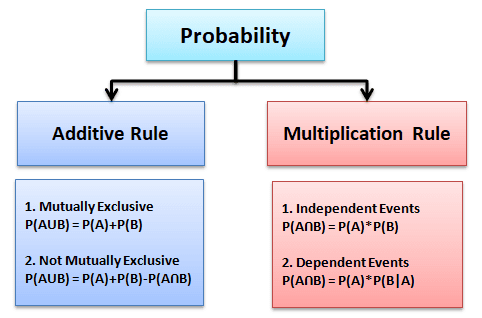
Summary of the Rules
This can feel like a lot to remember, but it boils down to four scenarios based on the keywords "AND" and "OR". The following flowchart is an excellent summary.
Test your understanding!
You roll a single fair six-sided die. What is the probability that you roll:
a) An even number or a 5?
b) An even number or a prime number?
(The prime numbers on a die are 2, 3, and 5)
Show answer
a) An even number or a 5 (Mutually Exclusive):
The even numbers are {2, 4, 6}. The number 5 is not in this set. The events are mutually exclusive.
. .
.
b) An even number or a prime number (Non-Mutually Exclusive):
The even numbers are {2, 4, 6}. The prime numbers are {2, 3, 5}. The number 2 is in both sets, so the events overlap.
. .
The overlap is the number 2, so .
.
Conclusion
You have now learned the foundational rules for calculating the probability of compound events. By identifying the keywords "and" or "or" and then checking for dependence or overlap, you can systematically solve a huge range of probability questions.
Key Takeaways:
- "AND" scenarios use the Multiplication Rule.
- Independent:
- Dependent:
- "OR" scenarios use the Addition Rule.
- Mutually Exclusive:
- Non-Mutually Exclusive:
Preview of the Next Lesson:
Today, we got a glimpse of conditional probability with the term . In our next lesson, we will dive deeper into Conditional Probability. We will formalize its definition, explore the formula for calculating it directly, and apply it to solve more complex, layered problems of the type frequently seen on the CAT.