Hello! Welcome to the final lesson in our "Commercial Mathematics" module.
In our last session on partnerships, we established that a partner's profit share is determined by the product of their investment and the time it was invested. This can be expressed as: Profit ∝ (Capital × Time). This idea of one quantity being "proportional to" another is the central theme of today's lesson.
Today, we will formalize this concept by exploring direct and inverse variation. Your learning outcome is to apply concepts of direct and inverse variation to solve word problems. This is a fundamental skill in quantitative aptitude. Many problems in topics like Time & Work or Time, Speed & Distance are simply applications of variation, and understanding the core principle allows you to solve them logically and quickly, even if you forget a specific formula.
1. Understanding Direct Variation
Direct variation (or direct proportion) describes a relationship where two quantities increase or decrease together at the same rate. If you buy more pens, the total cost goes up. If you work for more hours, you earn more money (assuming a fixed hourly wage).
The key relationship is that the ratio of the two quantities is always constant.
If a quantity varies directly with a quantity , we write this as:
This is translated into the equation:
where is the "constant of proportionality". By rearranging this, we get the core principle for direct variation:
This constant ratio allows us to solve problems without necessarily finding k. If () and () are two pairs of corresponding values, then:
This is often the fastest way to solve a problem.
Let's look at the basic definitions and graphs.
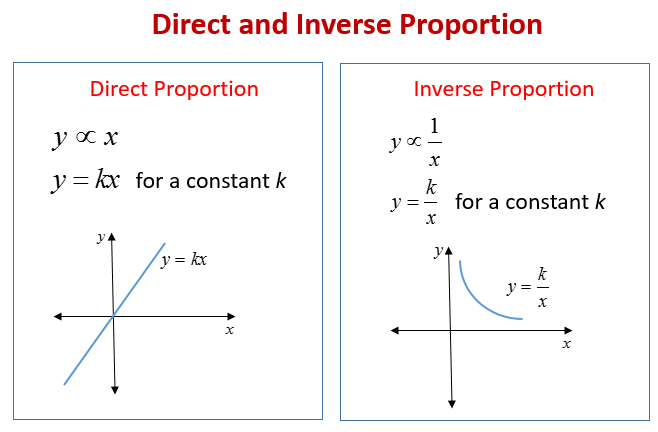
To solidify the core idea, please read the short introductory section in the following resource.
This PDF from NCERT provides a clear and concise definition of direct and inverse proportion. Focus on the definition and the resulting formulas.
Read the first two bullet points under section (A) Main Concepts and Results. This covers the definitions for direct and inverse proportion and introduces the equations y1/x1 = y2/x2 and x1y1 = x2y2, which are excellent shortcuts.
Now, let's see how to apply this to a word problem. The process generally involves two steps:
- Use a given set of complete information (e.g., "when
xis 2,yis 10") to find the constantk. - Use that constant
kto find the missing value in an incomplete set of information (e.g., "findywhenxis 5").
This video will walk you through a typical word problem.
Solving Word Problems Involving DIRECT and INVERSE Variation - Grade 9 Math
The following video from MATH TEACHER GON demonstrates the standard method of solving a direct variation word problem by first finding the constant of variation.
Watch the segment from 00:30 to 06:25. Pay close attention to the three steps: Translating the word problem into a variation equation (D = kS^2). Using the initial values to find k. Using the full equation to solve for the unknown distance.
Test your understanding!
The cost of a diamond varies directly as the square of its weight. If a diamond weighing 10 grams costs Rs. 80,000, what will be the cost of a diamond weighing 15 grams?
Show answer
Let be the cost and be the weight. The problem states , so our equation is .
Step 1: Find k
We are given when .
Step 2: Find the cost for the new weight
Now we use our full equation to find the cost when .
The cost will be Rs. 1,80,000.
Shortcut using ratios:
2. Understanding Inverse Variation
Inverse variation (or inverse proportion) describes a relationship where one quantity increases as the other decreases. For example, if you increase the speed of your car, the time it takes to cover a fixed distance decreases. If you hire more workers for a job, the time to complete the job decreases.
Here, the product of the two quantities is always constant.
If a quantity varies inversely with a quantity , we write this as:
This is translated into the equation:
Rearranging gives the core principle for inverse variation:
For two pairs of values, () and (), we have:
This is the fastest way to solve inverse variation problems. Let's watch the application.
Solving Word Problems Involving DIRECT and INVERSE Variation - Grade 9 Math
Now we'll watch the second half of the same video, which explains inverse variation using a classic 'work-time' problem.
Watch from 06:25 to 10:27. Note how the equation changes to T = k/E and how the product T × E is used to find the constant k.
3. Joint and Combined Variation
CAT problems often involve more than two quantities. This is where joint and combined variation come in.
-
Joint Variation: A quantity varies directly with the product of two or more other quantities.
- Example: "y varies jointly with x and z" means .
- Our partnership formula,
Profit = k × Capital × Time, is a perfect example of joint variation.
-
Combined Variation: A quantity varies directly with some quantities and inversely with others.
- Example: "y varies directly with x and inversely with z" means .
The strategy is the same: translate the sentence into a single equation and solve for k.
Variation: Direct, Inverse, Joint, and Combined
This short video from Mario's Math Tutoring provides a very clear explanation of how to set up equations for joint and combined variation.
Watch from 06:13 to 10:00. Focus on how the phrases 'varies jointly' and 'varies inversely' translate into the placement of variables in the numerator or denominator of the equation.
Let's look at a typical CAT-level problem involving combined variation.
Worked Example:
The duration of a railway journey varies as the distance and inversely as the velocity. The velocity varies directly as the square root of the quantity of coal used, and inversely as the number of carriages in the train.
How do we combine this into one formula?
Let = duration, = distance, = velocity, = coal used, and = number of carriages.
- From the first sentence: which means .
- From the second sentence: which means .
Now, substitute the expression for from the second equation into the first one:
Wait, I substituted V with an expression that contains V. Let's re-read. The second sentence defines V. So I should substitute the expression for V into the first equation.
Since and are both constants, their ratio () is just another constant. Let's call it .
This single equation captures all the relationships described. From here, you would use a set of given values to find , and then use to solve for an unknown. This problem is similar to Problem 2 in the "Level of Difficulty (II)" section of the "Ratio, Proportion and Variation" PDF resource (LINK), which you can review later.
4. Practice Problems
Let's try a couple of problems from a CAT preparation resource. Use the proportionality/ratio method to solve them quickly.
Ratio, Proportion and Variation
The following resource contains many practice problems. We will tackle two of them now.
Locate questions 3 and 4 in the 'Level of Difficulty (I)' exercise list. Try to solve them on your own before looking at the provided solutions below.
Problem 1 (Question 3):
If x varies inversely as and is equal to 3 when y = 2, find x when y = 4.
Show Solution
"x varies inversely as " means .
Using the principle :
- Given: ,
- To find: when
Substitute the values:
Problem 2 (Question 4):
If x varies as y, and y = 4 when x = 12, find x when y = 15.
Show Solution
"x varies as y" means direct variation, so .
Using the principle :
- Given: ,
- To find: when
Substitute the values:
Conclusion
Today we've demystified variation. By recognizing whether quantities are related directly or inversely, you can quickly set up an equation and solve for unknowns.
Key Takeaways:
- Direct Variation: As one goes up, the other goes up. The ratio is constant.
- Inverse Variation: As one goes up, the other goes down. The product is constant.
- Joint/Combined Variation: Used for relationships involving more than two quantities. Combine all relationships into a single equation with one constant, .
- Problem-Solving: The ratio/product shortcut is almost always faster than the two-step method of finding
kfirst.
This lesson concludes our module on Commercial Mathematics. You've built a strong foundation in percentages, interest, partnerships, and variation.
In our next lesson, we will begin the Averages and Mixtures module. We'll start by learning to solve problems with simple, weighted, and combined averages, which are essential skills for the CAT.