Hello! Welcome to our third lesson in the "Commercial Mathematics" module.
In our last session, you learned how to solve problems involving successive percentage changes, profit & loss, and discounts. We ended with a crucial insight: the formula for successive changes, , is the key to understanding how values compound.
Today, we will build directly on that foundation. Our learning outcome is to solve problems on simple and compound interest, focusing on the difference between them and the concept of effective rate of interest. You'll see that compound interest is simply successive percentage increase applied over time, a concept you are now familiar with.
1. The Fundamental Difference: Simple vs. Compound Interest
At its core, interest is the "rent" paid for using money. The way this rent is calculated defines the two types of interest.
- Simple Interest (SI): The interest is calculated only on the original principal amount, for the entire duration. The interest earned each year is constant.
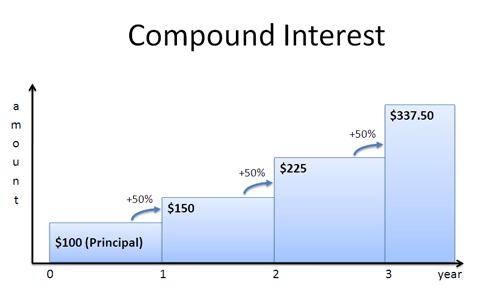
- Compound Interest (CI): The interest is calculated on the principal plus any interest that has already been earned. This means you earn "interest on interest," causing the investment to grow at an accelerating rate.
This image provides a clear visual of the accelerating growth of compound interest.
To see a side-by-side numerical comparison, let's watch a short clip.
CAT 2026 | Simple and Compound Interest Formulas Important Questions 🔴 By 5-Time CAT 100%iler
This video from Cracku provides a clear, step-by-step numerical example that highlights the core difference in how simple and compound interest are calculated year after year.
Watch the segment from 00:56 to 02:23. Pay close attention to how the principal amount for the next year's calculation stays the same for simple interest but increases for compound interest.
The standard formulas are:
- Simple Interest:
- Amount in Compound Interest:
- Where is Principal, is the annual rate, and is the time in years. The Compound Interest earned is .
2. Effective Rate of Interest: What You Actually Earn
As we saw in the last lesson, a 10% increase followed by another 10% increase doesn't result in a 20% total increase, but a 21% one. This "true" percentage change is what we call the Effective Rate of Interest.
Let's say a bank offers 10% annual interest, compounded annually.
- For the first year, you earn 10%.
- For the second year, you earn 10% on your new, larger amount.
- The effective rate for one year is simply 10%.
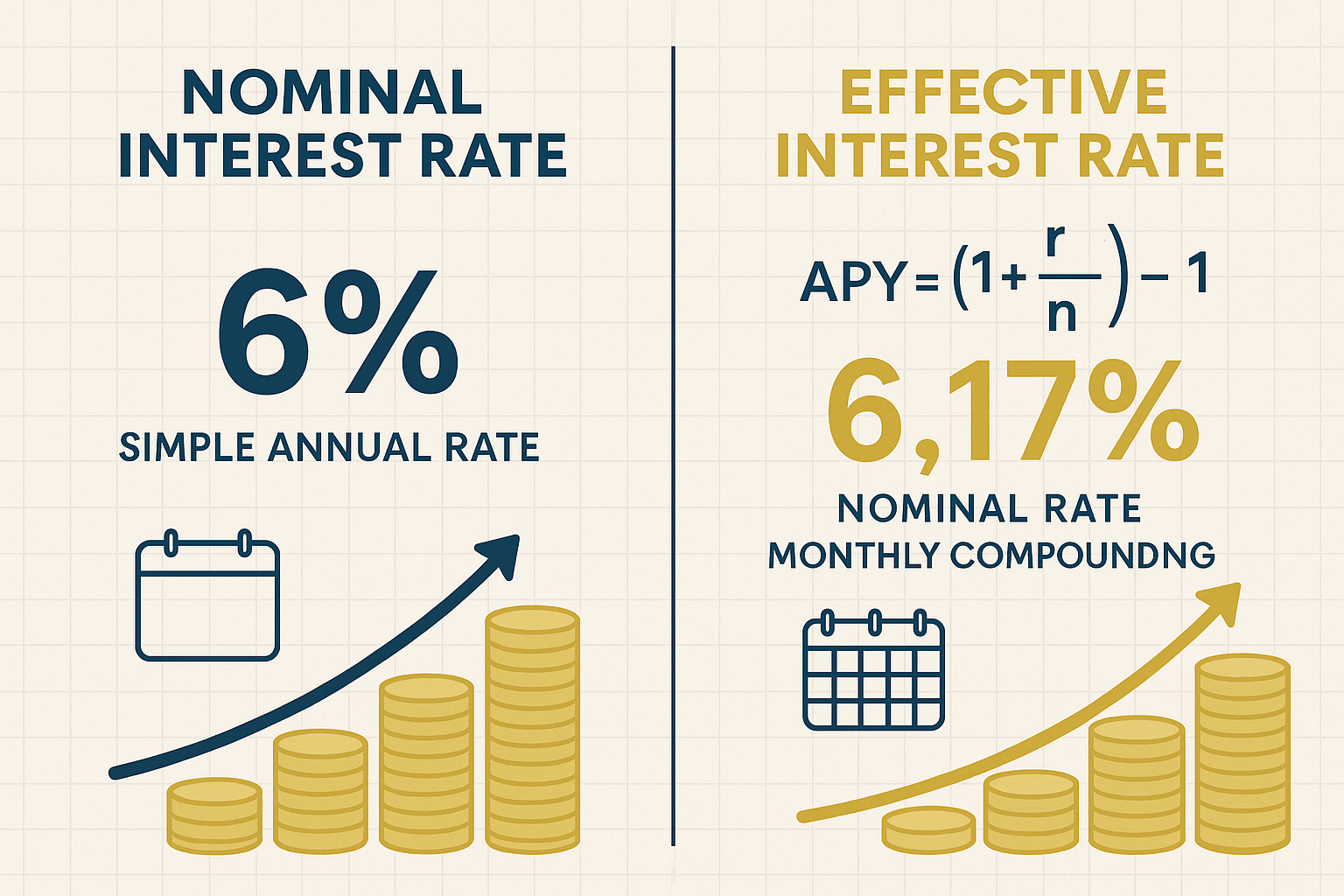
But what if the interest is compounded more frequently? The nominal rate is the stated annual rate (e.g., 6% per year), while the effective rate is what you actually earn after accounting for the compounding periods within that year.
This image perfectly illustrates the concept.
For the CAT, you don't always need to calculate the effective rate from its formula. Instead, you should be familiar with the effective rates for common scenarios, treating them as successive percentage changes.
Example: 20% p.a. compounded half-yearly.
This is equivalent to a 10% interest payment every 6 months. Over one year, this means two successive 10% increases.
Using our formula from the last lesson:
Effective Rate =
So, a 20% nominal rate compounded half-yearly gives an effective annual rate of 21%.
To help build speed, it's useful to familiarise yourself with the effective rates for common values.
Complete Simple & Compound Interest | IMP Questions | Short-Tricks | CAT IPMAT | Ronak Shah
The following clip from Unacademy CAT presents a handy table of effective interest rates for common percentages over 2 and 3 years. Knowing these can save you valuable time.
Watch the segment from 01:31 to 03:42. Focus on the table showing total interest for rates like 5%, 10%, and 20% over 2 and 3 years. Try to understand how these values are derived from successive percentage changes.
3. The Difference Between SI and CI: A Frequent Question Type
A very common problem on the CAT asks for the difference between compound and simple interest for a given principal, rate, and time.
Let's think about it for 2 years.
- Year 1: SI = CI. There is no difference.
- Year 2: The difference arises because CI is calculated on the first year's interest, while SI is not.
- Difference = Interest on (First Year's SI)
- Difference =
For 3 years, the logic extends, but it's faster to use a direct formula. For exam purposes, memorizing the formulas for the 2-year and 3-year difference is a high-yield strategy.
Shortcuts and Tricks for Compound Interest
This article from GeeksforGeeks provides the direct, powerful formulas for calculating the difference between CI and SI for both 2 and 3 years. These are essential shortcuts.
Read section '6. Formulas for CI-SI Difference Over 2 and 3 Years'. Commit these two formulas to memory.
Let's recap the formulas you just saw:
- Difference for 2 years:
- Difference for 3 years:
Test your understanding!
The difference between the compound interest and simple interest on a certain sum of money for 2 years at 5% per annum is Rs. 15. Find the sum.
Show answer
We use the 2-year difference formula:
Given: , . We need to find .
The principal sum is Rs. 6000.
4. Advanced Problem-Solving Techniques
Now let's look at how these concepts are applied in more complex CAT questions. A key idea is that in compound interest, the amount grows by the same multiplicative factor in equal time intervals.
For example, if an amount doubles in 4 years, it will double again (becoming 4x the original) in the next 4 years.
The following video walks through some excellent CAT-level problems that use these concepts.
Complete Simple & Compound Interest | IMP Questions | Short-Tricks | CAT IPMAT | Ronak Shah
Let's watch Ronak Shah solve a few typical CAT problems. Pay close attention to the logic rather than just the calculation. We will look at two types of problems.
Please watch the following two segments: Comparing SI and CI (09:56 - 12:09): See how assuming a principal of 100x and using effective interest rates makes the calculation straightforward. Comparing CI Across Different Years (16:48 - 23:20): This is a crucial section. Understand the core idea that the growth factor for the amount (and for the CI itself) is constant for equal time periods. For instance, the ratio of CI in Year 3 to CI in Year 2 is the same as the ratio of CI in Year 2 to CI in Year 1.
A Note on Installment Problems
Sometimes, loans are paid back in equal installments. Solving these problems involves the concepts of Present Value (the current worth of a future sum of money) and Future Value (the value of a current sum at a future date). While we won't dive deep today, it's good to know that these are direct applications of SI/CI formulas. The video resource LINK covers this in sections 2, 6, and 7 if you are curious to explore further.
Conclusion
You have now connected the dots from successive percentage changes to the world of simple and compound interest. This is a topic that rewards a strong conceptual grasp with significant time savings in the exam.
Key Takeaways:
- Compound Interest is essentially a series of successive percentage increases.
- The Effective Interest Rate is the actual annual rate of return, which can be higher than the nominal rate if interest is compounded more than once a year.
- The difference between CI and SI for 2 years is the interest on the first year's interest. Memorize the direct formulas for the 2-year and 3-year differences.
- Under compound interest, an amount grows by a constant multiplicative factor over equal time periods (e.g., it doubles every
xyears).
In our next lesson, we'll continue our exploration of commercial mathematics by looking at Partnership problems. We will learn how to distribute profits or losses among partners based on their variable investments and time periods.