Hello! Welcome to our second lesson in the "Commercial Mathematics" module.
In our last session, we mastered the art of rapid conversions between percentages, fractions, and ratios. We saw how memorizing common equivalences and using mental math shortcuts for 10% and 1% can drastically improve your speed.
Today, we'll apply these foundational skills to solve problems that are a cornerstone of the CAT quantitative section. Our learning outcome is to solve problems involving successive percentage changes, profit & loss, and discounts. You'll discover that these three topics are deeply intertwined and often appear together in a single question. A solid understanding here is crucial for your exam success.
Let's dive in.
1. The Compounding Effect of Successive Percentage Changes
A common trap in percentage problems is to simply add or subtract consecutive changes. For example, if a price increases by 20% and then by another 10%, the total increase is not 30%. Why? Because the second percentage change is calculated on the new, adjusted value.
Let's see this with an example:
- Initial Value: 100
- First increase (20%):
- Second increase (10%):
The final value is 132, which is a 32% increase from the original 100, not 30%. This is the essence of successive percentage change.
To understand this concept more deeply and learn a powerful shortcut, let's watch a segment of the following video.
Successive Percentages|change & applications| cat2022 quantitative aptitude preparation strategy|mba
This video from Unacademy CAT-alyst clearly explains the concept of successive percentage changes and introduces the universal formula to calculate the net effect quickly.
Watch from 04:10 to 14:38. Focus on: Why adding percentages directly is incorrect. The net change formula presented and how to use it.
The Net Percentage Change Formula
As explained in the video, a single formula can handle all scenarios of two successive percentage changes, and :
A key point to remember:
- Use a positive sign for increases (e.g., profit, markup, price hike).
- Use a negative sign for decreases (e.g., discount, loss, price drop).
Let's revisit our initial example: a 20% increase followed by a 10% increase.
- ,
- Net Change % = . This matches our manual calculation and is much faster.
2. Successive Discounts
This concept is most frequently seen in problems involving discounts. A store might offer a 40% sale and then allow you to use a 20% off coupon on top of that.
This image provides a great visual breakdown of how successive discounts work.
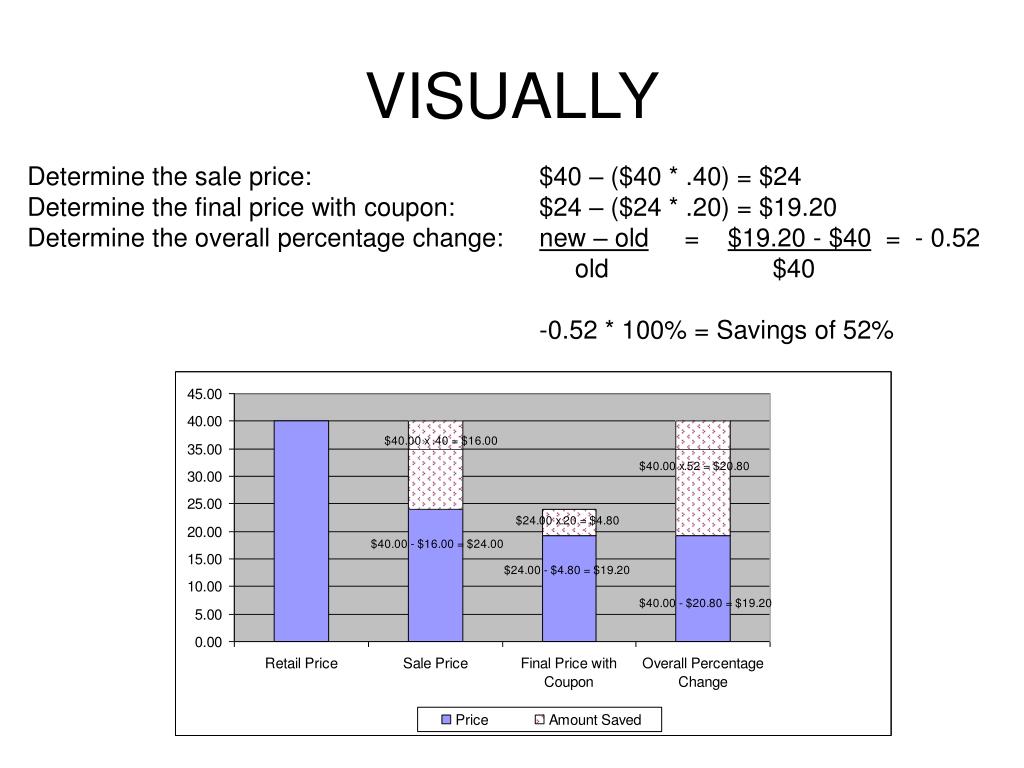
Let's apply our formula to this scenario: a 40% discount followed by a 20% discount.
- ,
- Net Change % =
- Net Change % =
The net result is a 52% discount, exactly as the image concludes.
Test your understanding!
The price of a smartphone is increased by 30%. Due to low sales, the new price is then decreased by 20%. What is the net percentage change in the price from its original value?
Show answer
Here, (increase) and (decrease).
Using the formula:
Net Change % =
Net Change % =
Net Change % =
There is a net increase of 4% in the price.
3. The Language of Commerce: Profit, Loss, and Discounts
Now, let's formally define the terms used in almost all commercial math problems. Understanding these terms and the relationships between them is non-negotiable.
Profit & Loss in CAT 2026: Only 3 Formulas Needed
This article from Careers360 provides clear, concise definitions for the key terms in profit and loss. It's essential to get this terminology right.
Read the introductory section up to 'Why Profit and Loss is important in CAT Quant'. Focus on the definitions of Cost Price (CP), Selling Price (SP), Marked Price (MP), and Discount.
Let's summarize the flow of a typical transaction:
- Cost Price (CP): The price at which a seller acquires an item. This is the seller's initial investment.
- Marked Price (MP): The seller increases the CP by a certain percentage (called markup) to set a label price or list price.
- Discount: The seller offers a reduction on the MP to entice buyers.
- Selling Price (SP): The final price the customer pays after the discount. .
The outcome for the seller is determined by comparing the final SP to the initial CP.
- If SP > CP, the seller makes a Profit.
- If SP < CP, the seller incurs a Loss.
The Golden Rules of Calculation Bases
This is the most common area for mistakes. Always remember:
- Profit % or Loss % is always calculated on the Cost Price (CP).
- Discount % is always calculated on the Marked Price (MP).
The Careers360 article you just looked at reinforces this in its "Common mistakes" table (section 5).
4. Connecting P&L to Successive Percentage Change
A typical profit and loss problem is often just a successive percentage change problem in disguise.
Example: A shopkeeper marks up an item by 40% and then offers a 25% discount. What is their net profit or loss percentage?
This is equivalent to a +40% change followed by a -25% change.
- ,
- Net Change % =
- Net Change % =
The shopkeeper makes a 5% profit.
This formula provides a much faster solution than the alternative method of assuming CP=100, calculating MP (140), then calculating SP (140 - 25% of 140 = 105), and finally finding the profit percentage . While the CP=100 method is reliable and great for understanding, the formula is built for speed.
Test your understanding!
A jacket has a cost price of Rs. 2000. The seller marks it up by 50% and then sells it at a 30% discount. What is the final selling price and the profit percentage?
Show answer
First, let's find the net profit percentage using our formula.
- ,
- Net Profit % = .
So, the profit is 5% of the Cost Price.
- Profit Amount = 5% of 2000 = .
- Final Selling Price = Cost Price + Profit = .
5. Expanding the Application
The power of the successive change concept extends beyond simple price changes. It applies to any relationship where quantities are multiplied together. Given your computer science background, you can think of it as analyzing the percentage change in the output of a function Z = X * Y when X and Y change by certain percentages.
Watch how this concept is applied to different scenarios in the same video.
Successive Percentages|change & applications| cat2022 quantitative aptitude preparation strategy|mba
The Unacademy CAT-alyst video demonstrates the versatility of the successive percentage change formula by applying it to problems involving geometry, expenditure, and even dishonest merchants.
Watch the following two segments: Area of Rectangle (25:07 - 28:24): See how changes in length and breadth affect the total area. Faulty Weight Problem (32:53 - 37:32): See how a dishonest seller's profit comes from two successive gains: one from the markup and one from cheating on the weight.
The faulty weight problem is a classic CAT question type. The seller's profit comes from two sources:
- Marking up the price (e.g., claiming to sell at CP but having a hidden markup).
- Giving the customer less quantity than they paid for.
Each of these can be treated as a percentage gain, and the successive change formula can find the net profit.
Conclusion
Great job working through these concepts. You've now built a solid framework for a huge portion of the arithmetic questions on the CAT.
Key Takeaways:
- Successive percentage changes do not simply add up; they compound.
- The formula Net Change % = is your fastest tool for solving problems with two successive changes (increases are +, decreases are -).
- Most problems involving markup and discount are successive percentage change problems.
- Always be clear about the base: Profit/Loss is calculated on Cost Price (CP), and Discount is calculated on Marked Price (MP).
In our next lesson, we will tackle Simple and Compound Interest. You'll see an immediate and powerful connection, as compound interest is nothing more than a series of successive percentage increases. The formula we learned today is, in fact, the basis for calculating compound interest over two years. Keep it fresh in your mind