Welcome to the module on bumps that are not necessarily scars. A raised area near a piercing or within a tattoo may reflect repeated irritation, a reaction to something touching the skin, infection, or inflammation around material in the skin. A particularly fragile, easily bleeding growth raises another possibility: a pyogenic granuloma. These can look similar at a glance, so this lesson focuses on which clues shift the possibilities, not on diagnosing a bump from its appearance.
Plan on about 35–40 minutes, including the short readings and videos. The aim is to replace the question “Is this a keloid?” with a more useful first step: “What has happened at this site, and how is the bump behaving?”
Start with the course of events
A keloid is a scar that can keep growing beyond the original wound. That growth pattern matters more than the fact that it is raised. A bump that appeared soon after jewellery began rubbing, a patch that itches wherever metal touches, or a spot that drains or bleeds readily calls for a broader explanation.
When comparing possibilities, keep four kinds of evidence together:
- Timing: Did the change begin soon after injury, after a change in jewellery or cleaning products, or long after the site healed?
- Distribution: Is it at a pressure point, throughout the area touching metal, confined to part of a tattoo, or centred on one small growth?
- Symptoms: Is itch, tenderness, increasing pain, drainage, or bleeding the dominant feature?
- Trajectory: Is it settling, repeatedly flaring, spreading, or steadily enlarging?
No single answer settles the diagnosis. For example, redness can occur with irritation, allergy, and infection. A small amount of clear fluid can occur during healing; its presence alone does not establish infection.
Irritation and contact allergy: similar settings, different clues
Irritation is a response to repeated physical or chemical stress. A piercing may be knocked, compressed by tight jewellery, or exposed to a cleaning solution that bothers the skin. The resulting bump or swollen rim often tracks the area receiving that stress. A fresh tattoo, too, can become irritated by rubbing or products applied to it. The strongest clue is a plausible exposure whose timing matches repeated flares—not a particular bump shape.
Allergic contact dermatitis is an immune reaction to a substance contacting the skin. With jewellery, nickel is a common culprit. Itch is often prominent; the affected skin may be red, blistered, dry, or thickened, and its extent may follow where the metal rests against the skin. A person can develop a reaction after previously wearing an item without trouble. Cleaning products can also cause irritation, so an itchy piercing is not automatically a metal allergy.
Read DermNet’s Jewellery allergy to compare those patterns with infection. Notice especially that the article describes other reactions to jewellery, not just allergy.
Jewelry allergy. Jewellery allergy
Read DermNet’s “Jewellery allergy” for the distribution and symptoms of metal allergy, then compare them with the other causes of a reaction at a jewellery site.
In “What is a jewellery allergy?”, read from the metal discussion, then the paragraph beginning “Jewellery allergy presents as” through the skin findings. In “What other reactions to jewellery occur?”, read from “Jewellery reactions are not always due to an allergy to a specific metal” through the comparison. Focus on friction and trapped soap as alternatives to allergy, and on oozing and crusting as possible infection clues.
For a tattoo, an allergic response to pigment may appear well after the tattoo was made. Persistent itch and inflammation concentrated in one coloured portion, rather than uniformly across the whole tattoo, can support that possibility; red pigment is often implicated. It is not proof: the timing, examination, and sometimes testing are needed to distinguish an allergic reaction from other tattoo complications.
Tattoo Allergy What to Know and How to Treat it
Watch selected parts of Dr G Messina Aesthetic & Medicine’s “Tattoo Allergy What to Know and How to Treat it” for the contrast between pigment reactions and raised inflammatory nodules.
Watch pigment allergy for the point that different pigments can provoke reactions, then delayed reactions for the range of timing and symptoms. Later, watch raised nodules. Treat the video’s visual descriptions as clues, not a way to identify an individual bump with certainty.
Infection: look for a worsening pattern, not redness alone
Piercing and tattooing break the skin barrier, making infection possible. A healing site can also be mildly red, tender, or crusted, which is why one feature in isolation is unreliable. Concern rises when pain, warmth, swelling, and redness are increasing, especially with thick pus, spreading redness, or feeling unwell. An infected piercing may ooze and crust. An abscess can produce a painful, swollen lump rather than a flat rash.
The distinction is often clearest in the trend. Mild swelling just after a piercing is less concerning than swelling that becomes pronounced and progressively painful after initially improving. Likewise, drainage needs context: clear watery fluid differs from thick purulent drainage, but colour alone cannot confirm or exclude infection.
Doctor explains: Is your piercing infected? How to care for a new cartilage piercing
Watch the infection-versus-irritation discussion in Dr Ezgi Ozcan’s “Doctor explains: Is your piercing infected? How to care for a new cartilage piercing.”
Watch warning patterns. Pay attention to the speaker’s opening caution that there is no absolute visual test, and to the combination of severe swelling, changing drainage, tender lymph nodes, fever, or chills. The subsequent treatment and jewellery advice is not needed for this lesson; management depends on an individual clinical assessment.
There is an important practical boundary here: do not assume that a potentially infected piercing should be treated as a scar, allergy, or routine irritation. A clinician can assess whether an infection or another complication is present. Painful swelling of ear cartilage or systemic symptoms deserve particular attention; the next lesson will work through assessment urgency in detail.
Foreign-body inflammation: a reaction around material in the skin
Sometimes the persistent trigger is within the skin. A foreign-body granuloma is a localized, continuing inflammatory response that can form around retained material. Jewellery, debris introduced during injury, or tattoo pigment may be relevant to the history. A lesion may feel like a persistent nodule and can be red or raised. Unlike an ordinary allergy affecting a broader contact area, the process may be centred more tightly on material embedded in tissue.
The word granuloma needs care. People sometimes use it loosely for almost any piercing bump, but a true foreign-body granuloma describes a particular inflammatory response; its presence cannot be established simply by calling a bump “fleshy.” A clinician may need to consider infection and other causes before assigning that label.
DermNet places foreign-body granuloma alongside other piercing complications. Read it as part of that wider context, rather than as an appearance-based definition.
Read the “Cutaneous adverse effects” portion of DermNet’s “Body piercing” to place contact reactions and foreign-body granuloma among the possible complications of piercing.
Under “Cutaneous adverse effects,” read “Contact dermatitis” from the contact reactions, focusing on nickel and cleaning solutions. Then briefly pass through “Keloid and hypertrophic scars” for context and read “Granuloma,” beginning the granuloma paragraph. The page identifies the condition but does not supply a visual test for diagnosing it.
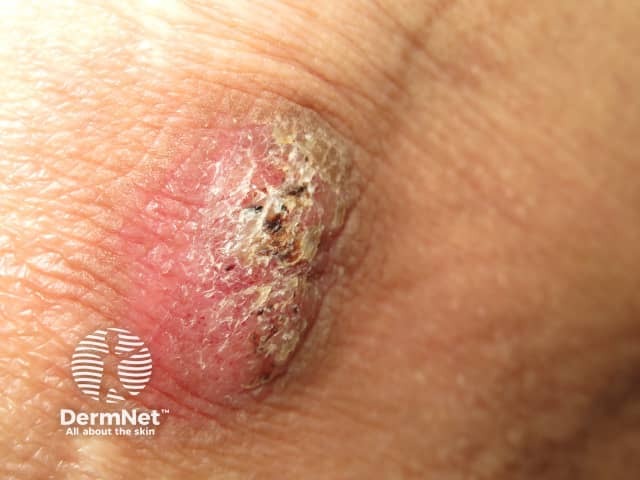
The image illustrates both the possibility and the limit of visual comparison. A foreign-body reaction need not resemble a neat, skin-coloured scar. Conversely, a crusted red bump is not necessarily a foreign-body granuloma.
The easily bleeding bump: pyogenic granuloma
A pyogenic granuloma is an especially important alternative when a small growth appears after skin injury and bleeds with minor contact. It is typically a rapidly developing, red or pink, moist-looking, fragile bump. It may occur at a piercing site and can occur in an area that has been tattooed. Despite its name, it is a growth of blood-vessel-rich tissue—not, by itself, evidence of pus or an infection. It is also not the same thing as a foreign-body granuloma.
Its tendency to bleed distinguishes it from the usual description of a firm, slowly enlarging keloid, but it still cannot be diagnosed reliably by sight alone. Other lesions can bleed or look similar, and a clinician should assess a persistent, recurrently bleeding, or changing growth. Avoid treating “it bleeds easily” as a reason to pick at it to test the theory.
Putting the clues together without overcalling them
These are working patterns, not five mutually exclusive diagnoses. Irritation can damage skin and coexist with infection; an allergy can be scratched and then become infected. A person who is prone to keloids can still have a piercing bump for an entirely different reason.
| Leading possibility | Clues that make it worth considering |
|---|---|
| Irritation | Repeated rubbing, pressure, knocks, or a harsh cleaning product; a flare at the stressed area. |
| Contact allergy | Marked itch with a rash following jewellery contact, or persistent inflammation concentrated in part of a tattoo; onset can be delayed. |
| Infection | Increasing pain, warmth, redness, or swelling; pus, spreading inflammation, or feeling ill. |
| Foreign-body inflammation | A persistent localized nodule associated with material in the skin, without a reliable appearance that confirms its cause. |
| Pyogenic granuloma | A relatively fast-growing, fragile red or pink growth that bleeds readily. |
Consider how the evidence changes in three ordinary histories. An itchy rash spreading across the area an earring touches makes contact dermatitis more plausible than a keloid, but the jewellery material and any cleaning products still matter. A piercing that becomes increasingly painful and swollen, with thick drainage, shifts concern toward infection even if a bump is also present. A small growth that repeatedly bleeds when lightly brushed raises pyogenic granuloma as a possibility—but also gives a reason for medical assessment rather than a firm diagnosis.
Appearance is the starting point, not the verdict. History and trajectory can narrow possibilities; examination may reveal something the photograph or description misses. If a lump is unexplained, changing, ulcerated, or persistently bleeding, it warrants clinical assessment rather than a scar label.
Key takeaways
The best way to compare piercing and tattoo bumps is to combine timing, exposure, distribution, symptoms, and progression. Itch following contact points toward dermatitis; escalating pain and inflammatory signs raise concern for infection; an enduring nodule may involve foreign-body inflammation; and a rapidly growing bump that bleeds easily brings pyogenic granuloma into consideration. None of those patterns confirms a diagnosis on appearance alone.
The next lesson turns that uncertainty into a practical decision: how urgently to seek medical assessment, particularly when infection, painful cartilage swelling, systemic illness, bleeding, ulceration, or an unexplained changing lump is involved.