Hello! Welcome to the final lesson in our foundational module.
In our last few lessons, we've built a solid base. We started by understanding what impressions and clicks are, and how to measure the effectiveness of an ad with Click-Through Rate (CTR). Then, we defined the ultimate goal of any campaign: the conversion—those critical actions like registrations and First-Time Deposits (FTDs) that drive an iGaming business forward.
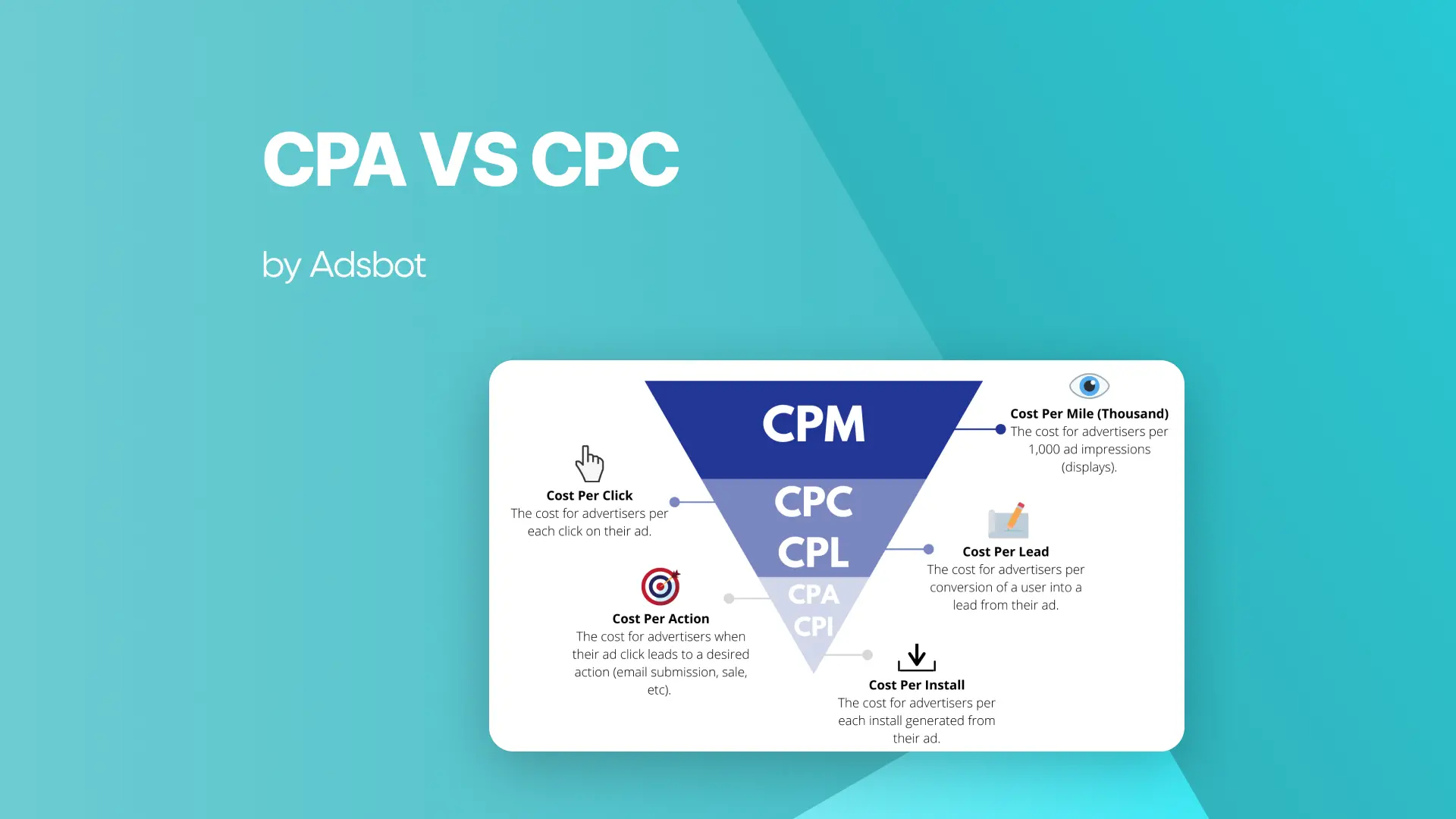
Now, it's time to connect these concepts to the most important factor: money. Getting clicks and conversions is great, but at what cost? This lesson introduces two of the most fundamental pricing models in digital advertising: Cost-Per-Click (CPC) and Cost-Per-Acquisition (CPA).
By the end of this lesson, you will be able to define both CPC and CPA, understand how they are calculated, and, most importantly, explain when to use each model strategically in an iGaming marketing campaign.
Paying for Interest: Cost-Per-Click (CPC)
The first and most common pricing model you'll encounter is CPC. As the name suggests, it's a model where you pay for every click your ad receives.
Cost-Per-Click (CPC): The amount of money you pay an ad platform (like Google, X, or an ad network) each time a user clicks on your ad.
This model directly answers the question: "How much am I paying to get one person to visit my website or landing page?"
To understand how it's calculated, let's watch a short segment from the analytics video we've used before.
Marketing Analytics 101 (A Beginner’s Guide To Marketing Metrics)
This clip from Adam Erhart's 'Marketing Analytics 101' provides a clear, simple calculation for CPC. It builds directly on the concepts of impressions and clicks we covered earlier.
Watch from 03:28 to 04:07. Focus on how the total budget is used to determine the cost of each individual click.
As the video showed, the formula is straightforward:
For example, if you spend $100 on an ad campaign and get 200 clicks, your CPC is:
You paid 50 cents for each visitor you brought to your site.
When to Use CPC in iGaming
So, when is CPC the right choice? CPC is the standard model for testing and optimization. Think of it as paying for data.
Pick the Right Pricing Model for iGaming PPC (CPC, CPM & CPA)
This article, 'Pick the Right Pricing Model for iGaming PPC', provides excellent, industry-specific advice on this topic. It explains why CPC is the go-to model for new campaigns.
Please read the following parts: The paragraph starting with 'CPC (Cost Per Click)'. The paragraph under the heading 'Making the Model Work for Your Campaign'. The first two questions in the 'Frequently Asked Questions (FAQs)' section.
As the article highlights, you should use the CPC model when:
- You are launching a new campaign: You don't know which ads, headlines, or audiences will perform best. CPC allows you to run tests and gather data without committing to performance goals you can't yet guarantee.
- You are testing new creatives or landing pages: You want to see which ad image gets a higher CTR or which landing page convinces more people to sign up. CPC lets you measure this affordably.
- You want maximum control: You set a bid for how much you're willing to pay per click, giving you direct control over your traffic costs.
The main drawback? You pay for every click, including those from users who were never going to convert. This is the risk you take in exchange for valuable performance data.
Test your understanding!
You're launching a new online casino brand. You've created three different ad designs to promote a "100 Free Spins" welcome offer. You spend $150 on an ad campaign to test them.
- Ad A gets 150 clicks.
- Ad B gets 100 clicks.
- Ad C gets 50 clicks.
What was the total number of clicks, and what was the average CPC for the entire campaign?
Show answer
- Total Clicks: 150 + 100 + 50 = 300 clicks.
- Average CPC: $150 (Total Cost) / 300 (Total Clicks) = $0.50 per click.
This data also tells you Ad A was the most effective at generating clicks for your budget.
Paying for Results: Cost-Per-Acquisition (CPA)
While CPC is about paying for traffic, CPA is about paying for results. It is often considered the "holy grail" for performance-focused marketers.
Cost-Per-Acquisition (CPA): The amount of money you pay to acquire one new customer or for a user to complete a specific, desired action (a conversion).
The "A" in CPA stands for "Acquisition," and it's crucial that you define what this means for your campaign. In iGaming, an acquisition could be:
- A user completing a registration (CPA for registration).
- A user making a First-Time Deposit (CPA for FTD).
- A user placing their first bet.
Let's return to the video to see how CPA is calculated.
Marketing Analytics 101 (A Beginner’s Guide To Marketing Metrics)
This next clip from the same video explains the concept of CPA, or 'Cost Per Action'. Notice how the focus shifts from the cost of a click to the cost of achieving the ultimate campaign goal.
Watch from 04:30 to 05:20. Pay attention to the formula and how it measures the cost of a 'sale' in his example, which is a type of conversion.
The formula for CPA is:
For example, you spend $1,000 on an ad campaign. The goal is to get new players to make their first deposit (FTD). If the campaign results in 20 FTDs, your CPA is:
Your cost to acquire one new depositing player was $50.
When to Use CPA in iGaming
The CPA model is powerful, but it comes with conditions. You can't just start a new campaign and expect to pay on a CPA basis.
iGaming Native Ads: Pick the Right Pricing Model for Maximum ...
Let's read another perspective on this. This article on iGaming native ads explains the conditions required to use the CPA model effectively.
Please read the following sections: Start at the heading 'CPA: The Performance Marketer's Dream (With Conditions)' and read until the next heading. The section under 'How to Actually Choose Your Pricing Model'. The FAQ question 'Why do networks require proof of conversions before offering CPA deals?'
As the articles explain, you should use the CPA model when:
- You have a mature, optimized campaign: You have already used CPC to test and find winning ads and landing pages. You now have reliable data on your conversion rates.
- You want predictable acquisition costs: With CPA, you know exactly how much you're paying for each new player. If your CPA is $50 and you know the average player will generate $200 in value for you, you can scale your campaign profitably and with confidence.
- You want to minimize risk: Since you only pay for a successful conversion, the risk shifts from you to the ad network or publisher. If they send you 1,000 clicks and no one converts, you pay nothing. This is why networks demand proof that your campaign works before they will agree to a CPA model.
The Strategic Choice: A Summary
The decision between CPC and CPA isn't about which is "better"—it's about choosing the right tool for the job based on your campaign's maturity.
Here's a table to summarize the key differences:
| Feature | CPC (Cost-Per-Click) | CPA (Cost-Per-Acquisition) |
|---|---|---|
| What You Pay For | A user clicking your ad. | A user completing a specific action (e.g., FTD). |
| Best For... | Testing new ads, audiences, and landing pages. Gathering data. | Scaling proven campaigns with predictable results. |
| Risk | Advertiser risk. You pay for all clicks, even if they don't convert. | Publisher/Network risk. They only get paid if the traffic converts. |
| Campaign Stage | Early Stage / Optimization. | Mature Stage / Scaling. |
A typical iGaming campaign evolves from CPC to CPA:
- Start with CPC: You launch a campaign for a new sports betting offer. You test different ads to see which gets the most clicks at the lowest cost.
- Analyze Data: You find an ad that delivers clicks for $0.40 and a landing page that converts 5% of those clicks into sign-ups. Your effective cost to get a sign-up is .
- Switch to CPA: You can now go to an ad network and negotiate a CPA deal. You show them your data and say, "I'd like to pay $10 for every sign-up you send me." The network agrees because you've proven your campaign works. You are now paying for guaranteed results.
Test your understanding!
You are managing marketing for an established online casino. You have a campaign that has been running for months and consistently generates FTDs. Your current effective CPA (calculated from your CPC spend) is around $75. An ad network offers you a CPA deal to get FTDs for a flat rate of $60.
Should you consider this deal? What is the primary advantage of switching to the CPA model in this scenario?
Show answer
Yes, you should strongly consider this deal. Your current cost to acquire a depositing player is $75, and the network is offering to deliver them for $60.
The primary advantage is predictability and reduced risk. By locking in a $60 CPA, you eliminate the uncertainty of CPC. You no longer have to worry about click prices fluctuating or conversion rates dropping. You know exactly what you'll pay for each new player, making it much easier to budget and scale your campaign profitably.
Conclusion
Congratulations on completing the first module! You've successfully built your foundation in digital marketing metrics. By understanding the cost of your actions with CPC and CPA, you can now move beyond simply running ads to making strategic, data-driven decisions about your marketing budget.
Key Takeaways:
- CPC (Cost-Per-Click) is the price you pay for a single click. It's best used in the early stages of a campaign for testing and data collection.
- CPA (Cost-Per-Acquisition) is the price you pay for a specific conversion, like a sign-up or First-Time Deposit. It's the ideal model for scaling mature campaigns with predictable performance.
- The progression from CPC to CPA is a common strategy in performance marketing, allowing you to use data to reduce risk and lock in profitable growth.
Preview of the Next Module:
With these fundamental metrics under your belt, we're ready to zoom in on our target industry. The next module, "The iGaming Industry Landscape," will immerse you in this unique world. We'll start by defining the main sectors of iGaming (online casinos, sports betting), exploring the specific marketing challenges and advertising restrictions that define this space, and understanding why things like licensing are so critical.