Hello! Welcome to the third lesson in our module on the Foundations of Tarot Reading.
In our last session, we focused on crafting effective, open-ended questions to guide your readings. You learned how to shift from seeking simple predictions to inviting guidance, placing you at the center of your own journey of self-discovery. A well-formed question is the first half of a meaningful dialogue with your cards.
Today, we complete that dialogue. Our learning outcome is to perform a one-card daily draw for personal reflection and guidance. This is one of the most powerful and sustainable habits you can build in your tarot practice. It’s a simple, direct way to connect with your deck, learn the card meanings organically, and get a daily dose of insight. By the end of this lesson, you'll have a complete framework for conducting your first type of tarot reading.
1. The Daily Draw: Your Personal Mindfulness Tool
Before we get into the "how," let's explore the "what" and "why." The daily draw is exactly what it sounds like: a practice of pulling one card each day to set a theme, offer a point of focus, or provide a piece of advice.
For you, with your goal of using tarot for personal insight, this practice is foundational. It’s not about predicting the day's events, but about bringing a specific energy or awareness into your day. Think of it as a daily mindfulness prompt.
Daily Tarot Card of the Day: How to do a Daily Tarot Draw
The video 'Daily Tarot Card of the Day' from Angie Green Tarot provides an excellent overview of this practice and its benefits. It explains how this simple habit helps to learn the card meanings and strengthen your intuition over time.
Please watch from 01:17 to 04:36. Pay attention to how the daily draw serves as a 'feedback loop' for learning and how it's a valuable practice for both beginners and experts.
As the video highlights, this practice is a fantastic way to learn the cards in a practical context and build your confidence. You get to see how the abstract energy of a card can manifest in the concrete reality of your day-to-day life.
2. The Step-by-Step Process for Your One-Card Reading
A one-card reading is a ritual. It combines the intention-setting you learned in the first lesson with the questioning skills from the second. The following video from Biddy Tarot provides a clear, structured walkthrough of the entire process.
How To Do a 1-Card Tarot Reading – Even if You’re Completely New to Tarot
Let's watch 'How To Do a 1-Card Tarot Reading' to get a complete, step-by-step guide. This will be our core framework for the practice.
Watch from 01:36 to 02:22 for an overview of the process. Then, watch the detailed steps from 03:02 to 10:47. Note the crucial distinction between connecting with your intuition first and then looking at the traditional meaning.
Let's break down those steps into a clear procedure:
-
Prepare Your Space and Mind: This is your ritual. Find a quiet spot, light a candle if you wish, and take a few deep breaths to center yourself. This signals that you're shifting from your daily tasks to a moment of reflection.
-
Formulate and Ask Your Question: Hold the deck and ask your open-ended question. For a daily draw, simple is often best. The article "How I Use Tarot For Personal Development & Mindfulness" offers some excellent examples.
How I Use Tarot For Personal Development & Mindfulness
This article from Moonleaf Magic reinforces the daily draw as a tool for self-discovery and provides great examples of questions you can use.
Please read the short section titled '1-Card Daily Draw'. Focus on the list of sample questions provided. These are perfect starting points.
Examples include:
*   *What is the theme for today?*
*   *What energy do I need to focus on today?*
*   *How can I best show up for myself today?*
3. Shuffle and Draw Your Card: While focusing on your question, shuffle the cards in the way you established in your personal ritual. When you feel ready, draw a single card from the deck and place it face-up in front of you.
-
Interpret - Part I: Your Intuition: Before you reach for any books or notes, pause and look at the card. What do you see?
- What part of the image catches your eye?
- What story does the picture seem to tell?
- What feelings or immediate thoughts does it bring up for you?
Spend a minute just observing. This step is vital for building your intuitive connection to the cards.
-
Interpret - Part II: The Traditional Meaning: Now, consult your notes from our previous lessons (or a trusted resource) for the card's upright meaning. How does the traditional interpretation connect with your intuitive response? Do they reinforce each other? Does the traditional meaning add a layer you hadn't considered?
-
Synthesize and Journal: This is where the insight solidifies. In a journal, write down the date, your question, and the card you drew. Then, write out the message for yourself, combining your intuitive hits with the card's established meaning. As the Biddy Tarot video suggests, end by reflecting on how you can integrate this message into your day. Your experience as a legal assistant with documentation and record-keeping will serve you well here; think of your journal as building a personal "case file" of your own growth and patterns.
3. A Visual Guide and an Example
To make the process even clearer, here is a visual guide that summarizes the key steps for a reflective daily draw.
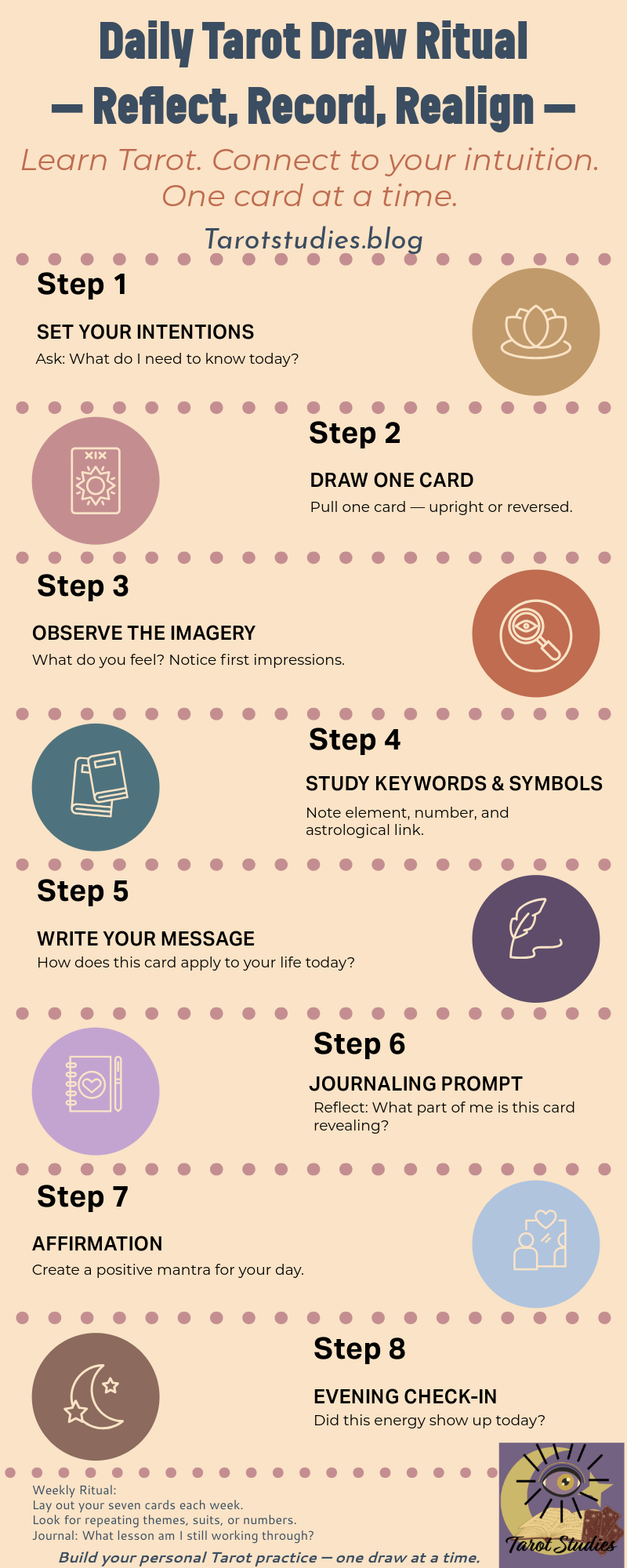
Now, how does this look in practice? Imagine you draw the Two of Cups.
Lesson 5 - The Daily Tarot Reading
Let's look at a concrete example from the 'Lesson 5 - The Daily Tarot Reading' article at learntarot.com. This will show you how to look for a card's energy throughout your day.
Read the first two paragraphs under the heading 'The Daily Reading'. Pay attention to how the keywords for the Two of Cups (connection, truce, attraction) manifested in different situations during the day.
As the example shows, the card's theme might not appear as one major event, but as a thread woven through different moments. Your job is simply to be aware and notice it.
Time to Practice!
It's your turn. Let's do your first one-card reading.
- Take out your tarot deck and a notebook.
- Follow steps 1-3 from the process above: Prepare your space, choose a question (e.g., "What do I need to know today?"), shuffle, and draw one card.
- Without looking anything up, spend two minutes writing down your intuitive thoughts about the card's imagery and feeling.
- Now, look up the card's upright meaning from your course notes or a trusted source.
- In your notebook, write a final interpretation that blends your intuition with the traditional meaning. What is the single, most important message this card has for you today?
- Finally, write down one small action you could take or one mindset you could adopt to honor the card's message.
(There's no "answer" to check here, as this is your personal reading. The goal is to complete the process and experience it for yourself.)
4. Tips for a Sustainable Practice
Consistency is more important than perfection. Here are a few tips to help make this a lasting habit:
- Find Your Time: While many people do their draw in the morning, an evening draw can also be powerful. Instead of asking about the day ahead, you can ask, "What was the primary energy or lesson of the day that just passed?" This can be a wonderful reflective practice.
- Track Patterns: As the learntarot.com article mentions, over time you might notice certain cards appearing frequently. These "stalker cards" often point to major themes or recurring challenges in your life, providing valuable data for self-reflection.
- It's for Learning: Remember, the daily draw is a primary tool for learning the deck. Don't feel pressured to get a profound, life-altering message every day. Sometimes, the goal is simply to spend time with one card and get to know it better.
Conclusion
You have now performed your first complete tarot reading! The one-card draw is a simple yet profound practice that serves as the bedrock of a personal tarot journey.
Key Takeaways:
- The daily draw is a mindfulness practice that helps you learn the cards and connect with your intuition.
- A successful reading follows a clear process: Prepare -> Ask -> Draw -> Interpret (Intuition First!) -> Synthesize -> Journal.
- Journaling is essential for capturing insights and tracking your progress over time.
- The goal is not to predict the future but to bring conscious awareness to the present moment.
Preview of the Next Lesson:
You've mastered interpreting a single card in the context of a daily question. Now you're ready to add a layer of complexity. In our next lesson, we will expand on this foundation by learning to execute a three-card spread. You'll learn how to interpret cards in specific positions and see how they interact to tell a richer, more detailed story.