Hello! Welcome to the fourth lesson in our module, Foundations of Tarot Reading.
In our last lesson, you mastered the one-card daily draw. This taught you the complete ritual of a tarot reading on a small scale: preparing your space, asking a question, drawing a card, and interpreting it for personal guidance. This is the foundational skill upon which we will now build.
Today's learning outcome is to execute a three-card spread (e.g., Past-Present-Future) and interpret each card in its position. We are moving from a single point of data to a small narrative. The key skill you'll develop is understanding how a card's meaning is shaped by the specific role it plays in a spread. This will dramatically increase the depth and detail of the insights you can receive.
1. From a Single Card to a Spread
A tarot spread is a predefined arrangement of cards where each position has a specific meaning or question assigned to it. While your one-card draw provides a theme or a single piece of advice, a spread provides a framework to explore a situation from multiple angles.
If a one-card draw is like a key witness statement, a three-card spread is like establishing the background of the case, the current facts, and the likely direction events are heading. It gives your reading structure and a logical flow.
The three-card spread is the most popular and versatile layout in tarot, used by beginners and experts alike for its simplicity and power.
2. The Anatomy of a Three-Card Spread
The most classic and intuitive three-card spread is Past-Present-Future. It tells a simple, linear story about a situation.
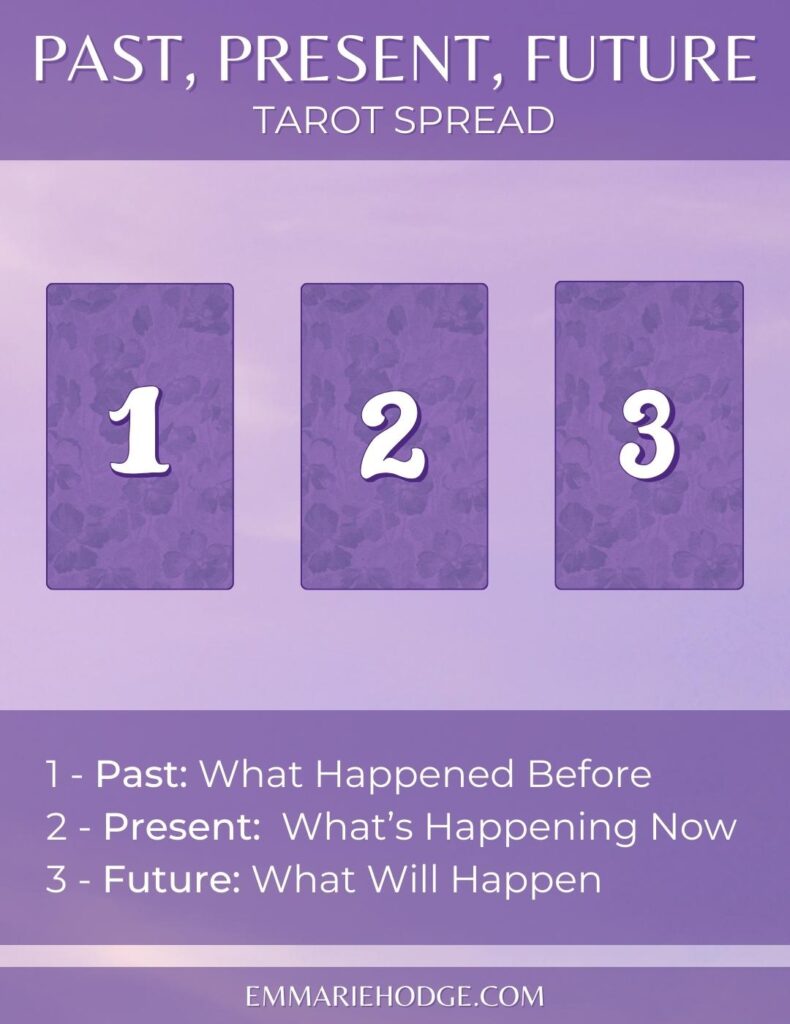
While Past-Present-Future is an excellent starting point, the three-card format is incredibly flexible. The positions can be adapted to answer almost any kind of question.
Tarot Spreads for Beginners: 3 and 5 Card Tarot
The article 'Tarot Spreads for Beginners' from Ethony provides an excellent overview of the three-card spread and some of its most common variations.
Please read the sections 'What is a 3 Card Tarot Reading?' and '3 card Tarot reading past present future'. These sections will solidify your understanding of the spread's structure and the specific roles of the Past, Present, and Future positions.
As you can see, the core idea is to break your main question down into smaller, focused inquiries, with each card answering one of them.
3. How to Perform a Three-Card Reading
The process for a three-card reading builds directly on the steps you learned for the one-card draw, with the crucial addition of interpreting each card according to its position.
The following video from Biddy Tarot offers a comprehensive guide to the entire process. We will walk through it step-by-step.
How to Do a 3-Card Tarot Reading
This video, 'How to Do a 3-Card Tarot Reading,' will be our primary guide for this lesson. It covers everything from preparation to interpretation.
Please watch from 00:38 to 07:16. Pay close attention to these key segments: Choosing a spread (02:48): Notice how she introduces Past-Present-Future and other variations. Laying out the cards (04:57): This is the physical execution of the spread. Interpreting each card (06:14): This is the most important part for today's lesson. Focus on how she advises you to look at each card individually and consider its position.
Let's break that down into a clear workflow:
- Prepare & Question: This part is the same as before. Center yourself, get clear on your open-ended question, and hold it in your mind.
- Choose Your Spread: Before you draw, decide on the positional meanings. For our practice today, we'll use Past - Present - Future.
- Shuffle & Draw: Shuffle the cards while focusing on your question. When you feel ready, draw three cards and lay them face down in a row from left to right.
- Reveal & Interpret: Turn the cards over one by one, or all at once. Now, interpret each card in the context of its position.
- Card 1 (The Past): What does this card say about the past events, choices, or energies that led to the current situation?
- Card 2 (The Present): What does this card reveal about what is happening right now? What is the core of the situation?
- Card 3 (The Future): What does this card suggest is the likely outcome if you continue on the current path?
This final step is the new skill. You aren't just reading three separate cards; you're reading one card as the past, one as the present, and one as the future.
4. A Walkthrough Example
Let's see this in action. The following article provides a fantastic, clear example of interpreting a Past-Present-Future spread for a real-world question.
Past, Present, and Future: A Three Card Spread
The article 'Past, Present, and Future: A Three Card Spread' from Sophrosyne Tarot provides a concrete example of a reading. This will help you see how to apply a card's meaning to its specific position.
Please read the sections titled 'The Past Position in a Three Card Spread,' 'The Present Position in a Three Card Spread,' and 'The Future Position in a Three Card Spread.' Notice how the interpretation of each card (The Fool, Six of Swords, Knight of Pentacles) is directly tied to its position in the spread and the client's question.
As you saw in the example:
- The Fool in the Past position suggests the job search began with a leap of faith or perhaps haste.
- The Six of Swords in the Present position indicates the person has already mentally and emotionally begun to move on from their old job.
- The Knight of Pentacles in the Future position points toward a future of steady, grounded, and positive career progress if they take the new job.
Each interpretation is precise because it considers both the card's inherent meaning and the role it plays in the story.
Test your understanding!
Let's say you're doing a Past-Present-Future reading about a friendship that feels distant, and you draw The Hermit in the Present position.
Which of the following interpretations is most focused on the card's position?
A) The Hermit means you need to go on a retreat and think about things.
B) In the past, this friendship involved a lot of soul-searching.
C) The Hermit suggests that right now, a period of introspection, solitude, or pulling away is a central part of the situation.
Show answer
Answer C is the best interpretation. It correctly applies the meaning of The Hermit (introspection, solitude) directly to the context of the Present position, explaining what is happening now in the friendship. Answer A is general advice, and Answer B incorrectly applies the card to the Past position.
5. Your Turn: Execute Your First Three-Card Spread
Now it's time for you to put this into practice.
- Get Ready: Take out your tarot deck and your journal.
- Formulate a Question: Think of a current situation in your life you'd like clarity on. It doesn't have to be a major problem. For example: "What do I need to understand about my creative project right now?" or "What can I learn about my current approach to my fitness goals?"
- Shuffle and Draw: Using the Past-Present-Future layout, shuffle your deck while focusing on the question. When ready, draw three cards and place them in a row.
- Interpret and Journal: In your journal, create three sections: Past, Present, and Future. For each card:
- Write down the card's name.
- First, describe your intuitive reaction to the card's imagery in that position.
- Then, consult your notes for the card's upright meaning.
- Finally, write a sentence or two interpreting what that card means specifically for that position in relation to your question.
The goal here is to produce three distinct interpretations, one for each stage of the narrative. Don't worry about weaving them together just yet—that's our next lesson! Focus on giving each card its proper place and voice within the structure of the spread.
Conclusion
Congratulations! You have successfully executed a three-card spread and learned to interpret each card within its specific position. You've moved from reading a single point of advice to mapping out the basic dynamics of a situation.
Key Takeaways:
- A tarot spread uses positional meanings to give a reading structure and depth.
- The three-card spread is a simple, powerful, and highly versatile tool for personal insight.
- The core skill is to interpret a card by combining its traditional meaning with the context of its position (e.g., Past, Present, Future).
- The Past-Present-Future spread provides a clear narrative framework for understanding how a situation has developed and where it might be heading.
Preview of the Next Lesson:
You now have the three core components of a story: a beginning (Past), a middle (Present), and an end (Future). In our next lesson, we will focus on the final and most creative step: synthesizing the meanings of the three cards into a cohesive narrative or piece of advice. You'll learn how to find the "thread" that connects the cards and transform three individual messages into one powerful story.