Hello and welcome back to our final module, "Deepening Your Personal Practice."
In our last lesson, we introduced the theory behind reversed cards. You learned that they are not something to fear but are instead invitations to look deeper. We covered several key interpretive frameworks, such as blocked energy, imbalanced energy, and internalized energy. You now have a mental toolkit for understanding what a reversed card might mean.
Today, we move from theory to practice. This lesson is designed to help you achieve the learning outcome: Apply a chosen framework to interpret reversed cards within a simple spread. We will cover how to physically incorporate reversed cards into your readings and, most importantly, how to confidently choose a framework and apply it to gain nuanced insights for your personal growth.
1. Preparing Your Deck for Reversals
First things first: how do you get reversed cards to appear in a reading? If you always shuffle the same way, you might find your cards stay upright. To get a random mix, you need to deliberately shuffle in a way that rotates them.
The following video demonstrates a simple and effective method.
4 Easy Ways to Read Reversed Tarot Cards
In this final clip from the Biddy Tarot video '4 Easy Ways to Read Reversed Tarot Cards,' the presenter shows you a practical way to shuffle your deck to include reversals.
Please watch the segment from 13:24 to 14:27. The presenter demonstrates the 'three-pile cut' method. She also mentions the 'messy pile shuffle' as an alternative.
To summarize, a reliable method is:
- Cut your deck into three piles.
- Take one of the piles and turn it 180 degrees (top to bottom).
- Recombine the three piles.
- Shuffle thoroughly as you normally would.
You can repeat this process a few times when you first start working with reversals to ensure a good mix. Over time, your regular shuffling will maintain the mix of upright and reversed cards.
2. How to Choose an Interpretive Framework
In our last lesson, you learned about several frameworks (blocked energy, too much/too little, internalized, etc.). But with so many options, how do you know which one to use for a specific card in a reading? This is where your skill as a reader begins to blend technical knowledge with intuition.
Let's explore some practical tips for making this choice.
4 Easy Ways to Read Reversed Tarot Cards
The Biddy Tarot video also offers excellent advice on how to decide which interpretive method to use in a given reading.
Please watch from 09:44 to 13:24. The presenter outlines several strategies: Decide on one method before you start the reading. Trust your intuition or 'gut instinct.' Look at the surrounding cards to see what fits the story. Draw on your experience and use a tarot journal to track patterns.
This last point is especially important for your goal of using tarot for personal development. Just as a lawyer builds a body of knowledge by studying case law, you will build your own interpretive "case law" by journaling your readings. Over time, you'll notice that a certain reversed card consistently shows up with a particular meaning for you.
3. Applying a Framework: A Walkthrough
Now let's put it all together. We will walk through a hypothetical three-card "Past, Present, Future" spread to see how to apply a framework in context.
Question: "What do I need to understand about my current creative process?"
Imagine you shuffle your deck, incorporating reversals, and draw the following three cards:
- Past: Four of Swords (Upright)
- Present: The Empress (Reversed)
- Future: Ace of Wands (Upright)
Step 1: Interpret the Upright Cards
- Past (Four of Swords): This points to a recent period of rest, contemplation, and mental recovery. You've been taking a step back, planning, and recharging your batteries.
- Future (Ace of Wands): This signals a new burst of creative energy, passion, and inspiration is on the horizon. A new idea or project is waiting to be sparked into life.
Step 2: Analyze the Reversed Card
Now we have the Empress reversed in the Present position, sandwiched between rest and a new beginning. The Empress upright represents creativity, nurturing, abundance, and bringing ideas into fruition. Let's consider which framework best fits the story.
- Opposite Meaning? "Lack of creativity." This feels too simplistic and negative, especially with the Ace of Wands promising inspiration.
- Blocked Energy? "Your creativity is blocked." This is possible. It could mean that despite the rest (Four of Swords), you're still struggling to access your creative flow.
- Imbalanced Energy? "Too much" could be creative burnout; "too little" is similar to a block. This is also a valid interpretation.
- Internalized Energy? This framework suggests shifting the upright meaning (nurturing others, external creation) inward. This would mean the energy is focused on self-nurturing, self-care, and internal creative development.
Step 3: Choose a Framework and Synthesize the Story
The "Internalized Energy" framework seems to create the most insightful narrative here.
- The Story: You have come from a period of necessary rest (Four of Swords). Now, in the present, the universe isn't asking you to produce or create something externally just yet. Instead, The Empress reversed is a powerful call to turn that nurturing energy inward. It's time for self-care, for tending to your own "inner garden" and filling your own creative well. This act of internal nurturing is the critical bridge that will allow the new spark of inspiration (Ace of Wands) to catch fire in the future.
By choosing a framework that fits the context, the reversed card becomes a piece of precise, actionable advice rather than a vague negative omen.
4. Your Turn: Practice with a Simple Spread
Now it's time for you to apply these skills. The following article provides a simple, structured exercise to help you get comfortable with interpreting reversals in a spread.
The Art of Reading Reversed Tarot Cards
The article 'The Art of Reading Reversed Tarot Cards' from Keen offers a practical exercise to build your confidence. It uses a three-card spread and encourages you to look at it through different lenses.
First, read the section 'Past/Present/Future Spreads' to see another example of how reversals are interpreted in this common layout. Then, follow the steps in the section titled 'A Simple Exercise.' Don't worry if it feels awkward at first; the goal is to practice the process.
Test your understanding!
Imagine you are doing the exercise from the Keen article. You pull the Ace of Cups reversed in the "Present" position. The upright Ace of Cups means a new beginning in love, emotion, and intuition.
How might you interpret the Ace of Cups reversed using the "Blocked Energy" framework? What could be blocking this new emotional beginning?
Show answer
Using the "Blocked Energy" framework, the Ace of Cups reversed suggests that a new emotional opportunity or intuitive connection is available but something is preventing you from receiving or expressing it.
Possible blockages could include:
- Fear of being vulnerable after past hurts.
- Repressing your emotions or not allowing yourself to feel.
- Being too "in your head" and ignoring your heart's wisdom.
- An unwillingness to open up to a new relationship or creative flow.
The card advises you to identify and address this blockage to allow the emotional energy to flow freely.
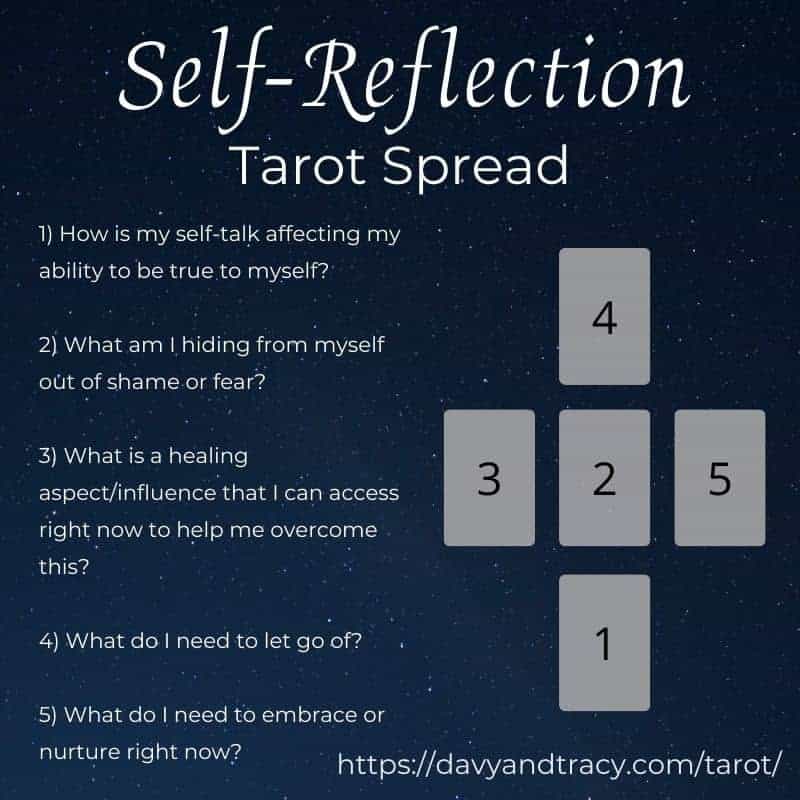
For further practice that aligns directly with your goal of self-reflection, you can also use the spread shown in the image below. When a reversed card appears, use the frameworks we've discussed to explore its message.
Conclusion
Congratulations on taking this significant step in your tarot journey! You've moved from knowing the theory of reversals to actively applying them. This skill adds incredible depth and precision to your readings, transforming them into more powerful tools for self-reflection.
Key Takeaways:
- You can incorporate reversed cards into your deck using simple shuffling techniques like the three-pile cut.
- Choosing an interpretive framework is a key skill; you can be guided by your intuition, the context of surrounding cards, and journaling your experiences.
- A reversed card, when interpreted within the story of a spread, provides specific, actionable guidance.
- Consistent practice with simple spreads is the best way to build confidence in reading reversals.
Preview of the Next Lesson:
So far, our focus has been on learning the established systems and meanings of the tarot. But reading tarot is both a science and an art. In our next lesson, we will focus on the art: Combine intuition with traditional card meanings to enrich and personalize interpretations. We will explore how to listen to that quiet inner voice and blend it with your knowledge of the cards to create readings that are uniquely insightful for you.