Hello and welcome to the final module of our course, "Deepening Your Personal Practice."
In our previous lessons, we built a solid foundation. You learned the structure of the deck, the meanings of all 78 cards in their upright positions, and how to weave them into a coherent story to diagnose the root cause of a situation. We have intentionally focused only on upright cards until now, following your preference to build a strong, foundational "toolkit" first. Now, with that foundation secure, we are ready to add a powerful new layer of nuance to your readings.
Today's lesson addresses the learning outcome: Describe common frameworks for interpreting reversed cards (e.g., blocked energy, opposite meaning, less intensity). We will demystify what it means when a card appears upside down and explore several systematic ways to interpret it, transforming it from a point of confusion into a source of deeper insight.
1. Why Read with Reversed Cards?
Many tarot learners—and even some experienced readers—choose to ignore reversed cards, often fearing they bring negative or confusing messages. However, by doing so, they miss out on a significant layer of information. A reversed card isn't necessarily "bad"; it simply points to an area where the card's energy is not flowing in its typical, straightforward manner. It's an invitation to look closer.
To get a better sense of why reversals are so valuable, let's start with a short, encouraging video.
4 Easy Ways to Read Reversed Tarot Cards
The Biddy Tarot video, '4 Easy Ways to Read Reversed Tarot Cards,' begins by addressing the common apprehension around reversals and explains how they can add incredible depth and insight to your readings.
Please watch the first 2 minutes and 27 seconds of the video. Notice how the presenter reframes reversals as a way to see the 'light and shade' of a situation and identify where to make impactful changes.
As the video suggests, reversed cards don't just mean the opposite of the upright meaning. They can show us where energy is blocked, where our work lies, and what's happening internally versus externally. Think of it like legal analysis: the main text of a statute provides the primary rule (the upright meaning), but case law and exceptions (the reversed meaning) provide crucial context and show where the application of the rule is complex or requires special attention.
2. A Toolkit of Interpretive Frameworks
There is no single "correct" way to read a reversed card. Instead, readers use a variety of frameworks. For your personal practice, you can choose the one that resonates most with you in any given situation. Let's explore the most common ones.
The following video provides an excellent overview of four distinct, practical methods for interpretation.
4 Easy Ways to Read Reversed Tarot Cards
Let's continue with the Biddy Tarot video. The presenter will now explain four clear frameworks you can use to interpret any reversed card you draw.
Please watch from 02:47 to 07:56. This segment covers three key frameworks: Internalized Energy: The card's energy is directed inward. Too Much or Too Little Energy: An imbalance of the card's qualities. Blocked Energy: Something is preventing the card's energy from expressing itself constructively. Take note of the examples she provides for each method.
To complement the video, let's review these concepts in a slightly different format and introduce another common framework. The following article from Labyrinthos provides a very clear, structured breakdown.
How to Interpret Reversed Tarot Cards
This article, 'How to Interpret Reversed Tarot Cards,' presents a concise list of frameworks. It reinforces what you just saw and adds a few more nuances.
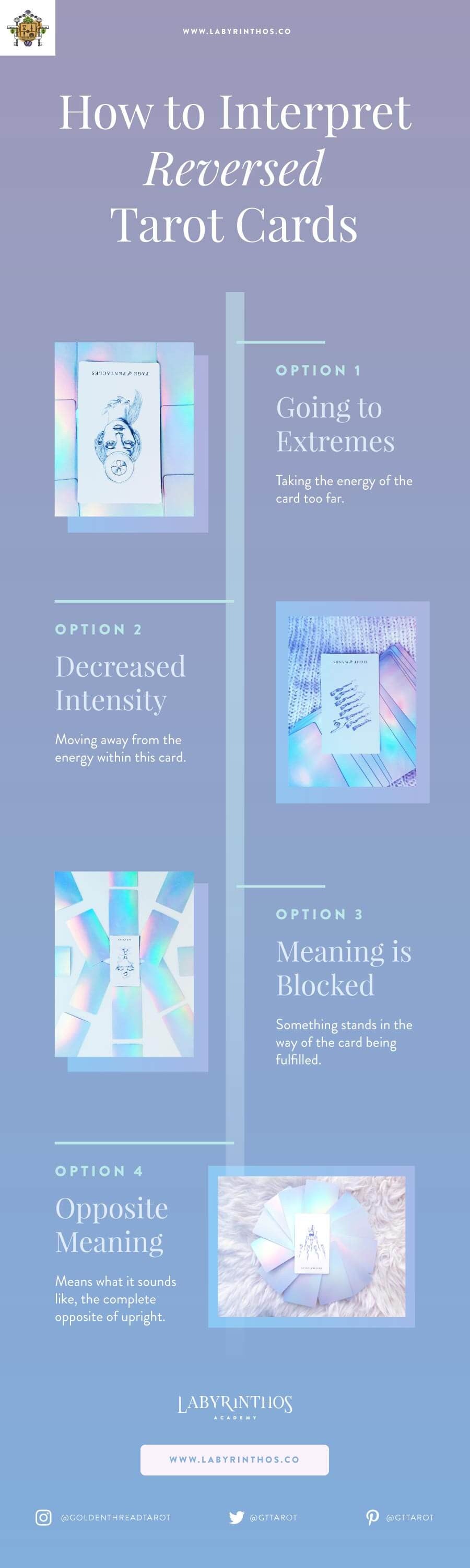
Please read the article from the beginning down to the end of the 'Opposite Meaning' section. Pay attention to its four categories: Going to Extremes (similar to 'Too Much/Too Little' energy) Decrease in Intensity (a subtle but important variation of blocked/weakened energy) Card is Being Blocked Opposite Meaning (noted as a simpler, less nuanced method)
Let's consolidate these ideas. Here are the primary frameworks you now have in your toolkit:
- Blocked or Weakened Energy: The card's upright energy is present but is being prevented from manifesting, or its influence is significantly reduced. This is often the most intuitive interpretation. (e.g., Reversed Strength may indicate that your courage is being blocked by self-doubt).
- Imbalanced Energy (Too Much / Too Little): The card's energy is being expressed to an unhealthy extreme. (e.g., Reversed Emperor could be an excess of control, leading to tyranny, or a lack of structure, leading to chaos).
- Internalized Energy: The upright energy is not expressed externally but is being focused inward, on the self. (e.g., Upright Empress is nurturing others; reversed Empress is a call for self-nurturing and self-care).
- Opposite Meaning: The most straightforward interpretation, where the reversed card means the direct opposite of its upright meaning. (e.g., Upright Two of Cups means partnership; reversed can mean a breakup or disagreement).
This infographic provides a great visual summary of these concepts.
Test your understanding!
Let's take The Chariot card. Its upright meaning includes willpower, determination, control, and success. How would you interpret The Chariot reversed using three different frameworks?
- As Blocked Energy:
- As Imbalanced Energy (consider both "too much" and "too little"):
- As Internalized Energy:
Show answer
Here are some possible interpretations:
- As Blocked Energy: You have the ambition and desire to move forward, but something is stopping you. You feel stuck, powerless, and unable to make progress despite your efforts. Your "chariot" is stuck in the mud.
- As Imbalanced Energy:
- Too Much: You are pushing forward with aggressive, reckless force, disregarding obstacles or advice. It's a lack of control, leading to a potential crash.
- Too Little: You lack the willpower and self-discipline to move forward. You are passive and directionless, letting circumstances control you rather than taking the reins.
- As Internalized Energy: The battle for control and direction is happening internally. You are working on mastering your own conflicting impulses and motivations before you can take external action.
3. Other Helpful Perspectives
While the frameworks above will cover most situations, a few other perspectives can be very helpful for personal reflection.
The article "How to Read Reversals in Tarot" introduces two creative and empowering ways to view reversed cards.
How to Read Reversals in Tarot
This article offers some unique perspectives that are particularly useful for personal development readings. It also introduces a helpful mnemonic.
Please read two specific sections from this article: Start with the section that introduces the 'WIND' mnemonic (Weakened, Inverted, Negative, Delay). This is another systematic tool you might find useful. Then, read the section titled 'What about seeing the reversal as a prescription?' This offers a proactive way to engage with a reversed card's message.
The "prescription" or "remedy" framework is especially powerful for personal use. When you see a reversed card, you can ask, "What is the medicine here?" The answer is often the energy of the card in its upright form.
- If you pull The Hermit reversed (representing isolation or avoidance of introspection), the prescription is to consciously embrace the positive qualities of the upright Hermit: schedule time for quiet reflection and seek your inner wisdom.
Conclusion
You have now moved past the initial fear of reversed cards and equipped yourself with a versatile toolkit of interpretive frameworks. You are no longer limited to a single, rigid "opposite" meaning. Instead, you can now explore the rich nuances that reversals bring to a reading.
Key Takeaways:
- Reversed cards are not inherently negative; they point to areas where energy is complex, blocked, or imbalanced.
- You can interpret reversals using several key frameworks: Blocked/Weakened Energy, Imbalanced Energy (Too Much/Too Little), Internalized Energy, or the simpler Opposite Meaning.
- A powerful approach for personal readings is to view the reversed card as a "prescription," where the remedy is to consciously cultivate the card's upright qualities.
- The best framework to use often depends on the context of the question, the surrounding cards, and your own intuition.
Preview of the Next Lesson:
Now that you understand the "what" and "why" of reversed card interpretations, the next step is to put it into practice. In our next lesson, we will focus on the learning outcome: Apply a chosen framework to interpret reversed cards within a simple spread. We'll cover how to physically incorporate reversals into your deck and then walk through a reading to see how these new meanings function in a real-world context.