Welcome back! In our last lesson, you created a plan for a short video using a shot list or storyboard. That was a crucial first step in moving from simply capturing moments to intentionally telling a story.
Today, we'll build directly on that foundation by exploring what makes a video truly compelling. We'll focus on identifying the three key elements of a great short video: a strong hook to grab attention, intentional pacing to hold interest, and a satisfying payoff to make the video memorable. Think of these as the core components of the narrative structure you started planning in the last lesson. Mastering them is the secret to creating trip videos that feel cohesive and engaging from start to finish.
The Hook, Hold, and Payoff Framework
At its heart, every compelling short story, including a video, follows a simple pattern: it grabs your attention, takes you on a journey, and leaves you with a feeling of satisfaction. We can call this the "Hook, Hold, Payoff" framework.
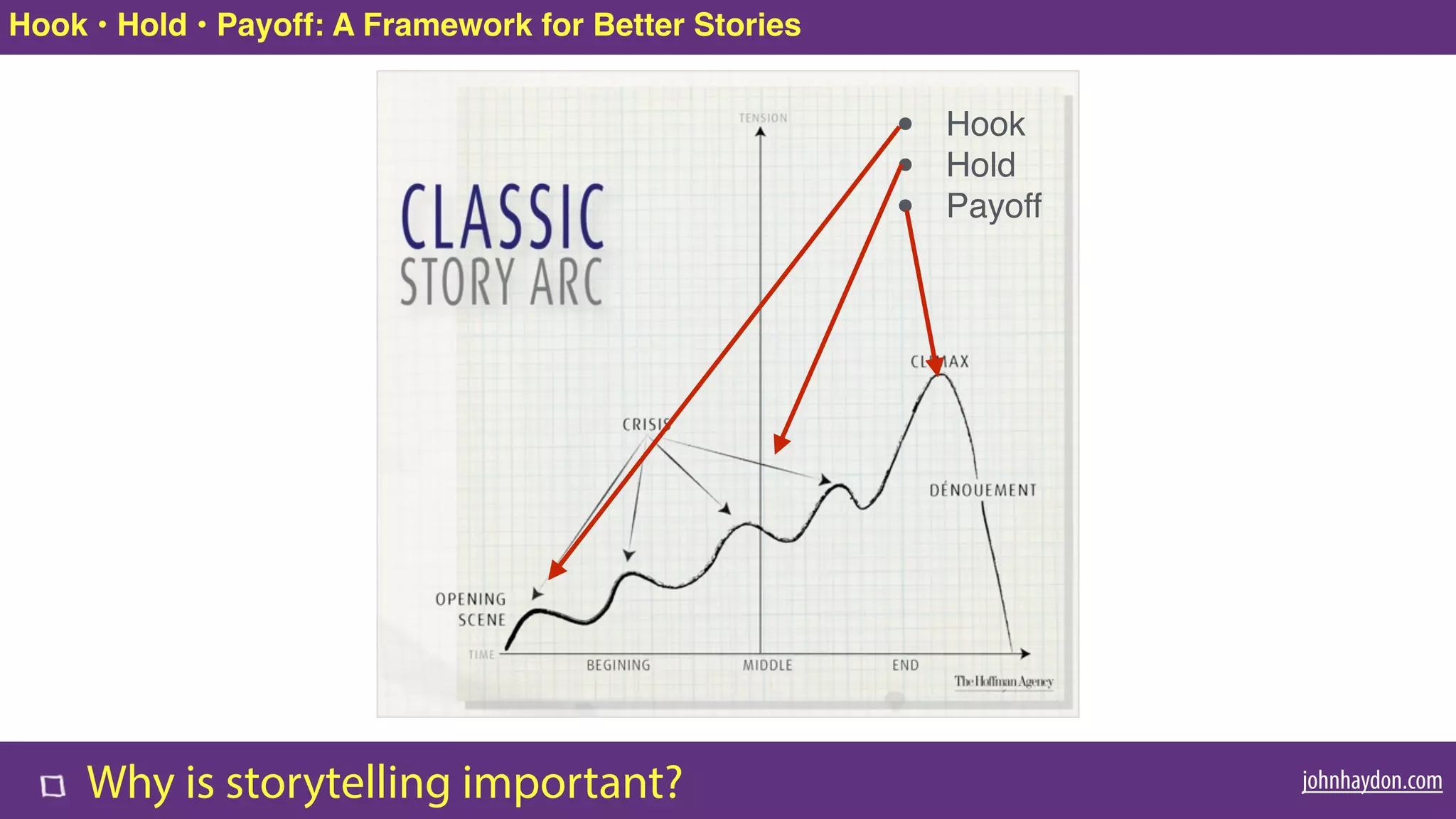
Let's break down each of these three critical stages.
1. The Hook: Grabbing Attention in the First 3 Seconds
On platforms like Instagram Reels, you have only a few seconds to stop a viewer from scrolling. The "hook" is what you do in those first moments to make them curious enough to stay. It can be a question, a surprising visual, or a bold statement.
The video "How to Create Irresistible Hooks" by Kallaway offers an excellent, systematic approach to creating effective hooks. Given your background in project management, you might appreciate his clear, three-step formula.
How to Create Irresistible Hooks (and blow up your content)
Watch this section to learn a repeatable formula for creating hooks that build a "curiosity loop."
Focus on the three-step formula: Context Lean-in: Immediately clarify what the video is about and get the viewer interested. Scroll-stop Interjection: Use a contrasting word (like "but" or "however") to create a pivot. Contrarian Snapback: Deliver a surprising twist that sends the story in an unexpected direction.
As Kallaway explains, the spoken hook is only part of the equation. Especially in short-form video, the visuals in your opening shot are just as, if not more, important.
How to Create Irresistible Hooks (and blow up your content)
Now, watch this segment from the same video focusing on the visual elements of a hook.
Pay attention to the two key components of a strong visual hook, explained from this point: Big, bold text on screen: A few words to quickly establish context. Compelling motion: Just enough movement in the shot to catch the eye without being overwhelming.
To summarize, a great hook combines a compelling verbal or text-based promise with an eye-catching visual to make the viewer think, "I need to see what happens next."
2. Pacing and Progress: The "Hold"
Once you've hooked your viewer, you need to hold their attention. This is where pacing comes in. Pacing is the rhythm of your video—the speed of your cuts, the movement within your shots, and the flow of your narrative. It's about making the viewer feel a sense of forward momentum, assuring them that their time is being well spent.
The article "How to Get More Views on Your Short-Form Videos" outlines this concept clearly with two principles.
How to Get More Views on Your Short-Form Videos
This article from ImpactPlus introduces a framework called "The Sticky 5." Let's look at the two principles related to holding viewer attention.
Read sections 2. Keep the Visuals Dynamic With The Three-Second Rule and 3. Show Them You’re Going Somewhere With The Progress Principle. Focus on how changing the visuals frequently and showing clear progression (like a cleaning process or a journey unfolding) keeps the audience engaged.
As the article notes, the pacing of your edits is key. In your travel videos, this means cutting between your wide establishing shots, your action shots, and your detailed close-ups to create a dynamic rhythm.
Another aspect of pacing relates to sound, which is especially relevant to your interest in using voiceovers. Just as visual cuts create rhythm, so does the delivery of your narration.
How To Create Viral Content with Hooks and Storytelling (grow your audience fast)
This short clip from creator Ethan Shaw explains how varying your delivery can make your videos more engaging.
Watch the section from this point where he discusses mixing short and long sentences to create "dramatic waves" in your content. This concept applies equally to editing visuals and recording narration.
Good pacing ensures the "middle" of your video isn't just a collection of clips, but a story that is actively unfolding and pulling the viewer along.
3. The Payoff: A Satisfying Conclusion
The payoff is the resolution. It's the answer to the question you asked in the hook, the beautiful view at the end of the hike, or the emotional culmination of the story. A strong payoff makes the viewer feel that watching your video was worthwhile.
A critical aspect of the payoff in short-form video is knowing exactly when to end.
How to Get More Views on Your Short-Form Videos
Let's return to the ImpactPlus article to look at the final principles.
Read sections 4. Deliver Emotional Impact With The Payoff Principle and 5. Maximize Retention With the Quit While You’re Ahead Principle. Notice the advice to end the video immediately after the climax to encourage replays.
Ending on a high note is crucial for the algorithms on platforms like Instagram and TikTok. When a video ends abruptly after the most exciting moment, viewers are more likely to watch it again, which signals to the algorithm that your content is engaging.
This image clearly illustrates the impact of payoff placement on watch time.

By designing a clear hook, maintaining progress and pace, and delivering a sharp, satisfying payoff, you create a complete narrative loop that feels both engaging and rewarding.
Practical Task: Refining Your Plan
Let's apply this framework. In the last lesson, you created a shot list or storyboard for a simple, everyday activity.
Your task is to revisit that plan and refine it using the "Hook, Pacing, Payoff" structure.
- Open the plan you made (e.g., for making coffee, a short walk).
- Analyze it through this new lens and write down your answers to the following:
- The Hook: How can you make the first 3 seconds more compelling? Could you add a text overlay with a question? Start with a more intriguing or visually interesting shot?
- The Pacing: How will you create a sense of progress? Can you plan for quicker cuts? Can you ensure you have a variety of shots (wide, medium, close-up) to create a dynamic rhythm?
- The Payoff: What is the single most satisfying moment or image? How can you ensure the video ends exactly at that high point, with no extra footage?
For example, if your original plan was for "making coffee," your refined plan might look like this:
- Hook: Start with an extreme close-up of espresso pouring into a cup in slow motion. Text: "The best 60 seconds of my day."
- Pacing: Use quick cuts: a shot of the bag of beans, a shot of the grinder, a shot of tamping the grounds. No shot is longer than 2-3 seconds to show progress.
- Payoff: A final, beautifully lit shot of the finished latte art. As soon as the cup is placed down, the video ends.
You don't need to create a new plan from scratch. The goal is to practice thinking about your video's structure in terms of viewer engagement.
Conclusion
Today we've deconstructed what makes a short video feel compelling. By thinking in terms of a clear narrative structure, you can be more intentional in your filming and editing.
Here are the key takeaways:
- The Hook, Hold, Payoff model is a simple but powerful framework for structuring your videos.
- A strong hook uses compelling visuals and a clear premise to stop the scroll in the first 3 seconds.
- Intentional pacing uses dynamic visuals, a sense of progress, and rhythmic editing to hold viewer attention.
- A satisfying payoff delivers on the hook's promise and ends the video on a high note to maximize retention.
In our next lesson, we will get even more practical with the camera. Now that you understand how to plan a story and structure it for engagement, we'll focus on composing visually appealing shots using the rule of thirds and other basic framing techniques. This will help you ensure that every clip you capture is as beautiful and effective as possible.