Introduction
Welcome to our final lesson in the module on China's Economic Statecraft. In our previous session, we analyzed the punitive side of China's economic power, examining how it uses coercion and sanctions to punish countries that cross its political red lines. Today, we'll explore the other, more constructive side of its economic statecraft: its ambition to shape the global financial system itself.
This lesson addresses the learning outcome: Describe China's role in creating alternative financial institutions like the AIIB. We will investigate why China felt the need to build new multilateral banks, focusing on two key examples: the Asian Infrastructure Investment Bank (AIIB) and the New Development Bank (NDB). By comparing these institutions, we'll see how China is attempting to create a financial architecture that better reflects its interests and those of other emerging economies.
1. The Rationale: Why Build New Banks?
For decades after its reform and opening, China was a major borrower from institutions like the World Bank and the Asian Development Bank (ADB). These loans were crucial for its modernization. However, as China's economic power grew, its leaders became increasingly frustrated with the existing global financial architecture, which was established at Bretton Woods in 1944 and remains dominated by the United States and its allies.
China's decision to sponsor new multilateral development banks (MDBs) was driven by several key objectives.
[PDF] CHINA-BASED MULTILATERAL DEVELOPMENT BANKS AND ...
To understand these motivations, let's turn to a detailed brief from the East Asian Institute at the National University of Singapore. It clearly lays out the strategic drivers behind the creation of the AIIB and NDB.
Please read the section titled 'Why Did China Set Up Two New Multilateral Development Banks?' (pages 1-2). As you read, focus on the three main objectives identified by the authors.
As the paper highlights, China's core motivations were:
- Closing the Infrastructure Gap: Beijing recognized a massive shortfall in funding for infrastructure (roads, ports, power grids) in Asia and other developing regions, which existing MDBs were not adequately filling.
- Increasing Influence: Despite being the world's second-largest economy, China's voting power in the IMF and World Bank remained disproportionately small. Creating new institutions where it held a leading role was a way to translate its economic weight into governance influence.
- Creating Alternatives: The new banks were designed to be alternatives to Western-dominated institutions, emphasizing principles like non-interference in domestic politics and avoiding the strict policy conditions ("conditionalities") often attached to World Bank and IMF loans.
This shift from being a rule-taker to a rule-maker is a pivotal moment in China's foreign policy. The following video provides a concise narrative of this transition.
How the World Bank Helped Create Modern China
This short clip from the YouTube channel 'Behind Asia' frames China's journey from a World Bank student to the founder of a 'rival academy'.
Watch the clip from 21:29 to 23:14. Pay attention to how it contrasts the 'China Model' of development assistance with the approach of the World Bank.
2. Case Study 1: The Asian Infrastructure Investment Bank (AIIB)
Launched in 2016 and headquartered in Beijing, the AIIB is China's flagship multilateral initiative. It was initially viewed with deep suspicion by Washington, which saw it as a tool to displace American influence and feared it would not adhere to international standards.
However, the AIIB's strategy has been more nuanced than a simple hostile takeover of the financial system.
China's Multilateral Bet and the Emerging Global Financial Order
The article 'China's Multilateral Bet and the Emerging Global Financial Order' offers a sharp analysis of the AIIB's strategy. It argues that China is seeking to 'shape, rather than overturn' the global order.
Please read the first five paragraphs of the article, from the beginning down to the paragraph ending '...treating them as uniformly revisionist.' Focus on how the AIIB has worked to establish its legitimacy and how it competes through 'reform by example'.
The AIIB's approach can be summarized as "shrewd institutionalism." Rather than trying to build a revolutionary new system from scratch, China designed the AIIB to beat the old system at its own game. Key features include:
- Broad Membership: China successfully courted over 100 members, including key US allies like the UK, Germany, and Australia, who defied Washington's pressure to stay out. This immediately gave the bank multilateral legitimacy.
- Conforming to Norms: The AIIB adopted a governance framework that mirrors established MDBs, with high standards for transparency and sustainability. Its slogan is "lean, clean, and green."
- Co-financing: A large portion of AIIB's projects are co-financed with the World Bank and ADB. This reduces risk and helps embed the AIIB within the existing development ecosystem as a partner, not just a rival.
While China is the largest shareholder, it deliberately designed a governance structure to ensure a multilateral character.
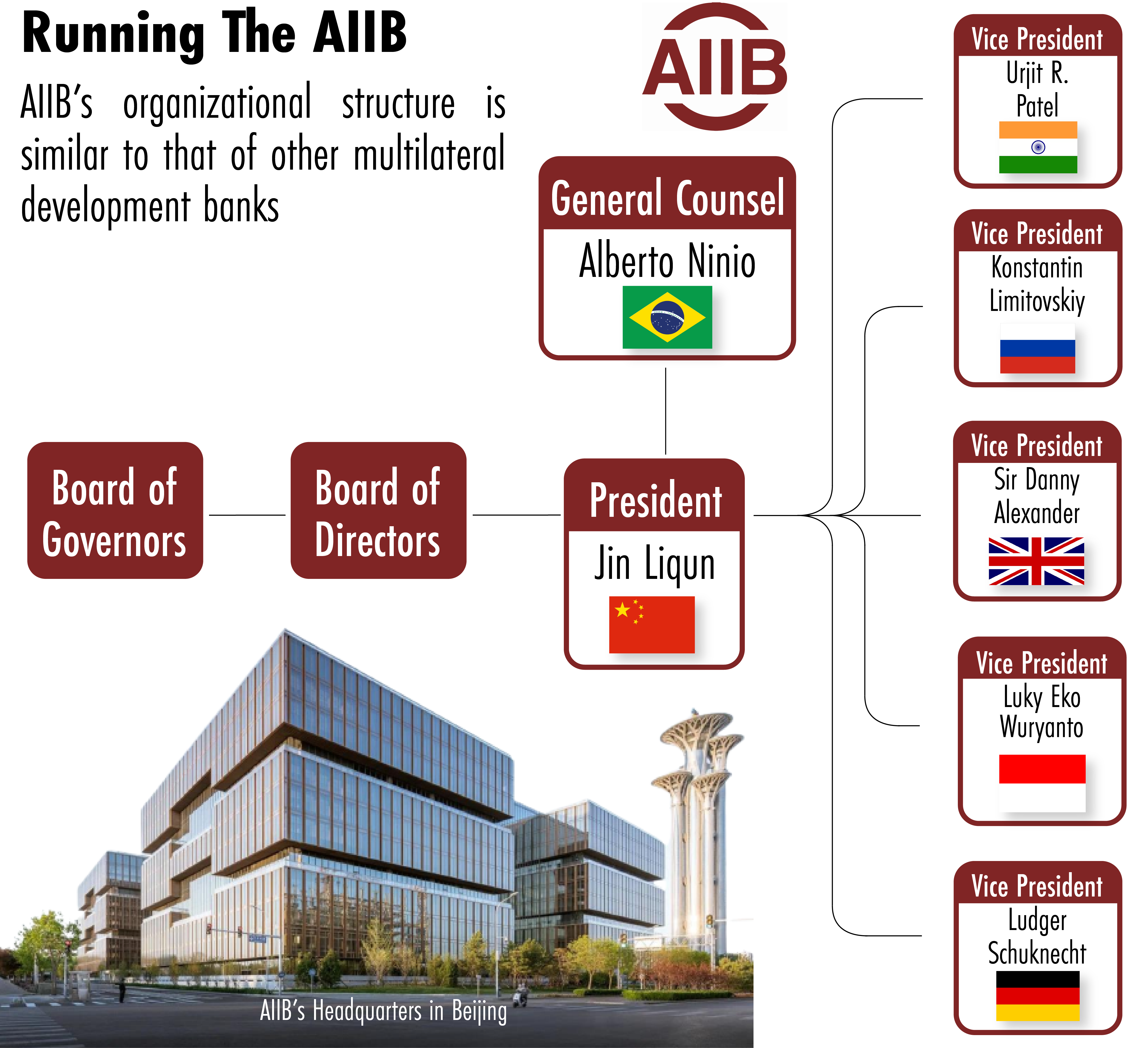
This multilateral structure, along with its high credit rating (AAA) and operational partnerships, has established the AIIB as a credible and influential player in global finance.
3. Case Study 2: The New Development Bank (NDB)
While the AIIB was designed for broad, global appeal, the New Development Bank (NDB) has a different origin and purpose. Established in 2015 by the BRICS nations (Brazil, Russia, India, China, South Africa) and headquartered in Shanghai, the NDB is more explicitly a project of the "Global South."
The NDB's founders envisioned a bank that would fundamentally challenge the principles of the Bretton Woods institutions.
10 Years of NDB: How the BRICS Bank Is Building a New World!
The 'Think BRICS' channel produced this video for the NDB's 10th anniversary. While it has a promotional tone, it does an excellent job of clearly explaining the NDB's revolutionary principles.
Please watch from 0:33 to 04:01. Focus on the three core principles that make the NDB different from the World Bank and IMF.
The video highlights three radical departures from the traditional MDB model:
- Equal Governance: The five founding members have equal voting power (around 19% each). This prevents any single country, including China, from dominating decisions—a stark contrast to the veto power the US holds at the IMF and World Bank.
- No Political Conditionality: The NDB assesses projects purely on their technical and financial merit. It does not demand that borrowing countries implement specific economic policies (like privatization or austerity) or governance reforms.
- Local Currency Financing: Perhaps its most innovative feature, the NDB aims to provide a significant portion of its loans in the local currencies of its members (e.g., Brazilian Reals, Indian Rupees, Chinese Yuan). This protects borrowers from the currency risk that comes with US dollar-denominated debt.
While both are headquartered in China, the AIIB and NDB represent two distinct approaches to shaping global finance.
[PDF] CHINA-BASED MULTILATERAL DEVELOPMENT BANKS AND ...
Let's return to the NUS paper to see a direct comparison and understand why the NDB is considered 'more politically entangled' than the AIIB.
Please read the section 'NDB Is More Politically Entangled than the AIIB' (page 12). Focus on the key differences in membership strategy and currency of operations.
In essence, the AIIB is China's bid to lead within a reformed version of the existing global system, while the NDB is a more radical attempt by the BRICS to build a parallel system based on different rules. The NDB's focus on de-dollarization, in particular, positions it as a more direct challenge to the current US-led financial order.
Conclusion
China's creation of the AIIB and NDB marks a major evolution in its foreign policy, demonstrating a clear intent to move from being a participant in the global financial system to an architect of it. These institutions are not merely extensions of Chinese foreign policy; they are genuine multilateral bodies with robust governance. However, they undoubtedly serve China's strategic goal of creating a global order that is less dominated by the West and more accommodating of the interests of emerging powers.
Key Takeaways:
- China has led the creation of new MDBs like the AIIB and NDB to address global infrastructure financing gaps, increase its own influence, and provide an alternative to the Western-dominated financial order.
- The AIIB follows a strategy of "reform by example." It works largely within the existing system, adopting best practices and partnering with established MDBs, while proving that a China-led institution can be inclusive and effective.
- The NDB represents a more radical alternative. As a BRICS initiative, its principles of equal voting power, no political conditionality, and local currency financing directly challenge the core tenets of the World Bank and IMF.
- Together, these institutions showcase a sophisticated, dual-track approach to China's economic statecraft: one track working to reform the system from within (AIIB), and another building a parallel system from without (NDB).
Preview of the Next Lesson:
Having concluded our module on economic statecraft, we will now shift our focus to one of the most pressing security issues in the world. In our next lesson, we will open the module "Regional Flashpoint: Taiwan and the South China Sea" by examining the complex and sensitive Taiwan issue, starting as we explain the historical origins of the Taiwan issue and the meaning of the 'One China' principle.