Hello! Let's get started on the final lesson of our module on the Mao Era.
Introduction
In our last lesson, we analyzed the causes and phases of the Sino-Soviet split. We saw how ideological disagreements, personal rivalries, and national interests culminated in bloody border clashes in 1969. This geopolitical earthquake left China in an extremely vulnerable position: diplomatically isolated and facing a direct military threat from a hostile Soviet Union along its vast northern border.
Today, we will examine the audacious and pragmatic response to this crisis. This lesson will explain the strategic logic behind the Sino-American rapprochement in the 1970s. This was one of the most dramatic diplomatic realignments of the Cold War, a move that stunned the world and reshaped the global balance of power. We will explore what motivated these two sworn enemies, after more than two decades of hostility, to set aside ideology in favor of pure strategic interest. This is a classic case study in realpolitik that will surely connect with your studies in diplomacy and international relations.
The Strategic Imperative: A Shared Threat
By the late 1960s, both the People's Republic of China and the United States found themselves in difficult strategic positions, creating a surprising convergence of interests. Their mutual adversary, the Soviet Union, became the crucial catalyst for their rapprochement.
To understand the context and motivations for both sides, please read the following brief from the U.S. State Department's Office of the Historian.
Rapprochement with China, 1972
This text, titled 'Rapprochement with China, 1972', provides a concise overview of the strategic conditions that led both Washington and Beijing to reconsider their relationship.
Please read the section that begins with 'In the late 1960s and early 1970s...'. As you read, focus on identifying the distinct strategic goals for each country: For the U.S.: How did the Vietnam War and the rivalry with the Soviet Union influence the decision to approach China? For China: What was the primary security concern pushing its leadership toward the United States?
As the text explains, the logic can be distilled down to a core principle of international relations: "the enemy of my enemy is my friend."
- For China, the threat was existential. The 1969 border clashes with the USSR made it clear that the Soviet Union was now China's principal and most dangerous enemy. Facing a nuclear-armed superpower on its border, China desperately needed a powerful strategic counterweight. The United States was the only viable candidate.
- For the United States, under President Richard Nixon and his National Security Advisor Henry Kissinger, the goal was to masterfully play the great power game. They were bogged down in the Vietnam War and locked in a global Cold War with the USSR. By opening relations with China, they aimed to:
- Gain leverage over the Soviet Union: This "triangular diplomacy" would force Moscow to contend with a potential two-front strategic challenge, giving the U.S. an advantage in arms control talks (détente) and other negotiations.
- Isolate North Vietnam: By improving relations with China (one of North Vietnam's main backers), the U.S. hoped to pressure Hanoi into a peace settlement, facilitating an "honorable" American withdrawal from Vietnam.
This next video clip clearly articulates the central U.S. motivation.
How Nixon’s 1972 China Visit Set the Stage for Today’s Tensions Over Taiwan | Retro Report
The Retro Report documentary 'How Nixon’s 1972 China Visit Set the Stage for Today’s Tensions' succinctly explains the realpolitik calculation at the heart of Nixon's strategy.
Watch the short segment from 02:26 to 02:51. Note how it frames the rapprochement not as a move of friendship, but as a calculated alliance against a greater threat.
The Architects and Their Motives
The rapprochement was not inevitable; it was engineered by pragmatic leaders who were willing to prioritize national interest over ideology.
| United States (Nixon & Kissinger) | China (Mao & Zhou Enlai) |
|---|---|
| Richard Nixon: Long before his presidency, Nixon argued that isolating a nation of China's size was unsustainable. As president, he saw the opening as a masterstroke to reshape the Cold War and secure his legacy as a great statesman, which was also crucial for his re-election prospects. | Mao Zedong: As China's paramount leader, Mao's primary concern was national security. The Soviet threat forced him to re-evaluate his decades-long anti-American stance. He also likely saw the move as a way to reassert his international prominence after the chaos of the Cultural Revolution. |
| Henry Kissinger: A former Harvard professor and a proponent of realpolitik, Kissinger was the intellectual architect and chief negotiator. For him, the global balance of power was paramount. A closer relationship with China was a powerful card to play against the Soviet Union. | Zhou Enlai: As Premier, Zhou was the master diplomat who implemented the policy. He skillfully navigated the complex negotiations with Kissinger, ensuring China's core interests were protected while achieving the strategic goal of aligning with the U.S. |
To delve deeper into the specific calculations of these leaders, please consult the following article.
The Nixon-Mao Summit: A Week that Changed the World?
The article 'The Nixon-Mao Summit' provides an excellent breakdown of the primary motives for each side, moving beyond the purely geopolitical to include domestic and personal factors.
Read the two short sections titled 'What did Beijing and Washington want in a rapprochement, and why?' and 'Mao, too, had multiple motives.' Focus on how these motives went beyond simply countering the USSR.
The Diplomatic Dance: From Secret Channels to Ping-Pong Diplomacy
With both sides interested but still officially enemies, establishing contact required delicate and secret diplomacy.
- Back-Channel Messages (1969-1970): Nixon used trusted intermediaries—primarily President Yahya Khan of Pakistan and President Nicolae Ceaușescu of Romania—to pass secret messages to the Chinese leadership, expressing a desire for talks. This bypassed the State Department, which Nixon feared would oppose the initiative.
- Public Signals (1970-1971): Both sides sent subtle public signals. Nixon eased travel and trade restrictions. Mao invited American journalist Edgar Snow, an old acquaintance, to stand beside him during a major public parade, signaling to the world—and Washington—his openness to contact.
- "Ping-Pong Diplomacy" (April 1971): The public breakthrough came unexpectedly. After a chance encounter at a table tennis tournament in Japan, the Chinese team invited the U.S. team to visit China. This informal, friendly exchange captured the world's imagination and created a positive public atmosphere for what was to come.
- Kissinger's Secret Trip (July 1971): This was the most critical step. While on a trip to Pakistan, Kissinger feigned illness and was secretly flown to Beijing for direct talks with Zhou Enlai. In these meetings, they laid the substantive groundwork for a presidential visit.
This intricate process of signaling and secret negotiation is a fascinating example of high-stakes diplomacy.
The Summit and the Shanghai Communiqué
The secret groundwork led to the historic public event: President Nixon's visit to China in February 1972. The image of the staunchly anti-communist Nixon shaking hands with Chairman Mao was a powerful symbol that the Cold War had fundamentally changed.
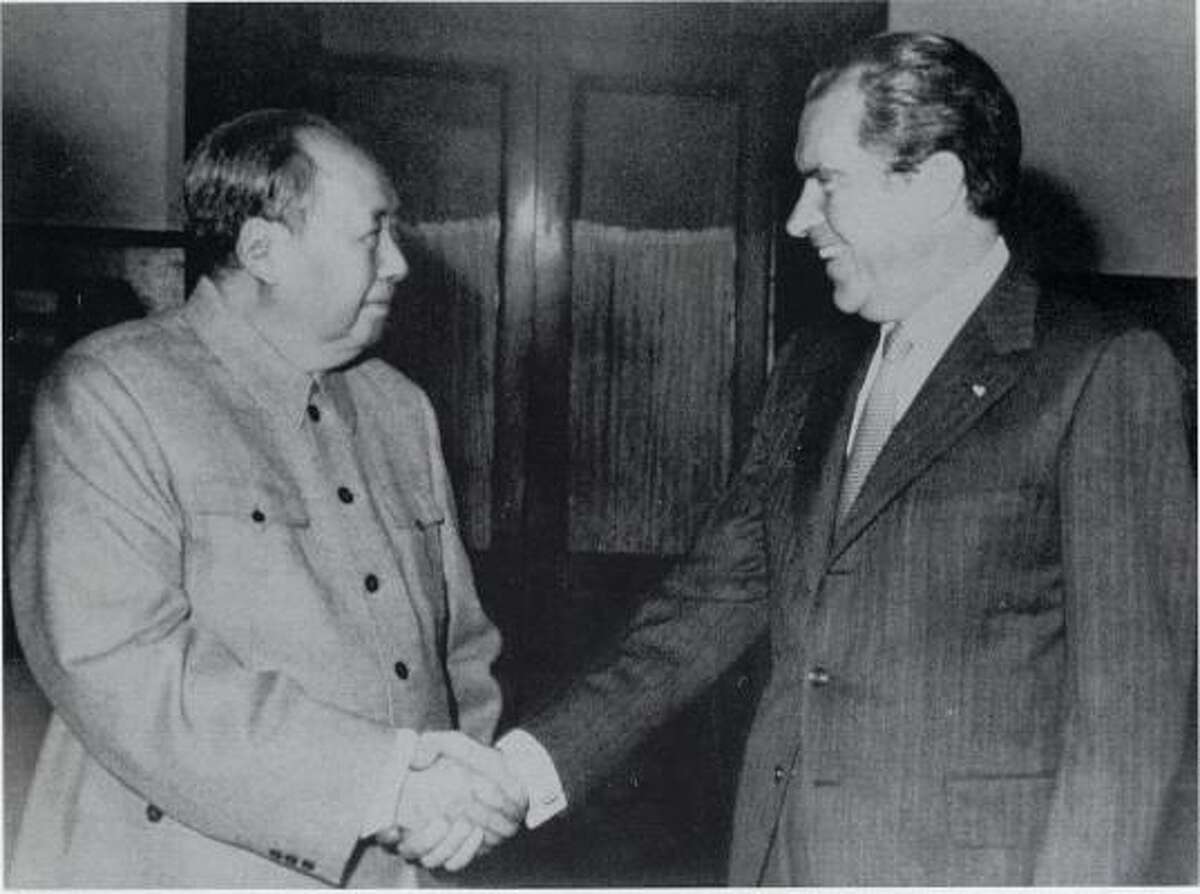
The visit's most important outcome was a carefully crafted document known as the Shanghai Communiqué. Its brilliance lay in how it handled the single biggest obstacle: Taiwan.
The U.S. had long recognized the Republic of China (ROC) government in Taiwan as the sole legitimate government of all of China. The People's Republic of China (PRC) insisted Taiwan was a province of China and its "liberation" was an internal affair. A resolution was impossible. Instead, they devised a masterpiece of diplomatic ambiguity.
Please watch this final video, which explains how this critical issue was finessed.
How Nixon’s 1972 China Visit Set the Stage for Today’s Tensions Over Taiwan | Retro Report
We return to the Retro Report documentary to see how the negotiators handled the seemingly intractable problem of Taiwan.
Watch from 02:51 to 05:29. Pay close attention to the specific wording used in the Shanghai Communiqué regarding Taiwan and why the English word 'acknowledge' was so important. This is a key example of constructive ambiguity in diplomacy.
As the video explains, the U.S. stated that it "acknowledges that all Chinese on either side of the Taiwan Strait maintain there is but one China and that Taiwan is a part of China."
The word "acknowledge" was genius. It meant the U.S. was simply noting the position held by both sides; it did not mean the U.S. agreed with it or endorsed it. This allowed both countries to "agree to disagree" on Taiwan, kicking the can down the road while they focused on the more urgent strategic goal of balancing the Soviet Union. With this diplomatic sleight of hand, the main obstacle to rapprochement was removed.
Conclusion
The Sino-American rapprochement was a pivotal moment in the Cold War, driven by a convergence of strategic interests rather than any change in ideology. It was a textbook example of realpolitik where national security concerns and the balance of power trumped decades of animosity.
Key Takeaways:
- Primary Driver: The primary driver for both the U.S. and China was the shared need to counter the growing power and threat of the Soviet Union.
- Strategic Logic: For the U.S., it was about gaining leverage in its global contest with the USSR and finding an exit from Vietnam. For China, it was about countering an immediate and existential threat on its border and breaking out of diplomatic isolation.
- Key Actors: The rapprochement was conceived and executed by pragmatic leaders—Nixon, Kissinger, Mao, and Zhou Enlai—who prioritized strategic goals over ideological purity.
- Diplomatic Innovation: The use of "strategic ambiguity" in the Shanghai Communiqué to address the Taiwan issue was the crucial diplomatic mechanism that made the agreement possible, allowing both sides to move forward on shared interests while setting aside an intractable dispute.
Preview of the Next Module:
This lesson concludes our module on the Mao era. The world that Mao left behind upon his death in 1976 was vastly different from the one he inherited in 1949. He had unified China and, through the rapprochement, had broken its isolation and placed it at the center of the global strategic triangle.
Our next module, The Reform Era (1978-2012), will explore what happened next. We will begin by examining the foreign policy of Mao's successor, Deng Xiaoping, who built upon the opening with the U.S. but introduced a completely different guiding philosophy: tao guang yang hui—"hide your strength, bide your time." This will mark our transition from an era of revolution to an era of pragmatic integration into the global system.