Hello! Welcome to the first lesson in our module on China's Reform Era.
Introduction
In our last lesson, we concluded the Mao era by examining the dramatic Sino-American rapprochement of 1972. This move, driven by pure realpolitik, broke China's diplomatic isolation and positioned it as a key player in the Cold War's great power triangle. Mao left a China that was unified and strategically relevant, but also economically devastated by decades of political turmoil.
Today, we transition to the era of his successor, Deng Xiaoping, and the period of "Reform and Opening Up." This lesson focuses on the cornerstone of Deng's foreign policy, a strategy that would guide China for decades and enable its astonishing economic rise. Our learning outcome is to explain Deng Xiaoping's 'hide your strength, bide your time' (tāo guāng yǎng huì) foreign policy strategy.
We will dissect this famous phrase, understand the critical historical context that made it necessary, see how it was put into practice through key case studies, and explore the different ways it has been interpreted. This strategy is the essential foundation for understanding everything that followed in Chinese foreign policy.
Defining the 24-Character Strategy
The phrase tāo guāng yǎng huì (韬光养晦) is most commonly translated as "hide your strength, bide your time." However, it was part of a broader, more nuanced strategic guideline known as the "24-Character Strategy."
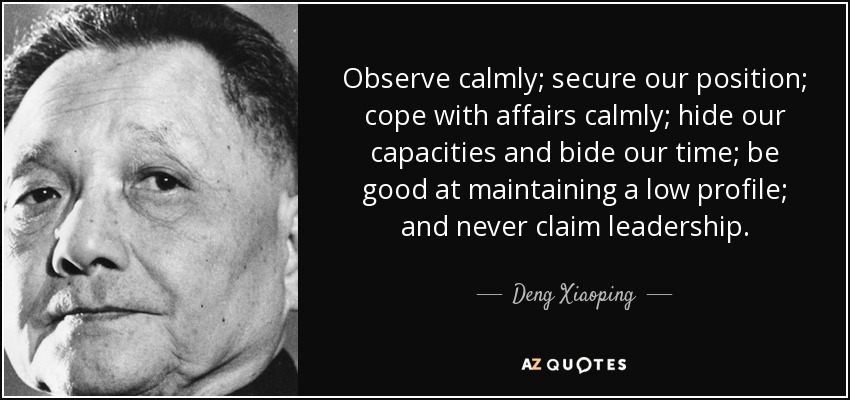
The full strategy, as laid out in the image above, is:
"Observe calmly; secure our position; cope with affairs calmly; hide our capacities and bide our time; be good at maintaining a low profile; and never claim leadership."
To understand the deeper meaning and strategic intent behind these words, let's watch a short video that breaks down the characters and the full context of the phrase.
What Deng Xiaoping REALLY Meant by “HIDE Your Strength” (And Why Xi ABANDONED It)
The video 'What Deng Xiaoping REALLY Meant by “HIDE Your Strength”' offers an excellent analysis of the full meaning of Deng's directive.
Watch the first 2 minutes and 41 seconds. Pay close attention to the breakdown of the individual characters and the often-forgotten second part of the phrase: 'accomplish something where possible' (yǒu suǒ zuò wéi).
As the video explains, this was not a strategy of pure passivity. It was about concealing capabilities and avoiding confrontation in order to cultivate strength and achieve concrete goals when possible. The core idea was strategic patience: bend like bamboo in a storm to avoid breaking, then stand tall once the storm has passed.
The Strategic Context: A Moment of Peril
Deng's strategy was not conceived in a vacuum. It was a direct response to a series of profound crises in the late 1980s and early 1990s that left China weak, isolated, and vulnerable.
- Post-Tiananmen Sanctions (1989): The violent crackdown on pro-democracy protests in Tiananmen Square led to widespread international condemnation. The US and European countries imposed sanctions, cutting off high-level exchanges and restricting technology transfers. China became a pariah state overnight.
- Collapse of Communism (1989-1991): The fall of the Berlin Wall, followed by the collapse of communist regimes across Eastern Europe and culminating in the dissolution of the Soviet Union itself, was a massive ideological shock to the Chinese Communist Party (CCP). They were left as one of the last major communist powers, facing a triumphant and ideologically hostile West led by the United States.
In this perilous environment, Deng made a cold calculation. China's GDP was a fraction of America's. Its military was obsolete. Direct confrontation with a dominant and confident US would be, as the video notes, "suicide." The only rational path was to lower China's profile, defuse Western hostility, and focus all national energy on one thing: economic development.
This text from GlobalSecurity.org confirms the historical timing and rationale.
Deng Xiaoping's '24-Character Strategy' - GlobalSecurity.org
The article 'Deng Xiaoping’s “24-Character Strategy”' provides a concise summary of the strategy's origins.
Read the first two paragraphs of the article. Note how it explicitly links the emergence of the strategy to the 'global backlash from the 1989 Tiananmen Square crackdown' and the 'collapse of the communist states of Eastern Europe.'
Strategic Patience in Action
The goal of tao guang yang hui was to create a stable, peaceful external environment that would allow China to integrate into the global economy and absorb the capital, technology, and know-how it needed to modernize. This required a diplomatic approach that prioritized long-term goals over short-term pride or nationalism.
How Deng Xiaoping Saved China—and Set It Up to Fail
In this brief clip from 'How Deng Xiaoping Saved China', the strategy is framed as a deliberate effort to attract Western investment by appearing non-threatening.
Watch the segment from 03:06 to 04:02. This provides a sharp, realpolitik perspective on how Deng 'played' the West by maintaining a low profile to facilitate economic growth.
Two key examples illustrate how this strategy was implemented:
- WTO Accession (1990s): China endured 15 years of grueling negotiations to join the World Trade Organization. It was forced to make massive concessions, including opening protected domestic markets, lowering tariffs, and strengthening intellectual property laws. From a nationalist perspective, many of these demands were humiliating. But Deng's successors, Jiang Zemin and Zhu Rongji, understood that the long-term prize—access to global markets and locking in domestic economic reform—was worth the short-term cost.
- The EP-3 Incident (2001): A US Navy EP-3 surveillance plane collided with a Chinese J-8 fighter jet over the South China Sea. The Chinese pilot was killed, and the US plane made an emergency landing on China's Hainan Island. The 24-person American crew was detained. The incident sparked outrage in China, with public and military calls for a harsh response. Instead, after 11 days of tense negotiations, China released the crew and, later, the dismantled American plane. It was a classic application of the strategy: swallow humiliation and exercise restraint to prevent a crisis from derailing the overriding strategic priority of peaceful development.
This next clip discusses these exact examples.
What Deng Xiaoping REALLY Meant by “HIDE Your Strength” (And Why Xi ABANDONED It)
We return to 'What Deng Xiaoping REALLY Meant...' to see concrete examples of the strategy in practice.
Watch the segment from 02:41 to 04:12, which covers China's WTO entry and the 2001 EP-3 incident as prime examples of Deng's doctrine in action.
Interpretations: Strategic Deception or Pragmatic Development?
Given your background in diplomacy, you'll appreciate the debate over the true intention of tao guang yang hui.

The central question is: Was this a sincere policy of peaceful integration, or was it a grand strategic deception—a ruse to lull the West into a false sense of security while China secretly prepared to challenge it?
-
View 1: The Strategic Ruse. This interpretation, popular among Western hawks, argues that tao guang yang hui is a modern-day Trojan Horse. It suggests China was only pretending to be a "responsible stakeholder" while quietly building comprehensive national power to eventually displace the United States and reshape the global order in its favor. The cartoon above perfectly illustrates this viewpoint.
-
View 2: Pragmatic Development. This view, which aligns with China's official statements, argues that the strategy was a practical and honest approach for a weak country needing to focus on its own development. It was not about "seeking revenge" but about creating the conditions for national rejuvenation. The principle of "never claim leadership" (jué bù dāng tóu) is seen as the sincere core of the strategy.
The following resource explores this debate, highlighting how the meaning of ancient idioms can be contested.
Deng Xiaoping's '24-Character Strategy' - GlobalSecurity.org
Let's return to the GlobalSecurity.org article, which directly addresses the different interpretations of Deng's strategy.
Read the sections that begin with 'As stated in a 2010 essay...', 'CCP General Secretary Jiang Zemin...', and 'After 30 years...'. Focus on how the text presents the official CCP interpretation versus the 'misunderstandings and distortions' of others. Pay attention to the argument about the core principle being 'never claim leadership'.
Ultimately, Deng's strategy was always meant to be temporary. It was a policy for when China was weak. The video clip you watched earlier makes this point succinctly: "Deng never said hide forever. He said hide until." The implication was that once China was strong enough, its foreign policy would naturally change—a transition we will explore in detail when we get to the Xi Jinping era.
Conclusion
Deng Xiaoping's "hide your strength, bide your time" strategy was the foundational doctrine of Chinese foreign policy in the post-Mao era. It was a pragmatic and deeply realist response to a moment of extreme vulnerability following the Tiananmen crisis and the collapse of the Soviet Union.
Key Takeaways:
- The Strategy: More than just "hiding," tao guang yang hui was a comprehensive 24-character strategy designed to avoid confrontation, maintain a low profile, and focus single-mindedly on economic development.
- The Context: It was born out of the crises of 1989-1991, which left China internationally isolated and ideologically besieged.
- The Implementation: In practice, it meant prioritizing long-term economic gains over short-term nationalist pride, as seen in the WTO negotiations and the handling of the EP-3 incident.
- The Debate: The strategy is viewed by some as a sincere development policy and by others as a long-term strategic deception to build power undetected.
- The Temporality: It was always intended as a phase for a specific period of weakness, not a permanent philosophy of passivity.
Preview of the Next Lesson:
The 1989 Tiananmen Square crisis was the single most important event in shaping the context for this strategy. In our next lesson, we will delve deeper into this crisis, assessing its profound and lasting impact on China's international relations and its relationship with the Western world.