Introduction
Welcome to our next lesson. In our previous discussion, we assessed how the 1989 Tiananmen Square crisis led to a period of international isolation for China. You'll recall that this isolation reinforced the necessity of Deng Xiaoping's "hide and bide" strategy, making economic development—and thus, regime stability—the paramount national interest. The key to this was breaking the sanctions and reintegrating China into the world economy on its own terms.
Today, we will examine the centerpiece of that reintegration strategy. Our learning outcome is to describe China's strategy of integrating into the global economy, focusing on its accession to the World Trade Organization (WTO). We will trace the path from the early economic experiments of the 1980s to the monumental and hard-fought achievement of joining the WTO in 2001. We will cover:
- The initial steps of "Reform and Opening Up," including the creation of Special Economic Zones (SEZs).
- The 15-year diplomatic and political marathon to join the WTO.
- The profound commitments China made and the internal debates they sparked.
- The transformative impact of WTO membership on China's economy and its global standing.
This story is a masterclass in economic statecraft, blending domestic reform, ideological innovation, and tenacious international negotiation.
The Groundwork: Reform, Opening Up, and "Socialism with Chinese Characteristics"
China's journey to the WTO didn't begin in the 1990s. Its roots lie in the "Reform and Opening Up" (改革开放, gǎigé kāifàng) policy launched by Deng Xiaoping in 1978. The goal was to modernize China by cautiously introducing market mechanisms and opening the country to foreign investment and trade, all while maintaining the absolute political control of the Communist Party.
A key part of this strategy was the establishment of Special Economic Zones (SEZs). These were coastal areas where flexible, market-oriented economic policies were tested. They acted as controlled laboratories for capitalism, designed to attract foreign capital and technology without immediately exposing the entire national economy to the shock of competition.
The following video provides an excellent overview of this early period.
Rise of China - The Economic Revolution that made China a Superpower
This segment from 'Rise of China' by Epic History illustrates the launch of Deng's reforms, the creation of the SEZs, and his famous 1992 'Southern Tour' which re-energized the reform process after the post-Tiananmen stagnation.
Please watch the following three clips: From 04:18 to 07:11 to understand the initial reforms and the concept of the SEZs. From 21:13 to 23:54 to see how Deng's Southern Tour rebooted the economic drive after 1989.
As the video highlights, this strategy was ideologically framed as "Socialism with Chinese Characteristics." This pragmatic, if paradoxical, concept allowed the CCP to justify using capitalist tools (markets, private enterprise, foreign investment) to achieve socialist goals (developing the nation's productive forces and improving people's lives).
The state didn't simply let the market run free. It guided development through what one architect of the reforms, Chen Yun, called the "bird cage economy": the market is the bird, but the state controls the size of the cage. A core part of this control was a strategic approach to foreign investment.
To understand this crucial mechanism, please watch the next video segment. It explains how China used requirements for joint ventures and technology transfer to ensure that foreign investment served its long-term goal of industrial upgrading.
This is how China's economic model works: Explaining Socialism with Chinese Characteristics
This video from Geopolitical Economy Report explains the mechanics of China's economic model. This specific section details the strategic use of foreign direct investment (FDI).
Please watch from 31:44 to 35:56. Focus on the explanation of 'technology transfer for market access' and how this was designed to help China move up the global value chain.
This strategy of gradual reform, state guidance, and strategic use of foreign investment set the stage for China's biggest step: fully integrating into the global trading system.
The 15-Year Marathon: Negotiating WTO Accession
By the early 1990s, China's leaders understood that to lock in the economic reforms and guarantee access to global markets, they needed to join the world's premier trade-rule-making body. China had formally applied to join the GATT (the WTO's predecessor) in 1986, but the process stalled after Tiananmen. The negotiation, which resumed in earnest in the 1990s, would take 15 long years.
The process was so arduous because it involved a fundamental clash of systems. The WTO operates on principles of market liberalization, transparency, and non-discrimination. China's economy, despite its reforms, remained state-led, opaque, and full of protections for domestic industries. Reconciling these two was a monumental task.
For China's reformist leaders, like Premier Zhu Rongji, WTO accession was a "win-win." It would secure export markets, but more importantly, it was a form of external pressure they could use to force through difficult and necessary domestic reforms against powerful vested interests.
The article below provides a superb analysis of the stakes and the changes WTO accession triggered within China.
In this Foreign Affairs article, 'How the WTO Changed China,' Professor Yeling Tan dissects the complex legacy of China's accession. We'll start with the introduction, which sets out the grand hopes and the demanding commitments involved.
Please read the entire introductory section of the article, down to the sub-heading 'THE SUM OF ITS PARTS'. Pay close attention to the ambitious terms China accepted and the initial expectations from both US and Chinese leaders.
As the article notes, the negotiations were incredibly complex. They were not just a single negotiation with the WTO, but a series of bilateral talks with key members, most importantly the United States. These negotiations were a classic example of multi-level diplomatic bargaining, where the outcomes were shaped as much by domestic politics in Beijing and Washington as by trade theory.
Within China, a fierce battle raged.
- The Reformers: Led by Premier Zhu and centered in the Ministry of Foreign Trade and Economic Cooperation (MOFTEC), they saw WTO entry as essential for modernizing China.
- The Protectionists: Powerful ministries in charge of sectors like telecommunications, automobiles, and agriculture, along with the large State-Owned Enterprises (SOEs), fiercely resisted opening up to foreign competition which they knew could destroy them.
This internal tug-of-war, which your background in governance makes you well-placed to appreciate, meant that Chinese negotiators often had their hands tied. They had to fight a two-front war: one in Geneva against foreign demands, and another in Beijing against domestic resistance. This political struggle was a major reason the process took 15 years to complete.
The Deal and Its Impact
After a final, dramatic push by Premier Zhu Rongji, China concluded its negotiations and formally joined the WTO on December 11, 2001. To do so, Beijing made a sweeping set of commitments that went far beyond those of any other developing country.
Let's return to the Foreign Affairs article to understand the specific reforms China implemented.
Please read the section under the heading 'THE SUM OF ITS PARTS' and the following untitled section that details the central government's legislative overhaul. Focus on the concrete changes China made to its laws, regulations, and institutions to comply with WTO rules.
The key commitments included:
- Slashing Tariffs: Average tariffs were cut dramatically, from over 23% to around 7%.
- Eliminating Non-Tariff Barriers: Quotas and licensing requirements for most imports were removed.
- Opening Service Sectors: For the first time, foreign investment was allowed in key services like banking, insurance, and telecommunications.
- Strengthening Rule of Law: China pledged to improve transparency, protect intellectual property rights (IPR), and establish impartial judicial review of trade-related administrative decisions.
The economic impact was immediate and explosive. Accession acted as a starting gun for one of the most incredible economic expansions in history.
Rise of China - The Economic Revolution that made China a Superpower
This final clip from the Epic History video vividly captures the economic explosion that followed WTO accession.
Please watch from 29:18 to 30:27. Notice how the video links WTO entry directly to China becoming the 'world's largest exporter' and the unprecedented GDP growth rates.
The data backs this up decisively. The following images visualize the scale of China's economic transformation after 2001.
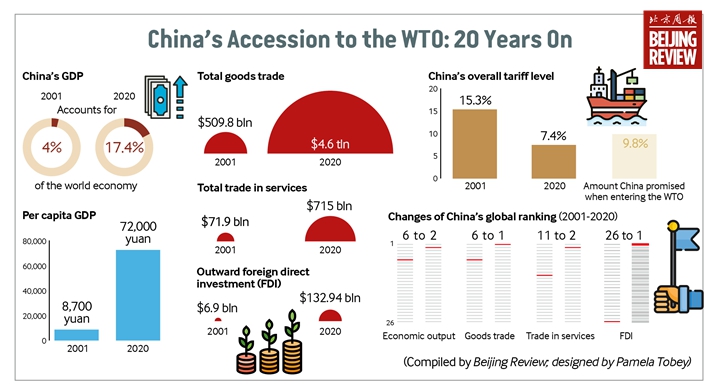

However, the story did not end as Western policymakers had hoped. The expectation was that by binding China to international rules, the WTO would inevitably force China to become a full-fledged market economy, and perhaps even foster political liberalization. This did not happen.
After the initial wave of reforms, and especially after the 2008 Global Financial Crisis appeared to expose the weaknesses of Western capitalism, the momentum reversed. China entered a period described as guójìn míntuì (国进民退)—"the state advances, the private sector retreats." Beijing became adept at using the letter of WTO law while operating within a state-capitalist model that many argue violates its spirit. Instead of China converging with the global norm, it learned to adapt the norms to serve its unique system.
Conclusion
China's integration into the global economy via the WTO was the defining act of its "Reform and Opening Up" era. It was a high-stakes gamble by China's leaders—a bet that they could withstand the shock of global competition and use it to forge a stronger, more modern economy without surrendering the Party's political control.
Key Takeaways:
- China's economic integration was a gradual strategy that began with SEZs and was ideologically justified as "Socialism with Chinese Characteristics."
- The 15-year negotiation to join the WTO was a complex political process, shaped by intense domestic bureaucratic battles between reformers and protectionists.
- To join, China made sweeping commitments to cut tariffs, open its service sectors, and improve its legal and regulatory framework.
- WTO accession unleashed an unprecedented economic boom, cementing China's role as the "world's factory" and dramatically increasing its global economic footprint.
- Contrary to Western hopes, China did not fully converge with a liberal market model, but instead adapted WTO rules to its own system of state-led capitalism, creating the foundations for future economic friction with the West.
Preview of the Next Lesson:
While China was pursuing economic integration, it also needed a new diplomatic narrative to reassure a world wary of its rapid growth. In our next lesson, we will explore the concept of China's "Peaceful Rise/Development" and how Beijing sought to match its growing economic power with an expanding role in global security, specifically through its contributions to UN peacekeeping.