Welcome to your first lesson. Your goal is to develop the skills for high-level country analysis, and our journey begins today with the most fundamental concept in all of economics and strategy. This lesson will introduce you to scarcity and opportunity cost, the two ideas that drive every decision, from an individual's daily choices to a nation's grand strategy. By understanding why choices must be made and how to evaluate their true cost, you will have the foundational tool for analyzing economic and political behavior.
The Core Concept: Scarcity Forces Choice
At its heart, economics is the study of how people make decisions in a world of scarcity. Scarcity is the simple, unchangeable fact that our wants and needs are limitless, but the resources available to satisfy them (like time, money, oil, and clean water) are finite.
Because of scarcity, we are forced to make choices. You can't be in two places at once. A government can't use the same tax revenue to build both a new hospital and a new fighter jet. Every choice to do or have one thing is simultaneously a choice not to do or have something else.
This leads us to the crucial concept of opportunity cost.

The opportunity cost is the value of the next-best alternative that you give up when you make a decision. It's not just the money you spend (economists call that the "out-of-pocket" or explicit cost), but the value of the opportunity you forgo.
To see a clear explanation of scarcity and how it leads to trade-offs and opportunity costs, please watch the first few minutes of the following video.
Scarcity, Trade-offs, and Cost/Benefit Analysis
This video from Professor Dave Explains provides a clear, concise introduction to scarcity, trade-offs, and opportunity cost.
Please watch from the beginning until timestamp 02:44. Focus on how the video defines scarcity, explains the concept of a trade-off, and finally defines opportunity cost as the 'next best thing we give up'.
Test your understanding!
Imagine you are a data scientist who can earn $150 per hour. You decide to take two hours off work to attend a free webinar on a new machine learning technique. What is the opportunity cost of attending the webinar?
Show answer
The opportunity cost is the $300 you would have earned if you had worked for those two hours. Even though the webinar had no ticket price (zero out-of-pocket cost), it was not "free" in an economic sense because you gave up the opportunity to earn money.
Illustrative Example: The True Cost of a Decision
To solidify the difference between the everyday meaning of "cost" and the economic definition, let's analyze a simple scenario. This distinction is critical for policy analysis, where the unseen costs are often more important than the explicit ones.
The following text from the CORE Econ textbook provides an excellent example comparing how an accountant and an economist view the cost of an action.
This section from CORE Econ's textbook, titled 'Scarcity, work, and choice', clearly explains opportunity cost using a simple, relatable example.
Please read the section titled '3.3 Opportunity costs'. Pay close attention to the example of choosing which concert to attend and how the 'economic cost' is calculated by adding the out-of-pocket cost and the opportunity cost.
As you read, notice that the decision to attend the concert changes based on the existence of a free alternative. This is a key insight: the options available to us define the opportunity cost and therefore shape our choices.
The "So What?" Factor: Geopolitical Implications of Scarcity
This concept scales up directly from personal choices to national and international strategy. A nation's power and stability are fundamentally constrained by scarcity. The scarcity of natural resources like water, arable land, and energy can define a country's economic potential and foreign policy.
Case in Point: Water Scarcity
Water is a classic example of a scarce resource with immense geopolitical importance. A country must decide how to allocate its limited water supply:
- To agriculture to ensure food security?
- To industry to drive economic growth?
- To cities for household consumption and sanitation?
- To ecosystems to maintain environmental stability?
The choice to allocate water to one sector has a direct opportunity cost—the value that water would have generated in its next-best use. For example, the opportunity cost of using water for low-value crops might be the high-value industrial products that could have been manufactured instead.
This has profound geopolitical consequences:
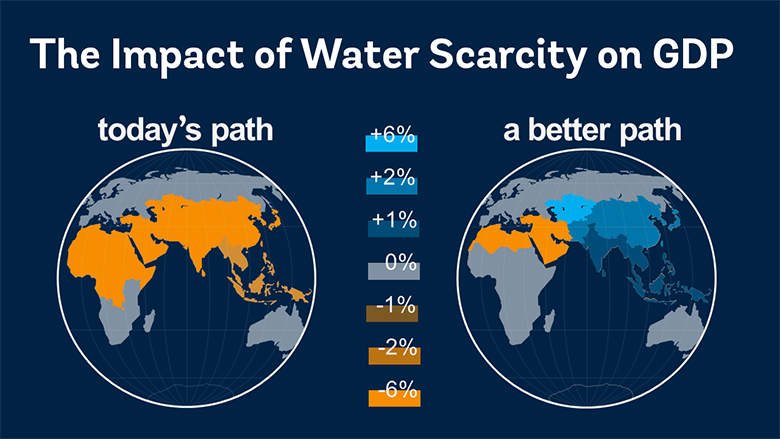
- Economic Growth: As the image from the World Bank below shows, severe water scarcity can directly reduce a country's GDP growth, weakening its position on the world stage.
- Social Stability: Competition for water can lead to internal social tensions and political instability, particularly if one group or region feels it is being deprived for the benefit of another.
- International Conflict: When nations share a water source, like the Nile or Mekong rivers, unilateral decisions by one country to build a dam or divert water can create intense diplomatic friction and even conflict with downstream neighbors whose supply is threatened.
Anchor Resource
For a real-world look at how international organizations analyze these issues, we turn to the Organisation for Economic Co-operation and Development (OECD). The OECD provides evidence-based policy advice to its member countries.
The report below, "The Economics of Water Scarcity," is an excellent example of applying core economic concepts to a pressing global problem. It explicitly discusses how to measure the "opportunity cost of using water."
The economics of water scarcity (EN)
This report from the OECD shows how the concept of opportunity cost is used in high-level policy analysis regarding water scarcity.
Please read 'Box 3.6: Reflecting the environmental and opportunity costs of water use'. You don't need to understand every technical term. Focus on how policymakers try to measure the opportunity cost of water to make better decisions about its allocation.
This report demonstrates that opportunity cost isn't just a textbook theory; it's a practical tool used by strategists and policymakers to evaluate trade-offs and design more effective policies.
Daily Challenge
Your government recently announced its annual budget. Identify one major area of public spending (e.g., defense, infrastructure, social welfare).
What do you believe is the primary opportunity cost of this spending? In other words, what is the most valuable alternative project or program that was likely forgone to fund this choice? There's no single right answer; this exercise is about applying the concept of trade-offs at a national level.
Next Day Preview
Today, we established that scarcity forces choices and that the true cost of any choice is the opportunity you give up. Tomorrow, we will see how millions of these individual choices interact in a marketplace. We will explore the foundational model of supply and demand, the engine that determines the prices and availability of nearly everything in an economy.