Day 3: The Iron Laws of Intervention: Price Controls & Taxes
Yesterday’s Bridge:
Yesterday, we saw how the "invisible hand" of the free market guides supply and demand towards an equilibrium price, efficiently allocating resources like oil on a global scale. Today, we examine what happens when a government’s visible hand intervenes, attempting to change that market price for social or political reasons.
The Core Concept: Distorting the "Handshake"
While market equilibrium is efficient, it may not be seen as "fair." A government might decide the equilibrium price of a staple food is too high for the poor, or the equilibrium wage for unskilled labor is too low for a decent living. In response, they intervene. Let's analyze the two most common forms of intervention: price controls and taxes.
1. Price Controls: Setting the Price by Law
Price controls are government-mandated legal minimum or maximum prices for specified goods or services. They come in two flavors:
a) Price Ceilings (Maximum Price)
A price ceiling is a legal maximum on the price at which a good can be sold. To be effective, or binding, it must be set below the free-market equilibrium price. The classic example is rent control.
- Intended Goal: To protect consumers from high prices.
- Inevitable Outcome: A shortage. Because the price is artificially low, more people want to buy the product than producers are willing to sell.

When price can no longer ration the good, other, less efficient mechanisms emerge:
- Lines and Rationing: First-come, first-served systems become common.
- Black Markets: Illegal markets emerge where the good is sold at a much higher price.
- Decline in Quality: Producers may cut corners to maintain profitability at the mandated low price.
b) Price Floors (Minimum Price)
A price floor is a legal minimum on the price at which a good can be sold. To be binding, it must be set above the free-market equilibrium price. The most common example is the minimum wage.
- Intended Goal: To protect producers or workers from low prices/wages.
- Inevitable Outcome: A surplus. Because the price is artificially high, producers are willing to sell more than consumers are willing to buy. In the labor market, this surplus is called unemployment.
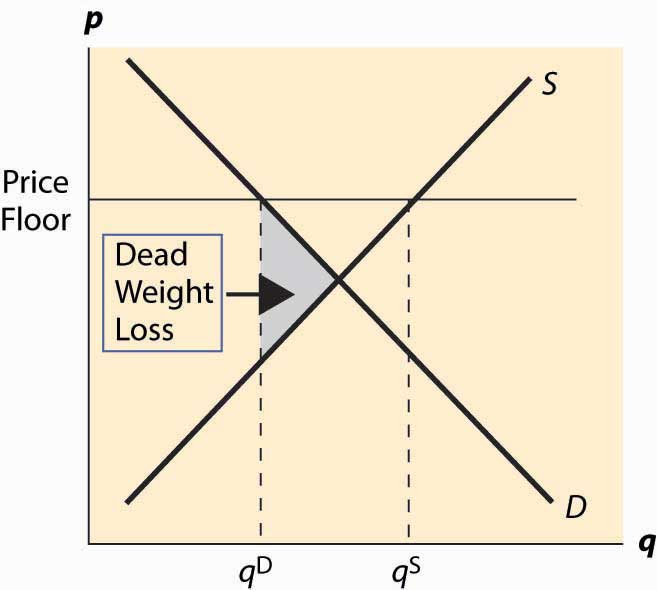
The following video provides a concise graphical explanation of how binding price ceilings and floors create these imbalances.
Chapter 6: Supply, Demand and Government Intervention - Part 1 - price controls and taxes
This clip from Dr. Azevedo's economics course clearly demonstrates why a price control must be 'binding' to have an effect, and how this inevitably leads to either a shortage or a surplus.
Please watch two short segments: Price Ceilings (00:30 - 04:05): Focus on the distinction between a non-binding and a binding price ceiling and see how the latter creates a shortage. Price Floors (24:09 - 26:07): Observe the parallel logic for price floors and how they create a surplus.
2. Taxes: Driving a Wedge in the Market
Unlike price controls, taxes don't create shortages or surpluses. Instead, a per-unit tax drives a wedge between the price buyers pay (Pb) and the price sellers receive (Ps).
The key outcomes of a tax are:
- Reduced Quantity: The market shrinks as the tax makes the good more expensive for buyers and less profitable for sellers.
- Shared Burden (Tax Incidence): The tax burden is shared between buyers and sellers. Buyers pay a higher price than before, and sellers receive a lower price.
- Government Revenue: The government collects revenue equal to the tax amount multiplied by the new, lower quantity sold.
- Deadweight Loss: Because the quantity traded is reduced, some mutually beneficial trades that would have happened without the tax no longer occur. This represents a loss of economic efficiency.
A fascinating insight from economics is that it doesn't matter who legally pays the tax. Whether the government taxes the buyer or the seller, the final outcome—the price buyers ultimately pay, the price sellers ultimately receive, and the quantity traded—is exactly the same. This has profound implications for policy debates.
Chapter 6: Supply, Demand and Government Intervention - Part 2 - price controls and taxes
This segment offers one of the most important lessons in political economy: the legal designation of a tax is irrelevant to its economic impact. Understanding this principle allows you to see through a great deal of political rhetoric surrounding tax policy.
Please watch from 20:54 to 27:05. Pay close attention to the conclusion that a tax on buyers is economically equivalent to a tax on sellers, and consider the political implications of this fact.
Illustrative Example: Fuel Subsidies and Political Instability
Many governments, particularly in emerging markets, use fuel subsidies to keep the price of gasoline and diesel artificially low for their citizens. This is, in effect, a price ceiling.
- The Intent: To ease the cost of living for the populace, support transportation and industry, and maintain social peace. Countries like Egypt, Nigeria, and Venezuela have historically spent billions on these subsidies.
- The Unintended Consequences:
- Fiscal unsustainability: When global oil prices rise, the cost of the subsidy can balloon, consuming a massive portion of the national budget and crowding out spending on health, education, and infrastructure.
- Smuggling and Black Markets: The cheap, subsidized fuel is often smuggled to neighboring countries where prices are higher, creating a lucrative black market and costing the government even more.
- Overconsumption: Artificially cheap fuel encourages wasteful consumption and discourages investment in energy efficiency or public transport.
The "So What?" Factor:
The geopolitical risk arises when a government, facing a fiscal crisis, is forced to remove or reduce these subsidies. The sudden spike in fuel and transportation costs often acts as a trigger for mass protests and severe political instability. The removal of fuel subsidies was a contributing factor to riots in Nigeria in 2012, Jordan in 2018, and Ecuador in 2019. For a geopolitical analyst, a country's fuel subsidy regime is a key indicator of underlying fiscal fragility and a potential flashpoint for social unrest.
Anchor Resource
The World Bank, a key international institution, has extensively studied the real-world effects of these policies. Their paper "Price Controls: Good Intentions, Bad Outcomes" provides a superb overview for policy analysis. It moves beyond abstract theory to document the widespread and often damaging effects of these policies in developing countries.
Price Controls: Good Intentions, Bad Outcomes
This World Bank policy paper provides a clear-eyed assessment of the consequences of price controls, drawing on evidence from dozens of countries. It is an excellent example of the kind of analysis you will learn to perform.
Please read Section 4, 'Challenges of price controls' (pages 9-11). Focus on the subsections 'Growth challenges' and 'Policy challenges.' As you read, note how price controls can discourage investment, create shortages, and impose huge burdens on government budgets.
Daily Challenge
Imagine the government of a small, import-dependent island nation wants to make bread more affordable. It imposes a binding price ceiling on all loaves of bread sold.
Based on today's lesson, identify two likely unintended consequences of this policy.
Show Analysis
- Shortages and Rationing: Local bakeries, unable to cover their costs at the mandated low price, will produce less bread or even go out of business. This will lead to empty shelves. Consumers may have to wait in long lines, and stores might limit the number of loaves each person can buy.
- Decline in Quality & Black Markets: To stay profitable, bakers might start using cheaper, lower-quality ingredients. Alternatively, some bakers might stop selling bread legally and instead sell it "under the table" at a much higher price to desperate consumers, creating a black market.
Next Day Preview
Today we focused on how government intervention affects individual markets. But how do we measure the health and output of an entire country's economy? Tomorrow, we zoom out to the macroeconomic level and tackle the single most important metric in country analysis: Gross Domestic Product (GDP).