Hello! Welcome to the first lesson in our second module, "Poetry Focus: Ageing and Oppression."
In our previous lesson, we concluded our study of 'A Thing of Beauty' by mastering the concept of the 'grandeur of the dooms'. You did an excellent job completing Module 1, and now we're ready to move on to the next set of important poems.
Today, we will delve into Kamala Das's poignant poem, 'My Mother at Sixty-six'. Our goal is to analyze extracts from the poem to explain its central themes: ageing and the fear of separation. True to your preference, we will use a question-driven approach, analyzing extracts from past papers to understand how these themes are explored and tested.
Let's begin.
1. An Overview of the Poem's Core Ideas
Before we dive into specific extracts, it's useful to get a bird's-eye view of the poem. 'My Mother at Sixty-six' is a deeply personal and emotional poem written in a single sentence, reflecting a continuous stream of thought. It captures the poet's feelings as she drives to the airport with her ageing mother.
This mind map provides a clear structure of the poem's key elements. We will be focusing on the 'Theme of Aging and Change' and the 'Emotional Conflict' today.
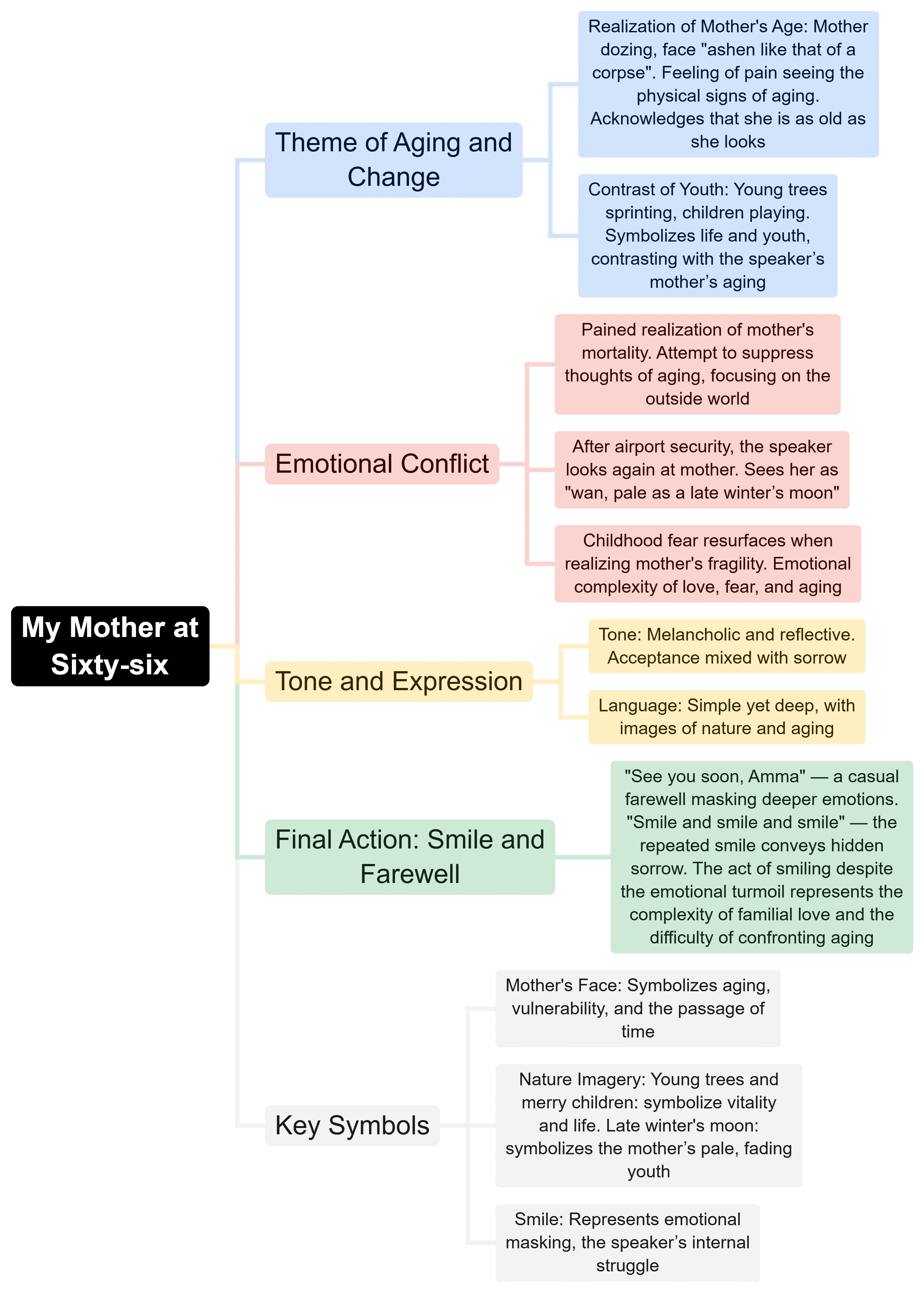
As you can see, the core of the poem is the poet's sudden, painful realization of her mother's mortality and the deep-seated fear of separation that this realization triggers.
2. The Painful Realization: Analyzing the First Encounter
The poem opens with a stark and unsettling image. Let's examine the first few lines, which have appeared frequently in exams.
Driving from my parent’s
home to Cochin last Friday
morning, I saw my mother,
beside me,
doze, open mouthed, her face
ashen like that
of a corpse and realised with
pain
that she was as old as she looked...
This description is the trigger for the poet's entire emotional journey. She sees her mother not just as a sleeping elderly woman, but as something lifeless—'ashen like that of a corpse'. This comparison immediately introduces the themes of ageing and approaching death.
Let's see how an expert breaks down this extract and the types of questions you can expect.
My Mother at Sixty-Six Class 12 English | Most Important PYQs, Extract & Competency Questions
The video from Sunil Panda's channel provides a detailed analysis of an extract-based question related to these opening lines. Pay close attention to how he explains the significance of phrases like 'doze, open mouthed' and 'ashen like that of a corpse'.
Watch the segment from 04:01 to 07:44. This will help you understand how the poet's painful realization of her mother's age is portrayed and how to answer related multiple-choice questions.
The key takeaway here is that the sight of her mother's frail and pale face causes the poet to feel a "painful realization." This isn't just a passing thought; it's a deep emotional ache stemming from the visual evidence of her mother's ageing.
3. Coping with Fear: Distraction and Contrast
The poet finds this thought of her mother's mortality so disturbing that she instinctively tries to push it away. This act of distraction reveals the depth of her fear.
...but soon
put that thought away, and
looked out at Young
Trees sprinting, the merry children spilling
out of their homes...
Here, the poet creates a deliberate contrast:
- Inside the car: An old, dozing mother, her face like a 'corpse'. This represents decay and mortality.
- Outside the car: 'Young Trees sprinting' and 'merry children spilling'. This represents youth, energy, and life.
This contrast sharpens the poet's awareness of her mother's condition and highlights her inner turmoil. She is trying to escape the fear of separation by focusing on images of life and vitality.
To solidify your understanding, let's work through some exam questions based on these lines.
Extract Based PYQs & CFQs Class 12 NCERT English Book Flamingo
This webpage from Sirji Tutorials contains several past CBSE questions. Let's focus on an extract that covers the poet's attempt to distract herself.
Scroll down to the heading 'Extract –CBSE – (F) 2010'. Read the extract and try to answer questions (b), (c), and (f) in your head. The answers are provided right there for you to check.
This exercise shows that the 'thought' being put away is precisely the fear of her mother's ageing and eventual death. The poet’s action of looking outside is a defence mechanism against the pain of this realization.
4. The Return of the 'Familiar Ache'
Despite her efforts to distract herself, the fear returns when she has to say goodbye at the airport. This is where the theme of separation becomes most explicit.
...but after the airport’s
security check, standing a few yards
away, I looked again at her, wan, pale
as a late winter’s moon and felt that old
familiar ache, my childhood’s fear...
This "old familiar ache" is the core emotion of the poem. It is the fear of separation from her mother, a fear she has carried since childhood. Now, seeing her mother so frail and old, that fear feels more real and imminent than ever.
The simile 'as a late winter's moon' is significant. A winter moon is often pale, lacks brightness, and can be obscured by fog or mist. It symbolizes the mother's fading vitality, her dimming life force, and the quiet approach of death.
Extract (MCQ's) & Competency Based Questions | My Mother at Sixty Six | Class 12 English | BOARDS 25
Let's watch another clip from Sunil Panda's channel that focuses specifically on this final, powerful image and the poet's childhood fear.
Watch the clip from 00:16 to 02:24. The instructor explains why the poet's parting words, 'See you soon, Amma,' are filled with pain and how her smile is a mask for her fear.
The poet doesn't express her fear. Instead, she smiles and offers words of reassurance. This contrast between her inner turmoil (the 'ache' and 'fear') and her outward expression (the 'smile and smile and smile') poignantly captures the complexity of her love and the pain of anticipated separation.
Conclusion
In this lesson, we have dissected 'My Mother at Sixty-six' through the lens of exam extracts to understand its central themes. You are now equipped to analyze how Kamala Das explores the universal experience of watching a parent age and confronting the fear of losing them.
Key Takeaways:
- Theme of Ageing: The poem presents a stark picture of old age through vivid imagery, describing the mother's face as 'ashen like that of a corpse' and 'pale as a late winter's moon'.
- Fear of Separation: The poet's 'old familiar ache' is her childhood fear of losing her mother. This fear is the primary emotional driver of the poem.
- Coping Mechanism: The poet attempts to suppress her painful thoughts by looking at symbols of youth and life outside, but the fear resurfaces at the moment of parting.
- Emotional Conflict: The poem's power lies in the conflict between the poet's internal fear and pain, and her external facade of smiling and reassurance.
Preview of the Next Lesson:
We will continue with 'My Mother at Sixty-six' in our next lesson. We will focus specifically on the second learning outcome for this module: interpreting the use of imagery and simile (e.g., 'late winter's moon') for extract-based questions. This will further strengthen your ability to tackle any question on this important poem.