Hello! Let's continue our rapid review of the CBSE English Core literature section.
In our last session, we established the core themes of 'My Mother at Sixty-six': the painful awareness of ageing and the deep-seated fear of separation. Today, we will build directly on that foundation. Our focus will be on the poetic tools Kamala Das uses to convey these powerful emotions. Specifically, we'll learn how to interpret the poem's key imagery and similes—like 'ashen like that of a corpse' and 'late winter's moon'—to master the extract-based questions you'll face in the exam.
Let's get started.
1. The Language of Comparison: Simile and Imagery
In poetry, a poet doesn't just state a feeling; they show it. Kamala Das uses vivid comparisons to make us feel her anxiety. The two most important literary devices she uses for this are:
- Imagery: Language that creates a picture in the reader's mind, appealing to the senses.
- Simile: A direct comparison between two different things using the words 'like' or 'as'.
Understanding how these devices function is the key to unlocking high marks in extract-based questions.
2. Deconstructing the Key Comparisons
The poem is built around three crucial sets of images and similes. Let's break them down one by one, using exam questions as our guide.
Image 1: The Face of Mortality
...her face
ashen like that
of a corpse...
This is the first shocking simile in the poem. The poet compares her mother's pale, lifeless face to that of a dead body.
- What it means: The word 'ashen' refers to the pale grey color of ash, indicating a lack of blood and life. By comparing it to a 'corpse', the poet expresses her sudden, horrifying realization that her mother is old and frail, and that death is a looming reality.
- Literary Device: Simile.
- Effect: It conveys the poet's shock and the pain of seeing her mother's vitality gone.
Let's see how this is tested.
Class 12th Poem (My Mother At Sixty Six ) DETAILED Explanation With PYQ By Dear Sir
The instructor in this video from the 'Dear Sir English' channel breaks down an MCQ from a past paper that directly tests the meaning of this simile. Notice how 'weakness' is the correct interpretation.
Watch from 11:54 to 12:19. The question asks what the phrase 'ashen like that of a corpse' implies about the mother.
As the video shows, in an MCQ context, the core idea conveyed by this simile is the mother's extreme weakness and fading life force.
Image 2: The Contrast of Life and Energy
To escape the painful thought of her mother's condition, the poet looks out the window.
...and
looked out at Young
Trees sprinting, the merry children spilling
out of their homes...
This is a set of powerful images that stand in direct contrast to the poet's mother.
- What it means: The 'sprinting' trees and 'spilling' children are full of life, energy, and movement. They represent youth, vitality, and the passage of time.
- Literary Device: 'Trees sprinting' is an example of Personification (giving a human quality, sprinting, to a non-human object, trees).
- Effect: This contrast between the scene outside (life, energy) and the scene inside the car (age, decay) makes the mother's condition seem even more poignant and heightens the poet's sense of loss.
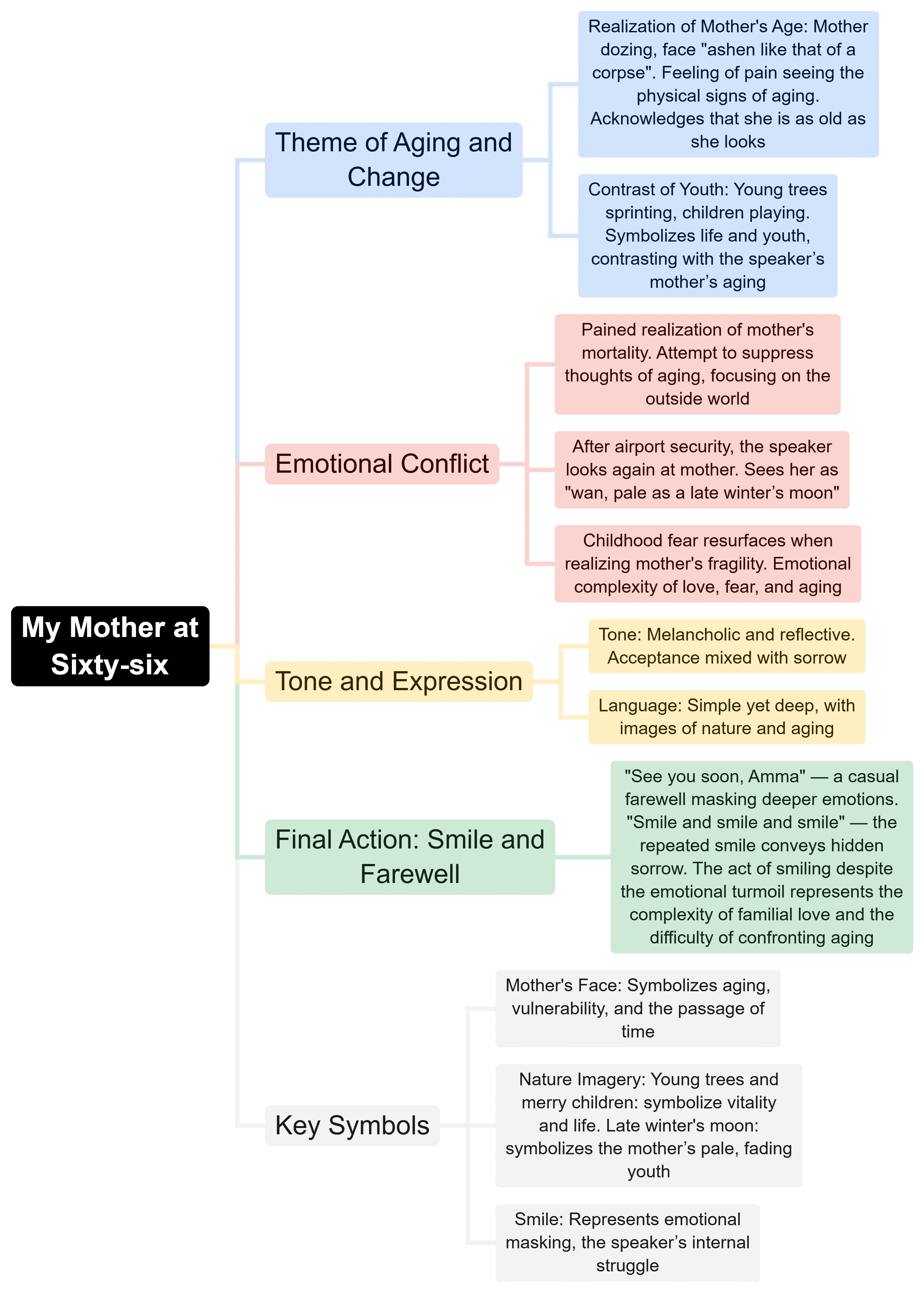
You can refer back to the mind map from our previous lesson to see how these symbols fit into the poem's structure.
Let's tackle a past exam question on this.
My Mother at Sixty Six Previous Years Question with Answers
This resource from SuccessCDS.net contains questions from the 2023 board exams. One question asks you to complete an analogy based on poetic devices.
Scroll to 'Questions from the Poem in 2023 Board Exams' and find Extract 1. Look at question (iv): 'Complete the following analogy : children spilling : metaphor : : _________ : personification'. The answer is provided, confirming 'Trees sprinting' as personification.
Image 3: The Waning Moon of Old Age
After the security check, the poet looks at her mother one last time, leading to the poem's most significant simile, which is directly mentioned in our learning outcome.
...wan, pale
as a late winter’s moon...
This comparison is crucial and frequently tested. Let's analyze it in detail.
- What it means:
- Wan and pale: Colorless, weak, and faded.
- Late winter's moon: A moon in late winter appears hazy, lacks brightness, and is often obscured by fog and mist. It is a symbol of decay and the approaching end of a cycle.
- Literary Device: Simile.
- Effect: The poet compares her mother's aging, declining appearance to this dim, fading moon. It perfectly captures the mother's loss of vitality, her fragility, and the poet's fear that her mother's life is nearing its end.
To fully grasp the depth of this simile, watch this excellent explanation.
My Mother at Sixty-Six Class 12 English | Most Important PYQs, Extract & Competency Questions
Sunil Panda provides a clear and concise analysis of why the mother is compared to a 'late winter's moon'. This is a high-yield topic for your exam.
Watch the segment from 35:47 to 37:36. Pay close attention to the keywords used: dim, colorless, weak, lifeless, and the connection to the poet's emotional pain and fear.
3. Practice and Application
Now, let's put your knowledge to the test with an extract-based question from a previous year's paper.
Extract Based PYQs & CFQs Class 12 NCERT English Book Flamingo
The following resource from Sirji Tutorials contains questions from the 2019 CBSE exam. Read the extract and try to answer the questions that follow.
Scroll to 'Extract – CBSE (2019)'. Read the short extract and focus on questions (iii) and (iv). Check your thinking against the provided answers.
How to structure your answer for a question like "Explain: ‘late winter’s moon’":
- Identify the comparison: State that the poet compares her mother’s pale and weak face to the late winter's moon.
- Explain the qualities: Describe the late winter's moon (hazy, dim, lacking luster and brightness).
- Connect to the theme: Explain that this comparison highlights the mother's old age, her declining health, and her fading energy, which reinforces the poet's fear of losing her.
Conclusion
Mastering the imagery and similes in 'My Mother at Sixty-six' is essential for scoring well on extract-based questions. These devices are the heart of the poem, transforming a personal moment into a universal experience of love, aging, and fear.
Key Takeaways:
- 'ashen like that of a corpse' (Simile): Emphasizes the mother's lifeless, pale appearance and the poet's shock at her mortality.
- 'Young Trees sprinting' (Personification): Creates a stark contrast between youthful energy and the mother's frail age, highlighting the painful reality.
- 'as a late winter’s moon' (Simile): This is the key simile, symbolizing the mother's fading vitality, weakness, and the quiet approach of the end of her life.
Preview of the Next Lesson:
We have now thoroughly covered 'My Mother at Sixty-six'. In our next lesson, we will move to the second poem in this module, 'Aunt Jennifer's Tigers'. We will analyze its themes of patriarchal constraint and the liberating power of art, again focusing on the symbols and images used to convey this message.