Welcome to your course on physiotherapy for Duchenne Muscular Dystrophy (DMD). This first lesson lays the essential groundwork for everything that follows. We will explore the progressive nature of DMD by breaking it down into distinct clinical stages. Our focus will be on identifying the key functional changes that occur at each stage—from patterns of muscle weakness and fatigability to the risk of joint contractures. Understanding this progression is fundamental, as it dictates how physiotherapy assessment and management must adapt over time to meet the evolving needs of children with DMD.
The "Why" Behind the Weakness
Before we examine the clinical stages, it's helpful to understand the underlying cause of DMD. At its core, DMD is a genetic disorder caused by a fault in the gene responsible for producing a protein called dystrophin.
Think of dystrophin as a crucial shock absorber and stabilizer for muscle cells. It links the internal muscle fibre structure to the outer cell membrane, protecting it from damage during muscle contraction and relaxation. In DMD, this protein is almost completely absent.
To get a clear picture of this process and its initial consequences, please watch the following video from Osmosis from Elsevier.
Duchenne & Becker muscular dystrophy - causes, symptoms, treatment & pathology
This video provides a concise explanation of the pathophysiology of Duchenne and Becker muscular dystrophy, followed by the resulting clinical signs.
Please watch from the beginning until the end. Pay close attention to the explanation of dystrophin's function (from 03:29 to 04:24) and how its absence leads to muscle cell damage, inflammation, and eventual replacement by fat and fibrotic tissue. This process explains many of the hallmark signs of DMD you'll encounter.
As the video explains, without dystrophin, muscle cells become fragile and are easily damaged. Over time, this damage leads to muscle cell death. The body's attempts to repair the muscle can't keep up, and the lost muscle tissue is gradually replaced by fat and connective tissue. This process, known as pseudohypertrophy, is why the calf muscles in young boys with DMD often appear large but are paradoxically very weak. This underlying pathology drives the progressive muscle weakness and functional decline that characterize the disease.
A Staged Approach to a Progressive Condition
Physiotherapy management in DMD is not a one-size-fits-all approach. It must be tailored to the child's specific functional abilities, which change as the disease progresses. To guide this, clinicians typically think in terms of clinical stages. While different frameworks exist, we will use a five-stage model that is widely understood and directly relates to functional capacity.
The image below provides a helpful visual overview of how the signs of DMD evolve from early childhood through to adolescence and adulthood.
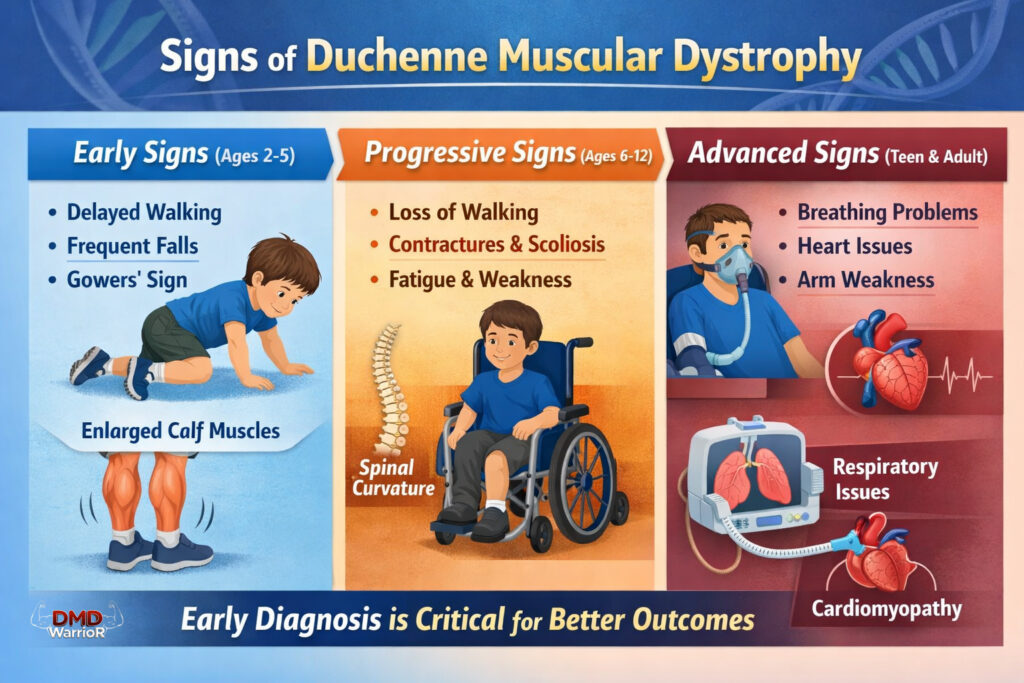
This infographic illustrates the progression of DMD, categorizing signs into Early (ages 2-5), Progressive (ages 6-12), and Advanced (teen and adult) stages, highlighting the key physical changes and health issues that arise over time.
We will now explore these stages in more detail, using a "pull-out" guide designed for families but based on clinical care guidelines. This will provide a clear and accessible framework for understanding the journey of a child with DMD.
Stage 1: Pre-ambulation / Early Diagnosis
This stage covers the period from diagnosis, which may occur before a child is walking independently, up to the point of early walking. Diagnosis sometimes happens very early due to a known family history, but often it follows concerns about a child's development.
[PDF] Physiotherapy & Occupational Therapy Guidance for DMD
This section of the Duchenne UK guide details the initial signs and physiotherapy considerations for the youngest children with DMD.
Please read the section titled Pre-ambulation/Early Diagnosis Stage. Focus on the descriptions of muscle weakness, joint problems, and the other classic signs, such as the Gowers' manoeuvre and calf pseudohypertrophy.
As you've read, the key functional consequences at this stage are:
- Delayed Motor Milestones: Boys with DMD may be slow to sit, crawl, or walk.
- Proximal Weakness: Weakness is most apparent in the muscles of the hips, pelvis, and thighs. This is what causes the characteristic Gowers' sign (or Gowers' manoeuvre), where the child uses their hands to "walk up" their own legs to stand up from the floor.
- Gait Abnormalities: If the child is walking, they may have a waddling gait and walk on their toes.
- Joint Issues: Early tightness can develop in the Achilles tendons. Conversely, some children may exhibit hypermobility in other joints.
- Fatigability: Children may tire more easily than their peers.
Your role as a physiotherapist at this stage is primarily supportive and educational, focusing on promoting development through play, providing advice on appropriate activities, and initiating early management of joint range, such as simple stretches or positioning.
Stage 2: Early Ambulant
This stage describes a child who can walk independently, but for whom the signs of muscle weakness are becoming more evident and functionally limiting.
[PDF] Physiotherapy & Occupational Therapy Guidance for DMD
This next section describes the challenges faced as weakness progresses in a walking child.
Now, please read the section on the Early Ambulant stage. Note the progression of weakness, the specific difficulties with activities like running and climbing stairs, and the increasing importance of managing joint tightness.
In the early ambulant stage, you will observe:
- Progressive Gait Changes: The waddling gait and lumbar lordosis (inward curve of the lower back) become more pronounced as the hip abductor and extensor muscles weaken.
- Difficulty with Dynamic Activities: Running, jumping, and hopping become difficult or impossible.
- Increased Falls: Balance is more precarious, leading to frequent trips and falls.
- Functional Limitations: The child will struggle with climbing stairs and rising from the floor or a low chair.
- Developing Contractures: Tightness in the calf muscles (gastrocnemius-soleus complex) and the iliotibial band (ITB) typically worsens, impacting gait and function.
Physiotherapy management becomes more structured, with a regular stretching programme being crucial. You would also begin to introduce formal functional assessments, which we will cover in a later lesson.
Stage 3: Late Ambulant
During this transitional phase, walking becomes increasingly difficult and effortful. The child may still walk for household distances but will rely more on a wheelchair for longer distances to conserve energy and for safety.
[PDF] Physiotherapy & Occupational Therapy Guidance for DMD
This section covers the critical period when walking ability is declining.
Please read the section on the Late Ambulant stage. Pay attention to the signs of increasing weakness, the emergence of trunk and arm weakness, and the introduction of equipment like wheelchairs and standing frames.
Key features of the late ambulant stage include:
- Significant Walking Difficulty: The child walks with a wide base of support and may be unable to stand still without swaying. Walking speed slows, and fatigue after short distances is significant.
- Increased Fall Risk: Falls become more frequent and potentially more injurious, often leading to a loss of confidence in walking.
- Emerging Upper Limb and Trunk Weakness: Weakness starts to become more apparent in the shoulder girdle and trunk muscles, affecting posture and the ability to lift objects.
- Pain: Pain in the calves and back can become a significant issue, partly due to postural changes and muscle fatigue.
This stage requires proactive planning for the transition to full-time wheelchair use. Physiotherapy focuses on maintaining range of motion, managing pain, and introducing equipment (e.g., wheelchairs, standing frames) to preserve function, support posture, and maintain participation.
Stage 4: Early Non-Ambulant
At this stage, the individual is no longer able to walk and uses a wheelchair (typically a powered one) for all mobility.
[PDF] Physiotherapy & Occupational Therapy Guidance for DMD
Now we move to the stage after the loss of ambulation, where the focus of physiotherapy shifts significantly.
Please read the section on the Early Non-Ambulant stage. Note the major risks that emerge here, such as scoliosis and respiratory muscle weakness, and how the focus shifts to upper limb function, postural support, and respiratory care.
The transition to being non-ambulant brings new challenges:
- Loss of Standing: The ability to stand, even with support, is lost.
- High Risk of Scoliosis: Without the forces of walking, and with increasing trunk muscle weakness, the risk of developing a significant spinal curvature (scoliosis) is very high, particularly during the pubertal growth spurt.
- Progressive Upper Limb Weakness: It becomes harder to lift the arms against gravity, impacting self-care, schoolwork, and leisure activities.
- Contracture Progression: Joint contractures in the hips, knees, and ankles can worsen due to prolonged sitting.
- Respiratory Muscle Weakness: The diaphragm and other respiratory muscles begin to weaken, making coughing less effective and increasing the risk of chest infections. Regular monitoring of lung function becomes essential.
Your physiotherapy goals will shift to 24-hour postural management (in the wheelchair and in bed), preserving upper limb function for as long as possible, managing contractures, and supporting respiratory health.
Stage 5: Late Non-Ambulant
This advanced stage is characterized by more significant weakness in the upper limbs, trunk, and neck, along with increasing involvement of the heart and respiratory muscles.
[PDF] Physiotherapy & Occupational Therapy Guidance for DMD
This final section covers the advanced stage of the disease.
Please read the short section on the Late Non-ambulant stage. Focus on the key challenges: severe upper body weakness, breathing and swallowing difficulties, and the need for comprehensive support.
In this final stage, the functional consequences are profound:
- Severe Upper Limb and Neck Weakness: Individuals often require support for their arms and head. Function may be limited to hand and finger movements.
- Cardio-Respiratory Compromise: Breathing difficulties often necessitate ventilatory support (e.g., BiPAP), initially at night and then extending into the daytime. Cardiomyopathy (weakness of the heart muscle) is a universal feature and requires careful management.
- Swallowing Difficulties (Dysphagia): Weakness of the bulbar muscles can lead to problems with chewing and swallowing.
- Pain and Comfort: Managing pain and maintaining comfort become paramount goals of care.
The physiotherapist's role is part of a wider multidisciplinary team. Your focus will be on managing complex seating for posture and comfort, gentle passive movements to prevent pain from stiffness, and intensive respiratory support, including airway clearance techniques.
Conclusion
In this lesson, we have charted the course of Duchenne Muscular Dystrophy through its clinical stages. You should now have a clear framework for understanding how the disease impacts function over time.
Here are the key takeaways:
- Progressive Nature: DMD is characterized by predictable, progressive muscle weakness, starting in the proximal lower limbs and gradually affecting the entire body.
- Staging is Key: Using a staging model (e.g., pre-ambulant, ambulant, non-ambulant) is essential for anticipating problems and tailoring physiotherapy management appropriately.
- Evolving Priorities: Physiotherapy priorities shift from promoting motor development in the early years, to maintaining ambulation and managing contractures, and finally to complex postural support, preserving upper limb function, and respiratory care in the later stages.
- Hallmark Signs: Key functional consequences include Gowers' sign, waddling gait, calf pseudohypertrophy, progressive contractures, scoliosis, and eventual cardio-respiratory compromise.
Understanding this natural history is the bedrock upon which you will build your clinical skills. In our next lesson, we will discuss corticosteroid therapy, the primary medical treatment for DMD, and explore how it modifies this disease progression and what that means for your physiotherapy practice.