In our last lesson, we established a foundational understanding of Duchenne Muscular Dystrophy by mapping its progression through five clinical stages and identifying the functional consequences at each step. This provides the "natural history" of the condition. Today, we turn our attention to the primary medical intervention that actively modifies this course: corticosteroid therapy.
This lesson will explain the crucial role corticosteroids play in managing DMD. We will delve into their significant benefits for muscle strength and function, but also critically examine their wide-ranging side effects. As a physiotherapist, you will be on the front line of observing both the positive impacts and the challenges of this therapy. Understanding these effects is essential for safe and effective physiotherapy management, helping you to maximize the benefits while mitigating the risks.
The Double-Edged Sword: Why Use Corticosteroids?
Corticosteroids (often just called "steroids") are the cornerstone of pharmacological management for DMD. While they are not a cure, they are currently the most effective treatment for slowing the disease's progression. Their primary mechanism is thought to be their powerful anti-inflammatory effect, which helps to reduce the secondary muscle damage caused by the body's inflammatory response to the dying muscle fibres we discussed in the last lesson.
To get a clear overview of the benefits, side effects, and controversies of steroid use in DMD, we'll turn to a presentation by a pediatric neuromuscular specialist.
[PDF] Duchenne Muscular Dystrophy: Neuromuscular Care Considerations
This presentation provides a concise, clinically-focused summary of steroid therapy, framing it as "The good, the bad, and the confusing."
Please start from the slide titled "Steroids: The good, the bad, the confusing" and read through the next several slides, ending just before "The confusing." Focus on the three key areas covered: The benefits: Note the specific functional outcomes that are improved, such as delayed wheelchair dependency and preserved respiratory function. The mechanism: Understand how steroids are thought to protect muscle. The side effects: Pay close attention to this extensive list, as many of these have direct implications for physiotherapy.
As you have read, the benefits are significant. By starting steroids, typically around ages 4-6 when motor skills are beginning to plateau, it's possible to:
- Prolong ambulation by several years.
- Preserve upper limb strength in the non-ambulatory stages.
- Maintain respiratory function and delay the need for ventilator support.
- Slow the development and progression of scoliosis.
The infographic below illustrates how corticosteroid therapy fits into the overall management plan, typically beginning in the "Diagnosis & Early Ambulatory Stage."
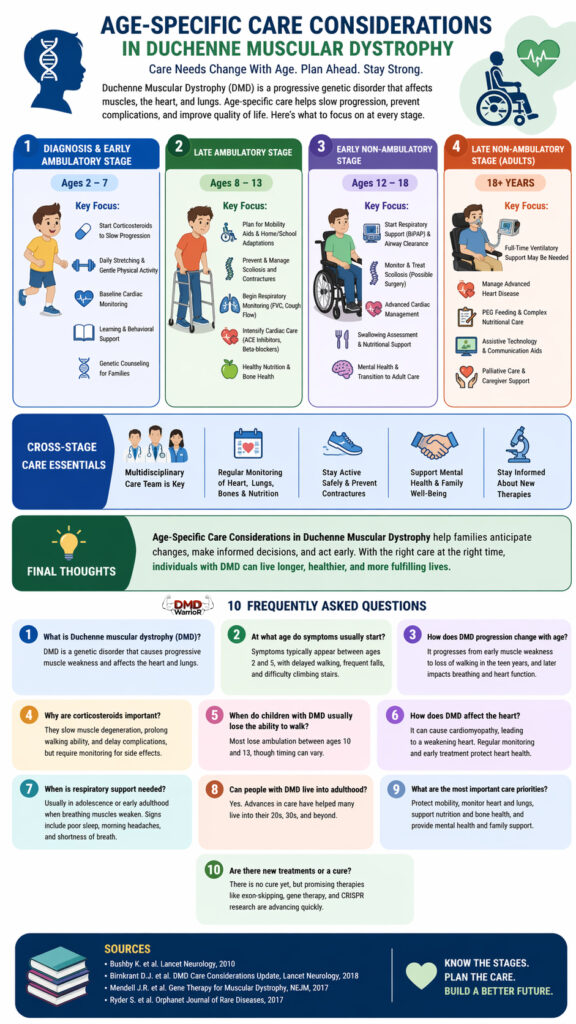
This infographic shows that corticosteroids are a key focus in the early stages of DMD (ages 2-7) to slow disease progression, alongside other interventions like stretching and cardiac monitoring.
Managing the Side Effects: The Physiotherapist's Role
The benefits of corticosteroids come at a cost. Their long-term use leads to a host of side effects that you must be able to identify and help manage. Let's explore the most prominent ones from a physiotherapy perspective.
1. Poor Bone Health and Fracture Risk
This is arguably one of the most significant side effects for you to manage. Corticosteroids directly inhibit bone formation and increase bone resorption, leading to osteoporosis. This, combined with the progressive loss of ambulation (which removes the stimulus of weight-bearing), creates a very high risk for fractures, especially of the vertebrae and long bones. Even minor trauma or a fall can lead to a fracture.
The diagram below provides an excellent visual summary of the multiple factors, with corticosteroids playing a key role, that contribute to poor bone health in DMD.

This diagram illustrates how corticosteroids, along with factors like systemic inflammation and loss of ambulation, contribute to osteoporosis, fragility fractures, and other bone-related complications in DMD.
Your role:
- Promote safe weight-bearing: Encourage ambulation for as long as it is safe. For non-ambulatory boys, regular use of a standing frame is crucial for bone health.
- Be vigilant during handling: Be mindful of fracture risk during manual stretching, transfers, and assisted movements.
- Advocate for monitoring: Ensure the child is having regular bone density scans (DEXA) and vitamin D/calcium level checks as part of their multidisciplinary care.
2. Weight Gain and Body Composition Changes
Steroids increase appetite, often leading to significant weight gain. This is frequently accompanied by a redistribution of fat, causing classic Cushingoid features like a rounded "moon" face and fat deposition around the abdomen.
Your role:
- Educate on energy balance: While you are not a dietitian, you can reinforce the importance of a healthy diet and portion control in discussions with the family.
- Adapt interventions: Increased weight makes transfers more difficult for both the child and caregivers. It can also put extra strain on weakened muscles, potentially accelerating functional decline. You may need to adapt your handling techniques and prescribe different assistive equipment.
3. Behavioural and Mood Changes
Irritability, mood swings, and difficulty sleeping are very common, particularly when starting steroids or changing doses.
Your role:
- Be patient and adaptable: A child's ability or willingness to participate in therapy can fluctuate. Be prepared to modify your session based on their mood and energy levels.
- Communicate with the team: If you notice significant, persistent behavioural changes, communicate this to the family and the medical team, as it may warrant a discussion about dosing schedules (e.g., daily vs. weekend dosing).
For a broader summary of the side effects and general management approaches, the following reading is helpful.
Corticosteroids for DMD: Benefits & side effects | Muscular Dystrophy News
This article provides a clear, categorized list of common side effects associated with long-term steroid use.
Please read the section Common side effects. This will reinforce and expand upon the side effects we've just discussed.
A Critical Safety Consideration: Adrenal Suppression
This is a point of utmost importance for safety. Long-term use of corticosteroids suppresses the adrenal glands' natural ability to produce cortisol, the body's own stress hormone. The body becomes dependent on the daily dose of medication.
If a child on long-term steroids becomes significantly unwell (e.g., with a fever, vomiting, or infection), undergoes surgery, or suffers a major injury, their body is unable to produce the extra cortisol needed to cope with the physiological stress. This can lead to a life-threatening adrenal crisis. Similarly, stopping the medication abruptly can trigger the same crisis.
[PDF] Duchenne Muscular Dystrophy: Neuromuscular Care Considerations
We return to the presentation to focus on this critical safety issue.
Please read the section beginning with the slide titled "Emergency care". It clearly explains what adrenal insufficiency is, what triggers a crisis, and the need for "stress-dose" steroids.
As a physiotherapist, you need to be acutely aware of this risk. If a child you are treating becomes unwell or has an accident, it's not just a minor event; it requires immediate medical attention and communication with their primary medical team. Families are typically provided with an emergency steroid management plan and a "stress dose" of hydrocortisone for such situations.
Conclusion
In this lesson, we have navigated the complex landscape of corticosteroid therapy in DMD. You now have a framework for understanding why this treatment is so vital, and what its consequences—both positive and negative—are for your physiotherapy practice.
Key Takeaways:
- Standard of Care: Corticosteroids (prednisone, deflazacort) are the primary medical treatment to slow the progression of DMD by preserving muscle strength and function.
- A Balance of Effects: The benefits of prolonged ambulation and preserved respiratory function must be weighed against significant side effects, including osteoporosis, weight gain, and behavioural changes.
- Physiotherapy Implications: Your role is to help manage these side effects through targeted interventions like promoting safe weight-bearing, adapting exercises for weight changes, and being mindful of fracture risk.
- Adrenal Suppression is a Medical Emergency: You must be aware that any significant illness or injury in a child on long-term steroids requires urgent medical management to prevent a life-threatening adrenal crisis.
Now that we have covered the disease stages and the primary medical treatment, our next task is to learn how to quantify function and track changes over time. In the next lesson, we will begin our deep dive into assessment by learning how to administer and interpret key functional outcome measures for ambulatory children with DMD.